Local SpotlightDiaspora

“These stories live in us”: Srab Der Haroutounian on trauma, identity and Armenians in the UK
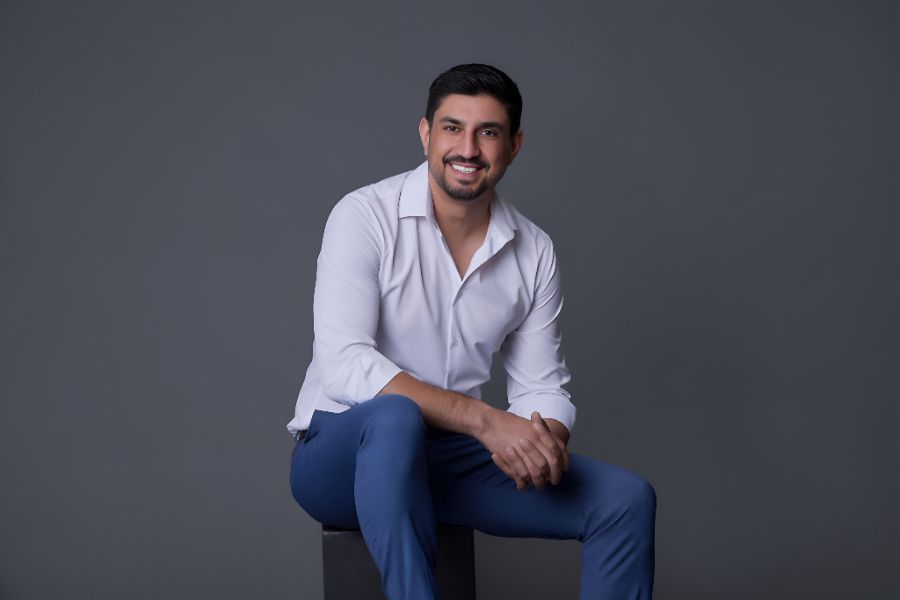
Srab Der Haroutounian, a Ph.D. candidate born and raised in the United Kingdom to Armenian parents, is examining the multigenerational impact of trauma through the lens of the Armenian Genocide within London’s Armenian community.

After living and working in Armenia from 2003 to 2014, Der Haroutounian returned to the UK. Eight years ago, he had what he describes as an epiphany and went back to school to study psychotherapy. Now, with one year left in his doctoral program, he is completing a dissertation focused on the emotional legacy inherited by third- and fourth-generation descendants of Armenian Genocide survivors.
“It’s been a fascinating, revealing and illuminating process over the last three years of my doctorate,” Der Haroutounian told the Weekly. “It’s not just theoretical. On a personal level, the journey has been eye-opening. It’s allowed me to see parts of myself, my family and my own trauma.”

His research, he said, became deeply personal. “Research is actually ‘me-search,’ being the descendant of Genocide survivors,” he explained. “My father is the son of an orphan, and my grandfather was a priest in Manchester. My intention wasn’t to focus on the Armenian story but to look at early developmental stress as a catalyst for ADHD and other mental health issues. Then the ethnic cleansing of Artsakh happened, and October 7 happened, and I internally and spiritually felt that my path had to continue the academic journey with the Armenian Genocide.”

His family roots trace back to Adana, Cilicia and Sassoun. One of the most striking stories in his family history centers on his grandfather, who was orphaned during the Genocide and separated from his younger sister during the death marches to Deir ez-Zor in 1915. He was eight years old; she was three.

Advertisement

30 years later, the siblings were reunited. While playing nardi (backgammon) in a café, his grandfather overheard truck drivers discussing Bedouin tribes. Following that lead, he visited several tribes and ultimately identified his sister by a scar on her face and a tattoo marking when and where she had been found. By then, she had married another Armenian orphan who had been raised by a different Bedouin tribe.

The reunion was a profound victory for both siblings.

“These stories live in us,” Der Haroutounian said. “They shape how later generations think, feel and relate to the world, often unconsciously.”

Der Haroutounian’s parents met in the UK. His mother is from Iran, and his father is from Syria. His research explores how second-, third- and fourth-generation Armenians are shaped by inherited stories, both consciously and unconsciously, within a society like the UK.

“A big part of my journey into this research is understanding how these generations are shaped by inherited thoughts and feelings,” he explained. “The Genocide is not recognized in the UK. I had never heard the word ‘Armenianness,’ but half of my participants have used that term. There are all of these themes coming up. There is more to the legacy of the Armenian Genocide, and especially with what recently happened in Artsakh, you see the connection between trauma and retraumatization.”

Born and raised in the UK, Der Haroutounian described growing up in a place where Armenian identity often felt invisible.

“Nobody knows who Armenians are here, and Armenianness isn’t recognized,” he said. “It’s intentionally being pushed down, especially in Manchester. There are approximately 300 Armenians in a city of 3.1 million. There was Sunday School, but no Armenian school.”

He said that the 2023 ethnic cleansing of Artsakh sharpened the urgency of his work. 

“Growing up as an Armenian here, I pressed my Armenian identity down. I didn’t share or talk about it and avoided it,” he admitted. “There is an internal split between our identity and the host culture. This is something that comes up in my research with Armenians in the UK. When the ethnic cleansing happened, I was flooded with survivor’s guilt, like I was in 2020 during the Artsakh War.”

Music became one of his outlets. In addition to his work as a therapist and researcher, Der Haroutounian is an alternative hip-hop and spoken-word artist.

“My music was an outlet for me,” he noted. “I’ve done a Genocide video and, in my spare time, I’m an alternative hip-hop spoken-word artist. I’ve made five music videos, and I didn’t know I had this talent until my mid-30s. I started posting during COVID and the Artsakh War. It was my way of contributing to my Armenian people.”

His dissertation distinguishes between intergenerational and transgenerational trauma. The latter, he explained, is not passed down genetically in any simple sense, but relationally, emotionally and culturally across a group setting and over multiple generations.

“One of my participants described seeing images on the BBC as a child — decapitated Armenians, Armenians being burned alive — and being shocked to the core,” he said. “Those same images have been passed down to us, along with the stories of the Genocide.”

Among the key themes emerging in his research are duty, invisibility and what he calls “the burden of Armenianness.”

“I think where we differ in the UK compared to other communities is that there is the same level of pressure in a small community that creates an internal split in the child between the host country and Armenianness,” he said. “I’ve observed the third and fourth generations dipping in and out of Armenianness.”

He recalled one participant of Greek and Armenian heritage who gradually shifted toward her Greek identity because the Armenian side had become too heavy to carry. Another story that stayed with him involved a boy with a British father and Armenian mother who was sent to boarding school and proudly identified as Armenian until racial abuse led him to bury that identity for nearly two decades.

“He said he would never talk about his Armenian identity for over 18 years, until the 1988 earthquake,” Der Haroutounian stated. “When we have a crisis, it brings us together. That was what the 2020 Artsakh War did. When faced with a threat, Armenians close off. We learned to survive persecution, we hibernated and then we come through when we feel it is safe.”

He contrasts the UK with countries such as the United States, where Armenian communities are larger and the Genocide is officially recognized.

“There is safety in being seen,” he explained. “Here, there’s resentment that comes from invisibility and non-recognition.”

Now in the data analysis stage of his dissertation, Der Haroutounian is coding interviews and identifying recurring themes. Alongside his doctoral work, he continues to practice as a therapist and is also a full-time father.

Ultimately, he said, his research is about both collective and personal recognition.

“It’s about understanding how trauma survives time,” he said, “and how identity survives silence.”

For more information about Srab Der Haroutounian and his work, visit his website.

Talar Keoseyan

Talar Keoseyan is a mother, educator and writer. She is the author of Vanna's Adventures (discusses Armenian traditions and customs); Mom and Dad, Why Do I Need to Know My Armenian Heritage? (a children's book about being proud of our heritage); Our Tigran and Tigran's Song (written in honor of Tigran Harutyunyan, a fedayee from the 44 Day War).

5 Comments

  1. This was a powerful and beautifully written piece. The idea that these stories live in us is something many of us feel deeply, especially in the diaspora where memory, history and identity are part of everyday life. Thank you for putting into words something that is often felt but not always easy to explain. Writing like this keeps those stories alive in the way they deserve.

  2. Well done Srab for making the Armenian Genocide more widely known and giving the descendants of the victims more of a voice, and a better knowledge of where they came from and why.

  3. Thank you. I can relate on every level. Both my parents were Armenian. My Mother was a Genocide survivor who spent many years in an orphanage before coming to the US. My Father was born in the US Armenian survivors. I have some sad and also fascinating stories, but I feel as if no one cares. Growing up in America as an Armenian felt like no one knew what an Armenian was so I tried not to recognize it. My Mom would tell me to be proud to be an Armenian but I didn’t get it. As an adult I am very aware of the injustices done to us. The recognition of the Genocide from US government is only recent. The average person is totally unaware of The Armenian dilemma. As an adult I do feel pain because of my personal awareness stemming from looking through the lens of my family’s tragedies, losses, sufferings and injustices. I am so glad and appreciative to read about what you are doing. What you are explaining definitely hits home with me. If you would ever want to speak with me I would share some of my family’s stories and my thoughts.

  4. There’s something missing here, I don’t get it. His grandfather overhears a discussion of Bedouin tribes, and he “follows that lead?” What is a lead about it? Did the discussion mention “there are lost Armenians living with those tribes” or what? There’s nothing in this story which explains why a truck driver’s discussion should have triggered a search for his sister lost decades ago. This missing detail makes what is billed as an incredible story fall flat.

  5. Thank you, Srab & Talar, for any story about our unjust genocide…
    which became part of our DNA to continue our mission
    to climb our Ararat…our lost bride.
    I have expressed my pain in > 30 poetry books in 5languages
    that I have published in Yerevan and on Amazon…and inaugurated many in Komitas Museum, Yerevan
    I wish someone could comment on them.
    Sylva’s >30 Poetry Collections since July 2007.
    Lance my Hart {Heart} at a Glance (July 2007)
    [Modified to the Arabic Language by Poet: Sylva (January 2019)
    Delete Depression ~ Type Inspiration (November 2007)
A Poetic Soul Shined of Genocides (August 2008)
Angel ‘Lilit’ Lilting via Internet (October 2008)
    
Sons: Take My Heart and Transplant (February 2009)
    
Millennium Brains’ Lacrimates (March 2009)

    Politics Play~People Pay~Poets Proms~Pledging Pray (May 2009)
    E-Mails: Beneath Blossoming Trees (June 2009)
    Songs of Searing Desert Storms (December 2009)
    Sylva’s Serenade Dative Eyes (January 2010)
    My Son~My Sun: Chants Ann, Obama’s Mother (June 2011)
    Syndromes of Souls (March 2012)
    Carve Poetry ‘INtTO’ Your Psyche (July 2014)
    Gomidas~Komitas, ‘My Musical Saint’ (April 2016)
    Arches of Symphonious ‘Sabre Dance’ of Ballet Gayane (May 2017)
    Churchill at Ararat with Sylva’s Ethereal Love Songs (May 2018)
    Sylva’s Blossoming Years ~ ”SERDIS”~ Armenian Poems (May 2018)
    Your Brain ‘IS-NOT’ a Box (June 2018)

    *BRING OUT our Genocided Skulls & Artful Hands! (April 2019)
    Sylva’s >1000 Passionate ~ Impassioned Poems for 1000 Nights (February 2023)
    Why Hate=Hateness=Hatism=Why !?! (March 2023)
    Your Blue~Green Eyes~Sparkling Love~Deleting Hates (April 2023)
    Sylva’s AI Poetic Stories (April 2024)
    * Gomidas Musical God (May 2024)
    * Pedicide iss Genocide (August 2024)
    Sylva’s Italian Poems (October 2024)
    Sylva’s French Poems (May 2025)
    Sylva’a Poetic Dictionary (2025 !)
    Fruits Serenades Stanzas (2026 !)
    Medical Healing Poems (2026 !)
    Roads to Happiness (2026 !)
    Children’s Songs: Sing to All Souls) (2026 !)
    Artsakh War & Holocausted Sons! (2026 !)

Leave a Reply

Your email address will not be published. Required fields are marked *


Back to top button