



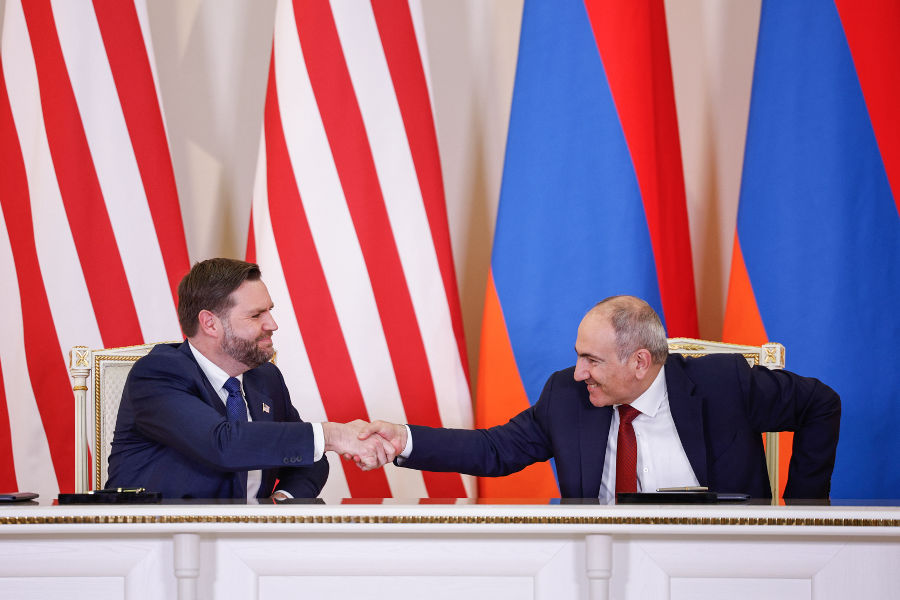
U.S. Vice President JD Vance’s visit to Armenia on Feb. 10 has clearly demonstrated that Russia’s long-standing dominance in the South Caucasus is waning quickly. The strategically important region, long considered part of Moscow’s zone of influence, is now slipping into Washington’s geopolitical orbit. But who will be the major loser in this shift?
Following the 44-day war between Armenia and Azerbaijan in 2020 over Nagorno-Karabakh, Armenian Prime Minister Nikol Pashinyan seems to have made a decisive move away from Russia, seeking closer ties with the West — particularly the United States. In September 2023, he described Yerevan’s policy of relying solely on Russia to guarantee Armenia’s security as a “strategic mistake.” In June 2024, Armen Grigoryan, secretary of Armenia’s Security Council, accused Russia of “taking Nagorno-Karabakh from Armenia, returning it to Azerbaijan and then leaving.”
Earlier in 2021, following incidents on the Armenian-Azerbaijani border, Grigoryan appealed to Russia under the 1997 defense treaty to protect Armenia’s territorial integrity. The Kremlin, however, remained silent, leaving its ally in the Collective Security Treaty Organization (CSTO) to handle the situation on its own.
As a result of Moscow’s ambivalence, on Feb. 20, 2023, the European Union (EU) launched a civilian monitoring mission along the Armenia-Azerbaijan border, marking the start of increased EU involvement in Armenia. Since then, Yerevan has steadily expanded military, political and economic ties with the West, while cooling off relations with Moscow. Later in 2023, Armenia began boycotting CSTO meetings. In 2024, it participated in NATO military exercises in Moldova.
In April 2025, Armenian President Vahagn Khachaturyan signed legislation initiating the country’s process of joining the European Union, despite Armenia being part of the Russia-dominated Eurasian Economic Union (EAEU). Previously, in January 2025, Armenia and the United States signed the “historic” Strategic Partnership Charter, which rests on four main pillars: economic cooperation, security and defense collaboration, democratic development and people-to-people exchanges.

The document also established a legal framework for peaceful nuclear cooperation. Consequently, during Vance’s visit to Yerevan, the two nations reached a $5 billion civil nuclear energy agreement which, in Pashinyan’s view, “opens a new chapter in the deepening energy partnership between Armenia and the United States.”
Coincidentally or not, the deal was signed just one day after Russian State Nuclear Energy Corporation Rosatom Director General Alexey Likhachev and the Speaker of the Armenian National Assembly, Alen Simonyan, discussed the construction of new nuclear power units in Armenia. While Moscow might view Yerevan’s nuclear deal with Washington as a “stab in the back,” Pashinyan is unlikely to cut energy ties with Russia immediately. More likely, he may adopt Kazakhstan’s approach: balancing between Rosatom and other corporations interested in doing business in Armenia.
However, if Russia continues to lose influence across the post-Soviet space, Pashinyan may eventually shift entirely toward American-backed civilian nuclear infrastructure, which would be a huge blow for the Russian nuclear giant.
Although energy has traditionally been a major driver of Russia’s foreign policy, what also should worry the Kremlin are the political and security implications of its declining authority in the South Caucasus.
In parallel, Armenia has started to develop energy relations with Azerbaijan. As of late 2025 and early 2026, Yerevan started importing refined fuel products from its neighbor, while Pashinyan recently signaled that energy systems of Armenia and Azerbaijan “will definitely and unequivocally be interconnected.” These moves demonstrate Armenia’s strategic pivot from Russia, extending not only to the West but also to Azerbaijan and Turkey.
The fact that the Armenian authorities plan to soon remove Russian border guards from the Akhurik crossing on the country’s border with Turkey perfectly illustrates that Yerevan no longer sees Moscow as an ally. Under such circumstances, Russia risks being effectively crowded out of the South Caucasus.
If that occurs, the Kremlin will undoubtedly suffer a heavy geopolitical defeat, but the country that may stand to lose even more is Iran — especially if the United States establishes de facto control over the Trump Route for International Peace and Prosperity (TRIPP) along Armenia’s southern border. If reports that no Armenian border guards will patrol the route are true, Yerevan will not only lose sovereignty over parts of its territory but it will also undermine relations with the Islamic Republic, as Iran will practically be surrounded by U.S.-aligned forces along its northern borders.
Given that the Kremlin is doing nothing to prevent such an outcome, Russia’s loss of Armenia could soon lead to the loss of Iran, another strategic partner of Moscow. But since the authorities in Tehran, beyond rhetoric, are not taking any practical steps to prevent the construction of the TRIPP, they seem to have reconciled themselves to being semi-encircled in the north.
The Kremlin, on the other hand, is not only failing to keep Armenia in its orbit, but is also making moves that push Yerevan even further toward the West and away from Moscow. Russian propagandist Vladimir Solovyov’s recent calls for the Kremlin to consider forceful intervention in Armenia only give Pashinyan more reason to continue distancing the country from Moscow and moving closer to the West.
Possibly the very last chance for Russia to preserve remnants of its influence in Armenia will come in June, when the South Caucasus nation will hold parliamentary elections. In both Armenia and the West, Moscow is already being accused of planning to interfere, a charge that Russian Foreign Minister Sergey Lavrov strongly denies.
It is, however, a double-edged sword for the Kremlin: if it does not meddle, Pashinyan’s Civil Contract will almost certainly win the vote.
As a result, in the mid-term, Russia will be completely pushed out of Armenia. Potential interference, on the other hand, would likely unite Armenia and Western powers openly in opposition to Russia, leaving Moscow in a precarious position.
There are, therefore, no easy options for the Kremlin in Armenia. Years of failed diplomacy, ambivalence toward its ally and a willingness to turn a blind eye to Pashinyan’s pro-Western geopolitical course have left Moscow on the verge of losing its grip on Armenia altogether. Inevitably, the United States is moving to fill Moscow’s void and become the dominant foreign power in the South Caucasus — a region that could play a pivotal role in the event of a large-scale American war with Iran.




Serbia and then Armenia have both had to find out the great expectations of Russia didn’t match the reality.
@Nikola Mikovic
Only gullible Armenians believe American la la land promises.
Ever heard of the Kurds?
How many times have the Americans betrayed them? including now in Syria?
Ever been to America?
Met any Americans?
If you have, you’ll know how pig ignorant they are of the world outside of America.
Americans are going to die for a country they know nothing about?
Do you even know where Armenia actually is?
Barbaric Turks on its Eastern and Western borders and Persians to the South
All three of whom have ruled Armenia in the past and treated Armeniams with the same contempt as dhimmis.
The most salient point about Armenia is that for 800 years, there was no Armenia.
Armenians can abandon their only ally, just don’t complain about living as dhimmis.
Absolutely. Making a deal with America is like a Faustian bargain, with Pashinyan as Doctor Faust and America as Lucifer/Satan, which never ends well for the bargainer, in this case not Pashinyan, but Armenia. No country has betrayed its partners and allies as much as America. That country is the epitome of ingratitude and betrayal.
Hear! Hear!