Under our own vine and fig tree: An Armenian plea for America’s creed
Fellow Armenian-Americans,
There is a cheeky Polish saying: where there are two Poles, there are three opinions. To which, one imagines, the Armenian response must be: only three?
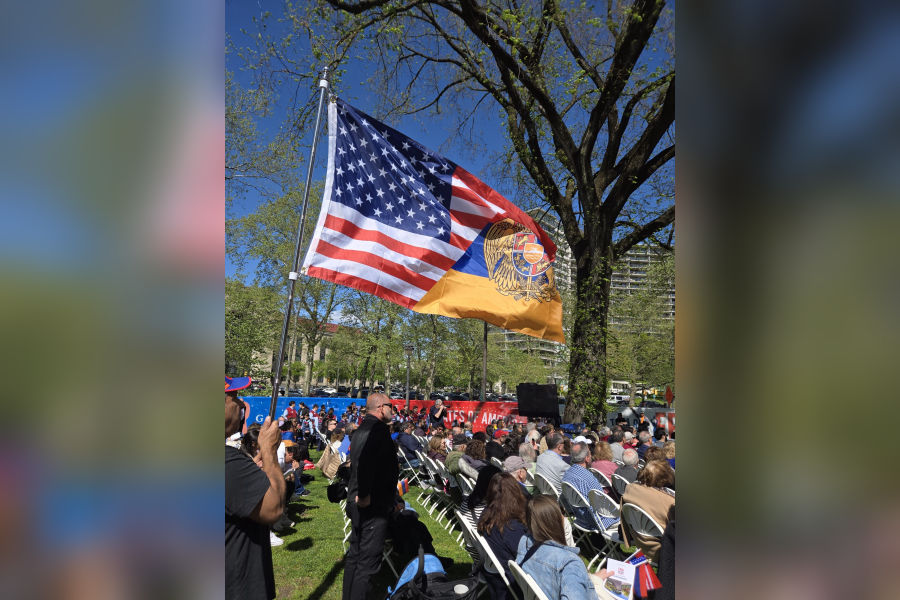
We have never been a people afraid of confrontation. In our ranks are communists and fat cats, atheists and zealots, Democrats and Republicans, hawkish revanchists and doveish internationalists, and so on. Yet for all our multitudes, there is something, one thing, we all seem to agree on. We agree that sustaining our Armenianness — our art, food, music, ideas, myths, stories, language and superstitions — is vital. We agree that the Armenian way of life must survive in the form of recognizably Armenian lives being lived in recognizably Armenian communities.
Which is why all of us, regardless of political persuasion, should reject the ideology now emanating from Donald Trump’s MAGA movement. Key voices in that movement have now lost patience with the way America has traditionally defined itself. That quaint old view — of America as a beacon to the world’s tired, weak, huddled masses; as a global invitation to a better life — they say is rubbish. They would say instead that America is not an idea but a land and a people — a territory defined by those who have lived in it longest (except, of course, for the Indigenous). The rest of us must take a back seat to the “true Americans.”
Where, then, does that leave Armenian-Americans? Not in a great spot, I fear. Let me explain.
I.
Traditionally, the magic of America — when it was at its best — was that your name, blood, religion and even place of birth were irrelevant to whether you belonged here. This policy of tolerance has been America’s national signature.
Go back to 1790 to witness it in action. As President George Washington’s first term was wrapping up, he visited the seaside town of Newport, Rhode Island. The occasion for his visit was that the state had finally ratified the Constitution — the last colony to do so. Rhode Islanders had truly made Washington sweat: they waited until after his presidency began to accept federal rule, and even then by a vote of just 34 to 32. Long before the wariness of centralized power became associated with the Mountain West, its chief champions were Rhode Islanders.
During his visit, Washington was met by an especially vulnerable group of locals: a tiny congregation of Jews whose synagogue, the oldest in the United States, still stands in Newport today. Addressing Washington, the congregants prayed that the new federal government would give “no sanction” to bigotry and “no assistance” to persecution, lest those “children of the stock of Abraham” once again brook the prejudice they had encountered pretty much everywhere else.
As was often the case when Washington was called upon to act, he set an enduring standard. He promised the Jews of Newport that here, in America, things would be different. In a country rooted in freedom of conscience, Washington vowed that the worshippers could keep their holy texts and live freely in their faith. All that would be asked is that they “demean themselves as good citizens” and offer America “their effectual support.” Other than that, Washington promised — quoting Micah 4:4 — every congregant would be free to “sit in safety under his own vine and fig tree, and there shall be none to make him afraid.” These were words of unusual tolerance in 1790.
Decades later, and still today, those words (or at least the sentiment they capture) would attract immigrants from around the globe. They shaped America into the shining beacon — the haven — it had set out to be. True, many of those newcomers would meet serious discrimination upon arrival, but most would also make homes here. And as America’s Chinatowns and Little Italys and Glendale all attest, those communities would not be mere carbon copies of white Anglo-Saxon Protestant America. Quite the contrary, they often flourished on their own terms — producing a bonanza you’ve partaken in if you’ve ever bitten into a California roll, a hamburger, a hot dog, a pastrami on rye, a fortune cookie, Tex-Mex (or Tex-Ethiopian) or deep-dish pizza. These and other brilliant fusions found a place here precisely because American identity was spacious enough to let them in.
“What makes an American,” summarized one great hyphenated-American, Supreme Court Justice Antonin Scalia, is simply a “belief in the principles of freedom and equality that this country stands for.”1
Thus there was, and is, no conflict between ethnic roots and American identity: “I say you can be proud of your Italian heritage,” Justice Antonin Scalia reassured his paisans, “without feeling any less than 100 percent American because of that.”2
II.
Enough of that!, says MAGA.
You can’t just “identify America” with “the principles … of the Declaration of Independence,” Vice President J.D. Vance recently snarled, because “that’s a definition that is way overinclusive and underinclusive at the same time.” Such a “creedal” definition of America, Vance feared, would leave out all the fine Americans who don’t buy the ideas of equality and liberty — the kinds of people, Vance acknowledged, who would be “label[ed] as domestic extremists.” Those extremists “belong” here too, Vance insists; in fact, they may even have a greater “claim” over America than their critics: “I think the people whose ancestors fought in the Civil War have a hell of a lot more claim over America than the people who say they don’t belong.”
This preference for Americans who have been here a long time (except, again, the actual original inhabitants) is not limited to Vance. Republican Senator Eric Schmitt, of Missouri, has lauded Trump for leading a “pitchfork revolution” of “the real American nation,” defined as those “forgotten men and women” whose “neighborhoods were transformed beyond recognition by immigration.” (Please, nobody tell the Senator what Glendale looked like before we got there.) And according to Senator Schmitt, even Trump himself believes that America is not just an “abstract ‘proposition’” but “a nation and a people, with its own distinct history and heritage and interests.” Prominent far-right antisemitic commentator Nick Fuentes embraces this view too, contending that the government should favor what he calls “heritage Americans.”
III.
My fellow Armenian-Americans: we are not anyone’s idea of “heritage Americans.” Heritage Americans are Americans with an “Anglo-Protestant spirit,” a “tie to history and to the land” and a last name that can be found “in the Civil War registry.” Oh for three.
Worse, the concept of a “heritage American” is meant to affirm (as someone who helped popularize the term explained) “the domination and pre-eminence of the European derived peoples, their institutions and their way of life.” So much for Justice Scalia’s musing that a person’s “name or … blood or even … place of birth” is besides the point in this country. So much for the idea that belonging transcends heritage. Now, heritage anchors belonging.
For a people whose heritage emerged not on Civil War battlefields but on the highlands surrounding the Ararat Plain, this is bad news. The “creedal America” that Vance attacks is the only America in which Armenians can flourish — or have ever flourished. We are not cut from the Anglo-Saxon cloth, Puritan austerity has never been our thing and God knows our “spirit” is not Anglo-Protestant.
We are flexible, communitarian, adaptable and animated. We have a unique religious and spiritual tradition. And we have a voluble pride in having inherited an utterly ancient civilization. Assimilation into white Anglo-Saxon Protestant America is not an option. If we are to thrive in America, it must be an America in which we can be different.
Lest these fears be dismissed as the troubled musings of a guy who overthinks and overanalyzes, recall our arrival in Anglo-Protestant Glendale. Glendale was then a sundown town — a “bastion of conservatism and prejudice” — where we were not welcome. The City downzoned and blocked new housing in an attempt to keep us out. When that failed, they came for our banquet halls, requiring them to (1) provide more parking than ordinary restaurants had to provide, (2) use no more than 30% of the halls’ space for private parties and (3) cease outdoor barbecuing. And beyond that, to chill our religious expression, the City designated St. Mary’s Armenian Apostolic Church a historic landmark, crushing our plans to dome its roof. This hostility will doubtless return in an America bent on amplifying its Anglo-Protestant heritage.
Or maybe, it will be much worse. What this could be is an inch-by-inch return to our people’s darkest days. For if heritage Americans are the “real nation,” with their own distinct “interests” — as that Missouri Senator insisted — then we must be fake Americans with different interests. And if our interests are so different from those of the “real nation,” then that makes us interlopers.
With that logic, we are here not because we love America and what it stands for, but because, like a virus, we need a host to survive.
We are, then, on Schmitt’s view, and perhaps even the view of the vice president, and perhaps even that of the president, a foreign element, an alien out-group which will never really be American, which will never really belong in this massive empire where we are merely a tiny minority.
My fellow Armenian-Americans: our ancestors have been down that path before.
Not again.
1. stands for: Scalia, Antonin. “What Makes an American.” In Scalia Speaks: Reflections on Law, Faith, and Life Well Lived, edited by Christopher J. Scalia and Edward Whelan, Crown Forum, 2017, p. 17. ↩︎
2. because of that: Id. ↩︎


Compelling and well-written!