


Book Review: Smart Nation 2.0
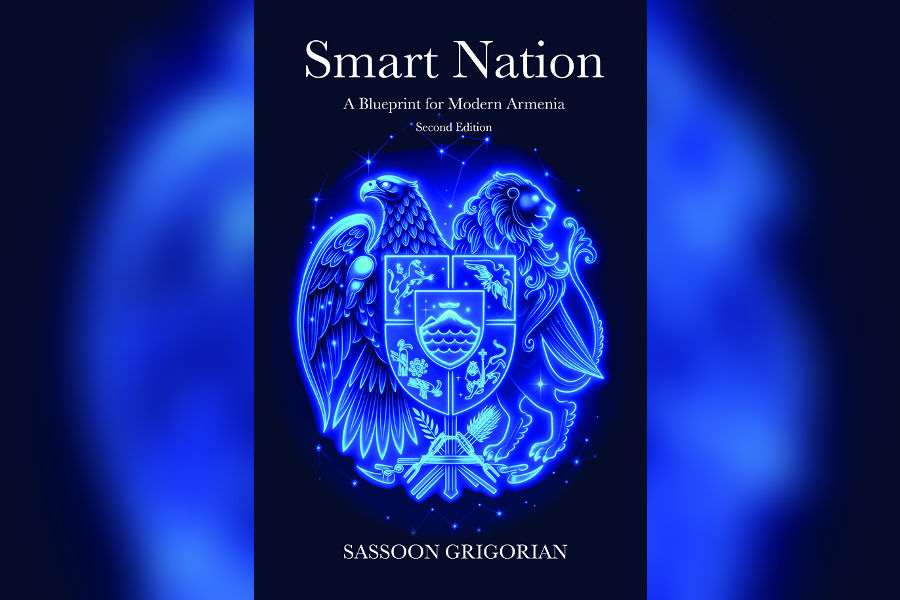
In “Smart Nation 2.0,” Sassoon Grigorian returns nearly a decade after the first edition of his influential policy blueprint to reimagine Armenia’s trajectory in a world transformed by war, technology and shifting alliances. Published by the Gomidas Institute, this second edition aims to draw a comparative study with other states and draw lessons for Armenia.
“Smart Nation 2.0” is not an academic work; rather, it is a policy-oriented study written with conviction. Some may argue that Grigorian’s proposals are overambitious for a small, resource-constrained country like Armenia. However, international relations have shown that small states can adopt flexible strategies to navigate regional and global challenges. Recommendations such as establishing a Ministry for AI or hosting a Global AI Summit in Yerevan distinguish the book from the incrementalism that often dominates Armenia’s policymaking.
The author also draws comparative lessons from Singapore, Finland and the UAE, concluding that, unlike these states, Armenia lacks the political stability and institutional capacity that enable long-term success. Aware of this gap, Grigorian offers ideal benchmarks intended to push Armenia’s policymakers to think beyond fatalism.
From “Silicon Mountain” to smart governance
The first chapter, dedicated to “Silicon Mountain,” exemplifies Grigorian’s optimism about Armenia’s “tech ecosystem.” He reflects the emergence of the country’s innovation sector — anchored by successful companies like Picsart, ServiceTitan and SuperAnnotate — as the potential engine of future growth. He calls for Armenia to develop an ambitious $10 billion homegrown startup to build entrepreneurial confidence, adopt a National AI Plan, establish a Ministry for AI and an AI Advisory Council and integrate AI across education and other structures modeled by the UAE and Singapore.

This idea reflects his main theme: Armenia’s future competitiveness depends on coordinated governance, not just individual innovation. Digital infrastructure, he suggests, is the new national security.
If Armenia was once branded as the “start-up nation of the Caucasus,” then “Smart Nation 2.0” reframes this ambition through strategic statecraft. Hence, according to the author, technology becomes not merely a growth sector but a pillar of sovereignty — one capable of reducing geopolitical vulnerability.
Armenia’s 360-degree foreign policy
The book’s most compelling and thought-provoking section is the “Smart Foreign Affairs” chapter, which reads like a realpolitik manifesto for post-war Armenian diplomacy. Grigorian argues that “Armenia has no allies, none,” and calls for a “360-degree foreign policy” — a doctrine similar to India’s non-alignment policy or Singapore’s neutrality. He reflects on Armenia’s relations with key regional and extra-regional actors, including Turkey, Iran, Russia, India, China and the U.S.
With Turkey, he advocates for “pragmatic normalization” within a “climate of trust,” suggesting the establishment of economic zones near the border as confidence-building measures. With Iran, he sees the potential in a “strategic partnership,” vital for countering Armenia’s regional isolation and strengthening trade interconnectivity and energy deals. With Russia, his assessment is more critical: he urges a “recalibration,” arguing that Armenia’s heavy dependence on Russian energy and security has eroded the country’s sovereignty. Still, he warns against complete detachment, recommending instead a managed diversification of security partnerships. Regarding U.S.-Armenia relations, he mentions that the U.S. is in no position to provide defense guarantees for Armenia, but the strength of these relations lies in investments and technological cooperation.
Throughout this chapter, the author defends the thesis of “interest-based diplomacy” — a doctrine that trades illusions of alliances for realistic partnerships. Though such an idea may unsettle many idealists and realists alike, Grigorian offers a roadmap for navigating an era of multipolar, volatile global competition.
The role of the diaspora and nation-state-building beyond borders
Perhaps the book’s most important chapter is “Diaspora Reimagined,” where Grigorian links the global Armenian diaspora to the state-building process in the homeland. He addresses social cohesion, governance reform and diaspora engagement. The author argues that social issues such as women’s rights, well-being and economic development signal an understanding that modernization is not merely a technological process but also a social one. Likewise, his proposals for e-government, taxation reform and good governance aim to dismantle what he calls Armenia’s “unfinished business” of institutional corruption that has sucked the resources of the country since its independence from the Soviet Union.
Coming to the role of the diaspora, he revisits the question of how the global Armenian nation can serve as a development network rather than a sentimental abstraction. The author also urges the emergence of the new diasporan institutions anchored in professional collaboration and technological exchange rather than traditional charity. He also emphasizes the preservation of the Western Armenian language as a cultural asset. He argues that the “Real Armenia” narrative should be replaced by a “One Armenia” doctrine that includes the diaspora. By arguing this way, he challenges both the government and traditional diasporan institutions to move beyond nostalgia and romanticism and engage in nation-building, which goes hand-in-hand with state-building.
Conclusion
At its core, the “Smart Nation 2.0” is a call to Armenia and the Armenian people to think critically and act strategically. It emphasizes planning decades ahead in a world full of geopolitical surprises and shifting alignments that rarely offer such luxury. The initiative combines technocratic pragmatism with national idealism, providing a multidimensional approach and programs that connect digital transformation with sovereignty, governance and identity.
For a country often historically caught between survival and challenges, this book offers a different perspective on resilience. It serves as a wake-up call for Armenia’s policymakers to shift from crisis management to designing the future of the entire nation and its sovereignty.