


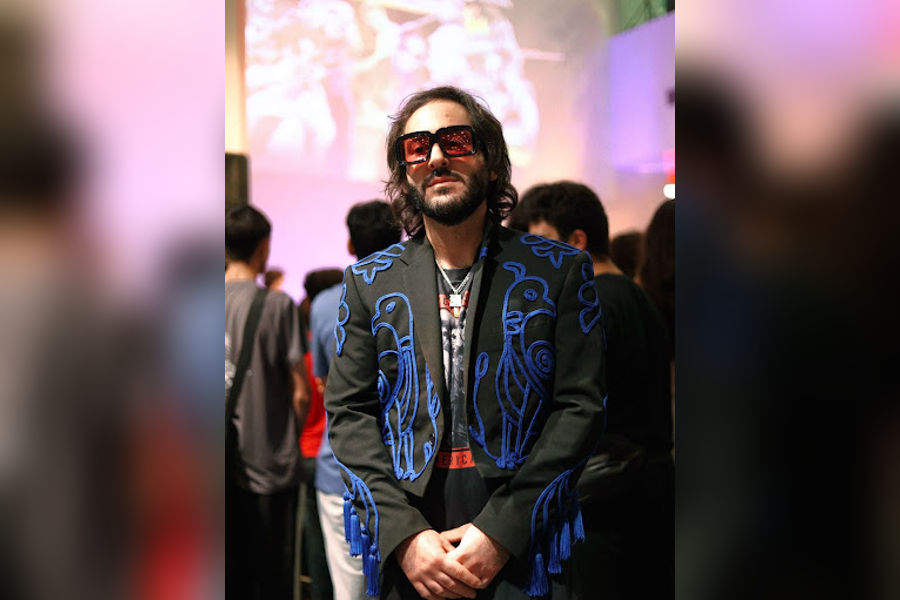
Armen Zabounian, known professionally as Peyote Beats, is an Armenian-American music producer. His work spans genres and countries, collaborating with artists across rap, hip-hop, K-pop, J-pop and more. A multi-instrumentalist, Peyote’s layered, diverse beats contribute a unique sound to the hits of Doechii, Tyga, French Montana and Yuki Chiba.
Earlier this year, he won a GRAMMY for his work on Doechii’s album “Alligator Bites Never Heal.” The award made Doechii only the third female rapper to ever win Best Rap Album. This summer, he brought his expertise to Armenia and spent time teaching students at the TUMO Center how to produce music.
The Weekly caught up with Peyote Beats to talk about music production, the GRAMMYs and his hopes for Armenian artists.
This interview has been edited for length and clarity.
Rosie Nisanyan (R.N.): How did you get started in music?

Peyote Beats (P.B.): My whole life, I’ve been in it. When I was five or six, my parents got me into classical piano. It’s funny because
my parents are Armenian, so of course, they wanted me to play Aram Khachaturian and Arno Babajanian songs when I had recitals every year.
Fast forward to high school, I heard someone playing the guitar and asked them what song it was. They told me it was “Hey Joe” by Jimi Hendrix. After that, I went home, got my dad to get me a guitar and started playing guitar. Then I started a rock band. So, music has been around my whole life. But with Armenian families, you know how they are, “Hey, you gotta get a real job. You gotta be a lawyer or a doctor.”
So, I put the music on pause and came out to Los Angeles about 15 years ago for business school. It was also a way for me to get out of Palm Springs. But halfway through my time there, I got into music production because it was just an easy way for me to do music — all I needed was a laptop. I didn’t need a band anymore; I already played pretty much any instrument. I saw how clean and easy it was to do, and I could just make cool records on my own.
Around 2015, SoundCloud was gaining popularity, and a new type of rap came out — people called it “mumble rap.” It was a new movement, and I loved it — I wanted to be a part of it. I started using my marketing and networking skills and just started reaching out to rappers, just cold emails, cold DMs (direct messages). I’m huge on that.
R.N.: Did that work?
P.B.: Oh yeah, that’s my bread and butter. Instagram is my best friend, you know. Sending DMs — sometimes you get left on read, and sometimes they just never get opened.
R.N.: As a music producer, how do you typically collaborate with an artist?
P.B.: There are multiple ways. One of the easiest ones is: they come in and I play them a few different instrumentals. They say, “I like this one, not that one, this one, that one.” And then we record a few different tracks on beats that I already made.
Another way is: they come in, and maybe they’re in a little more of a creative mood and are patient enough to wait for me to make them an instrumental or a beat from scratch that’s more tailored for them. And then again, we record on it.
Sometimes, with the bigger artists, we might not get a chance to get in the room with them. A lot of times, we’ll find ourselves sending beats to the artist or their team, they record it wherever they feel comfortable and then we get a record back. And you sit and wait and hope they release it soon — it could take anywhere from a month to even five years.
R.N.: That timing is crazy because it’s a seemingly less involved process of making music, compared to a band.
P.B.: It’s definitely less tedious than a band, but it also depends on the genre. Because I also work on pop music — I do K-pop now and J-pop. Those are a little more delicate and complex. There are a lot more vocals going into it, we’ll bust out the instruments — guitar, piano, all that is still in it.
R.N.: You mentioned Jimi Hendrix earlier — are there any music producers that have really inspired you?
P.B.: The term “music production,” I learned from Kanye West back in the day. I know everyone has a nervous laugh when you bring him up now, but you can’t take away the fact that 25 years ago, I listened to his albums — even when I was making rock music at the time — and I thought it was dope and then I found out that he was making his own beats and his own production.
I’d also say Dr. Dre. And those are from an older time, but still, those are our guys.
R.N.: Are there any new artists or genres that you are really interested in working on?
P.B.: It’s hard to say. A lot of times, I run into artists naturally these days, whereas I used to have SoundCloud. And if I like them, I’ll work with them. But I’m super picky because it’s saturated at the moment with a lot of people trying to get into the market. It’s a game; they really have to be different.
I do want to continue getting on historic albums. Luckily, with the Doechii album, it was a big thing for female rap history, so just getting on albums that are changing the atmosphere would be amazing.
R.N.: Yes! You produced “BOILED PEANUTS” on her album “Alligator Bites Never Heal,” which won you a GRAMMY this year — congratulations! What was the recording process like? How was the GRAMMY experience?
P.B.: Thank you. It was out of the blue, completely unexpected, even up to the point of going to the award show and them presenting the award. She was the only female in the Best Rap Album category with four other guys — you had Eminem, Metro Boomin and Future, J. Cole and Common and Pete Rock. The whole time, I was like, “Eminem always takes it, whatever he releases, so they’re gonna give it to him.” But yeah, it was just crazy going through it. It was the first award they announced. Cardi B came out and announced it, and it was just crazy. Definitely the most touching moment in my life, you know. It was insane.
For the process, I already had a song from before Doechii, but with the same label, TDE. TDE, which also has Kendrick and SZA, is pretty much the strongest rap label there is right now. I had a song with one of their artists.
While they were putting the contract together for the song — each song we do is bound by a contract and details our shares and how much we’re going to get, etc. — I looked up some of the email addresses involved. I did my little networking thing and just started DMing them like, “Yo, I’ve been trying to work with you guys for 13 years. What do we gotta do?” And then they said, “Yeah, just come on down to the office.” So, I went over there and played them my tracks for like 40 minutes.
A couple of days later, they called me. They were working on a specific beat for Doechii, which was in the style of boom bap, which was like 90s hip hop. Usually, she goes for poppier music that’s kind of futuristic-sounding. But I did it and sent it back to them, and they already had the vocals and everything ready for it, so the song was already in the bag. It’s funny, it was probably the fastest that I’ve gotten the record, and the easiest and it became the biggest highlight of my career.
R.N.: Does that mean you have more songs with Doechii in the works?
P.B.: Yeah, I do. I have other songs with her, just in the vault. I have songs with the other artists on the TDE roster as well, yet to be released.
R.N.: This summer, you went to Armenia to teach music production at the TUMO Center. How did that come about?
P.B.: A friend of mine named Aram, who goes by Mickey, runs a studio in the Glendale/Burbank area called Mint Room Studios. It’s a famous spot in Los Angeles; a lot of rappers go there. I visited there like five years ago and we’ve kept in touch. Then out of nowhere, earlier this year, he hit me up and said, “Yo, I started talking to TUMO and they’re interested in bringing you out.” At first, I didn’t know what TUMO was, but as the date came closer and I learned about TUMO — it’s such a big institution worldwide — and I decided to do it.
I work in Tokyo once a year with the rappers and the pop artists out there as well — I’ve been doing it for 10 years. I try to go in the Fall, but I just went in July, right before TUMO to perform at the Budokan Arena, which is one of the most famous arenas out there for concerts. I performed with Yuki Chiba, who is one of the famous Japanese rappers out there.
With TUMO, the objective was teaching the students how to make songs — music production with a hip-hop/rap focus. The first week was me making a song from scratch in front of them. The beat instrumental, doing the melodies for the vocals and lyrics and having them help me find words and lyrics. We made an official rap song for TUMO that talks about TUMO and how “we’re the best,” and “we learn this and that,” and it just kind of has an attitude.

Then, the two weeks that followed, they got into three different groups of maybe 10 kids each. They did what they saw me do and had to make their own song from scratch.
These Armenian kids are so talented — each one of them plays an instrument, so it’s easy for them to put it together. It was just a matter of showing them the process and the tools for making the song, which they had never seen. For me, it was so rewarding to see them get into it and make something that they love. I’ve said it before — it’s not about getting any of the awards that I’ve received, it’s about potentially shaping their future.
R.N.: Are any of those songs going to be released?
P.B.: I’m hoping they will! TUMO has the final copy and everything. I think they’re going to put it out on YouTube. I really want people to hear it, it’s really cool and fun. Also, Jack Jr., the comedian, visited TUMO while he was in Armenia. He happened to come into my lab in the studio, and he recorded a few words, so I put those excerpts in the keynote song, like a sample.
R.N.: Can you tell me more about the music scene in Armenia?
P.B.: Honestly, I didn’t get a chance to look at too many artists, but I did get to look at the one that I wanted: Brunette. She was in Eurovision. Someone showed her to me and, versus all the other artists that are new at the moment, she has the highest chance of succeeding outside of Armenia. She’s out there singing in English, and the beats and everything that are on it just sound more in tune with music in the rest of the world. So, I made a record with her that I hope to get released soon.
And then, as far as the rest of the scene, what I’d like to help out with is showing them how to make their sound more in tune with global taste. It’s going to be super hard, but I believe I could put my efforts into it and kind of shape that culture out there because we need it. We need to be in the scene, so however I can help with that shift, I’d like to.
For the new [Armenian artists] who are coming up, I want to show them, “Look, there’s someone in front of you that’s working with the majors.”
R.N.: How can people support your music? What can we expect next?
P.B.: Keep your eyes on my Instagram to stay in tune with what’s happening on the journey and with the mission, really. I have two K-pop songs coming out and one J-pop song, “Black Nightmare,” that just came out. That was pretty big — it’s not just rap anymore that I work on, because it’s global, it’s also a pop thing.
R.N.: Do you have any advice for aspiring Armenian musicians or music producers?
P.B.: Yeah, I’d say just keep studying the greats, keep studying the biggest artists that are out right now. Why are they there? Play your music and then play their music.
I get that we want to incorporate the Armenian sound into it, but we need to somehow make it so that it could be recognized by non-Armenian people as well. Let’s get the sound out of Armenia and into the rest of the world. It’s easy for me to say, of course, because I grew up in America, I grew up in Palm Springs. I didn’t grow up in Armenia, so I kind of naturally listened to what I listened to out there with the early Armenian influences that I had. Let’s figure out how we can get our sound out to the rest of the world today.
You can follow him on Instagram @Peyote Beats to keep up with all the latest news and releases. Check out the Spotify playlist “Produced by Peyote” to listen to all the music he’s produced, including his latest work, “Black Nightmare” with Naniwa Danshi and GRAMMY-winning “BOILED PEANUTS” with Doechii.