



Los Angeles-based comedian Mary Basmadjian first gained notoriety over a decade ago for her viral videos sharing witty, relatable takes on being Armenian. A seasoned stand-up and improv performer, she has spent years developing her craft in comedy clubs across Los Angeles County. Known for her forward but supportive character of Vartoush—the internet’s favorite Tantig/Tota—Mary’s humor and charisma resonate deeply within the Armenian community, while also building broader connection and solidarity.
Her first stand-up special, Funny Armenian Girl, was released in 2024 and covered everything from dating to therapy to eating disorders—in the endearing and approachable way only Mary can.
While Mary’s stand-up is undeniably hilarious, she recently took audiences in a new direction: a one-woman show at the Hollywood Fringe Festival, called Mom, Are You There? In the show, Mary shares a “different level of vulnerability” than seen in the past, making audiences laugh and cry.
We caught up with Mary after the run of Mom, Are You There? to talk about her comedy career, the origins of Vartoush and how Big Mouth inspired one of her on-stage characters.
This interview has been edited for length and clarity.

Rosie Nisanyan (R.N.): How did you get started in comedy? Did you always know you wanted to be a comedian?
Mary Basmadjian (M.B.): I always really liked performing. When I was younger, I went to Saturday Armenian school and we had a hantes. When I would say the Armenian poems, everybody would get emotional and I was like, “Oh my gosh, I love this feeling!” I loved doing my grandpa’s impressions and my grandma would laugh at that, so that really gave me a boost, too. My dad and his parents also did some Armenian sketch comedy shows, in which I would be an extra as a little kid.
I remember going to the Ice House Comedy Club in Pasadena—it was my first time, and I was like, “This is so funny; this is so great,” because I would always tell stories. I took the public bus to school, and there were a lot of characters on there, so when I would get to school, I’d be like, “You guys would never believe what happened.” I just love telling stories.
Originally, my friends said to go to the Groundlings for improv, but because I was raised in an immigrant household, some of the American stuff didn’t make sense to me—you know what I mean? I didn’t watch Star Wars until my 20s—I don’t know this s***! I wouldn’t know any of the suggestions they would give me, so I never went to Groundlings. I love stand-up! It’ll be 15 years [doing stand-up] this year. But my Vartoush character is improv.
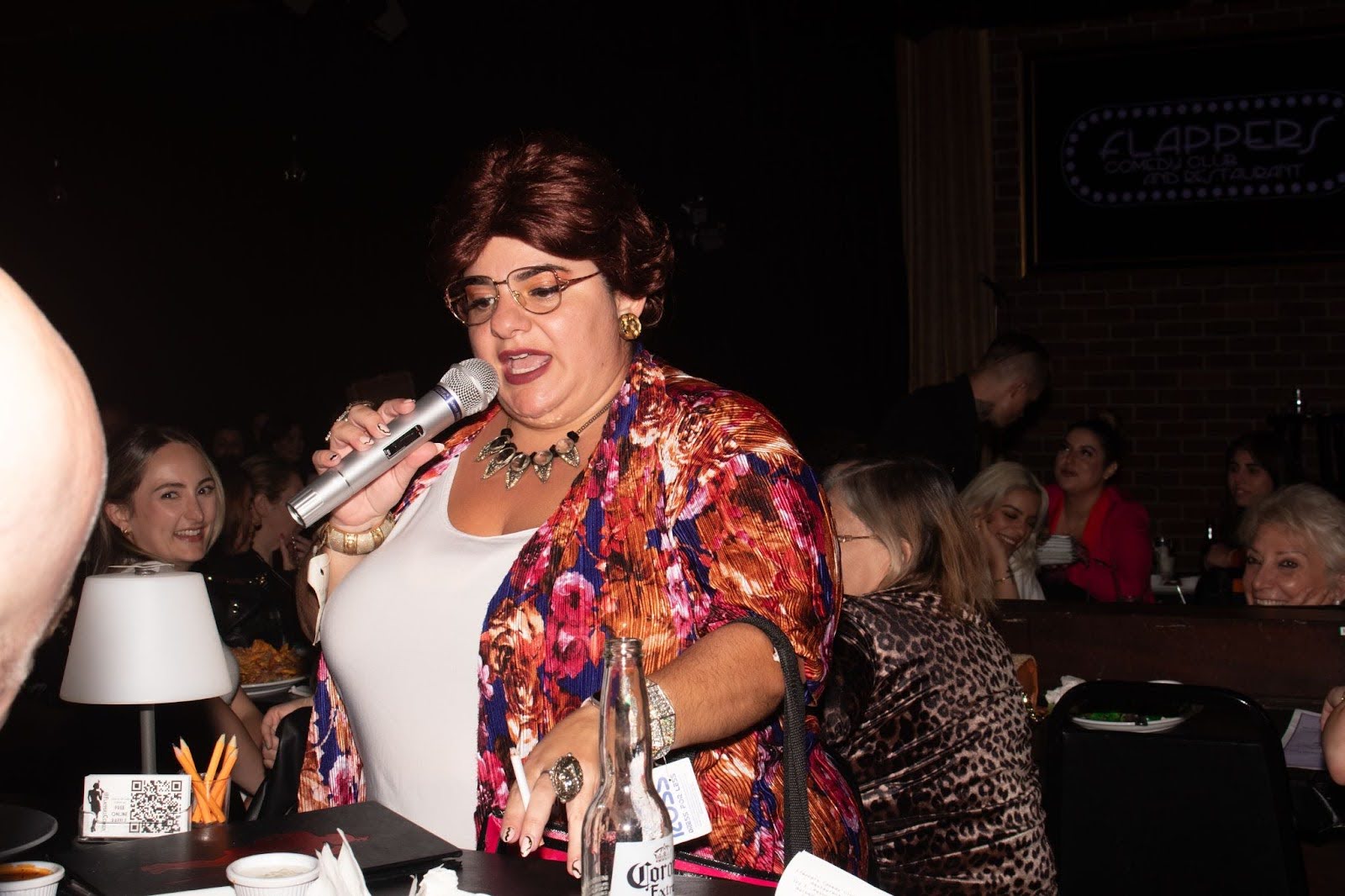
R.N.: Tell me more about Vartoush. She’s a fan favorite at live shows and on social media. How did you develop that character? What inspired her?
M.B.: Instagram had started the 15-second videos back in the day—I think it was, like, 10 years ago—with the “Armenian moms be like…” and “White moms be like…” videos. In that sense, I did “Armenian moms say this” and one of the first videos I had posted that went viral was me as myself and my mom saying things like, “Don’t eat anything after six,” “Don’t eat bread,” “Don’t eat …” And back then, with Vartoush, I didn’t have a wig, so sometimes, I would put a jacket over my head and call it a wig. I was still working at a healthcare facility at the time—luckily, I had an office in the basement, so nobody was around! I was just making videos all day long, I wasn’t getting any work done and it got to the point I was like, “This doesn’t make me happy,” so I got out. But that’s how it kind of came about.
Vartoush is like a mixture of my aunts and my dad. She’s evolved a lot over the years. She used to be more judgmental, but I wanted to see Armenian women in a more progressive, nicer light. She still bites with her words—it’s just that she doesn’t punch down.
When I do the Vartoush Loves You show at Flappers Comedy Club in Burbank, I go up as myself and do stand-up, I have some comedians do stand-up, and then at the very end, Vartoush comes out as the headliner. I go into the crowd, talking and messing with people. I have a bag full of random 99¢ stuff and I think I scratch the improv itch with Vartoush.
R.N.: Historically, there haven’t been a lot of English-language Armenian comedians, let alone Armenian women comedians. What has that meant for you? How has your experience been in the industry?
M.B.: The first four years I was doing stand-up, there was no Armenian show that I was on. It was just that I’m an Armenian comic and I speak about my family and I’m an Armenian. And then, when I started doing the videos, it would go viral within the Armenian community. I met another Armenian comic who was producing a show called Armenian Nights, and it introduced me to the other Armenian comics. That was, like, 10 years ago and we haven’t had the show together in about six years, so my show on July 31st is an Armenian Nights reunion!
Other than that, I wasn’t really going after that niche—it just happened naturally. Of course, now it’s really different because social media has changed so much. What worked back then may not work now. I started as just a regular comic, just doing stand-up, and then the Armenian side of it came; I still do non-Armenian stuff, too.
R.N.: Your first standup special, Funny Armenian Girl, came out last year. I loved it! It was so nice to relate to the content because it’s not every day someone jokes about being Armenian on-screen. What was that experience like? How does it feel to have a taped special?
M.B.: It was really cool—surreal, almost. I was very grateful for the opportunity. It was done with Comedy Dynamics. There were a lot of comedians that weekend filming specials. They did such a wonderful job and were such a good company to work with. The video, as you saw, was shot in such a beautiful, professional way. It would take me so much longer to do something like that on my own, so I was very grateful for that experience.
There was also this thing inside of me where I was like, “This is on a way bigger level, and you better come correct. You better not let down the Armenians.” I was freaking out! There were moments where I would just need to scream into a pillow, but then that day, it was awesome, and I was just really grateful for the experience!
 R.N.: And now, you just performed your new one-woman show, Mom, Are You There?, at the Hollywood Fringe Festival. How was that experience? How does the tone compare to your stand-up or videos on social media?
M.B.: That one is a little bit more personal. I talk about things that I have not posted online or talked about in my stand-up, so it was a different level of vulnerability than I have displayed in the past. This one also made people cry, so there was laughing and crying—I didn’t just make people cry.
I used Vartoush to narrate the story. It was just me, wearing all black, and I would take out her glasses when it was time to be the narrator. And it was just going through points of my life where I have felt like I wasn’t good enough. A lot of it had to do with having a young mom and her being a narcissist. I haven’t seen or talked to her in 10 years, and that, in and of itself, is a very odd feeling to have as an Armenian because moms are like the thing, you know what I mean? It’s just so freaking weird. But the crazy thing is, when my comedy was taking off and I was being more visible, that’s when all this was happening. So, the online career was great, and then at home, it was terrible. That’s what I talk about there.
The narrator sets up the scene, and then I go in and play the different characters—over 20 of them. I personified shame because it’s a very big part of our community. I think everybody has some sort of shame attached to them. I personified an eating disorder, called her Edie. I personified fear.
I work with Jessica Lynn Johnson, who is a solo theater director and developer. She told us that when there are really difficult scenes and really sad scenes, to personify inanimate objects. So, I played the refrigerator, I played the stove, I played a carton of cigarettes.
R.N.: Wow! Personifying shame, fear and an eating disorder—that reminds me a bit of Inside Out, with all the different emotions. Can you talk about the difference between their personalities or how you brought them to life?
M.B.: Another really good person I worked with within that solo theater community is Heather Dowling, who is an amazing acting teacher. With Shame, I was doing something else completely. And she was like, “When you think of shame, what do you think of?” For me personally, a lot of the shame comes from religious institutions. She said, “Who do you think of?” Just an uptight priest, like Frollo from The Hunchback of Notre Dame. So, I made Shame very uptight and judgmental.
For Fear, obviously, you’re just like, “Ohh, I’m so scared.” With Mary Jane she’s very laid back, she’s chill, she’s a friend. Edie, the eating disorder, is terrible—constantly reminding you that you’re not good enough, you don’t look good, you’re fat, you’re this, you’re that. So, obviously Edie and Shame were besties.
I also played Sexy Susan, who is kind of like the Hormone Monstress from Big Mouth on Netflix. She comes about when teenage Mary is looking in the mirror and is like, “I wish I had a boyfriend. All my friends have a boyfriend but me.” And Edie says, “Fat girls like you don’t have boyfriends. They have diets they never stick to.” And that’s when Sexy Susan comes about with sexy music playing in the background. Edie says, “Look at your fat thighs and a**” and Sexy Susan says, “That’s right, more cushion for the pushin’!”
There are those little moments, and that’s how I differentiate them. Also, your stance, voice, eyes, eye levels—that’s how you differentiate between the different characters within the scene.
R.N.: Obviously, a lot of your comedy has to do with being Armenian. How has the Armenian community supported you?
M.B.: They’ve been so supportive. First of all, they always come to shows; it’s always a good time. When we were in lockdown for COVID, I was doing personalized Vartoush videos, like birthday messages for people. I do private events as Vartoush, including Armenian events. Recently, I did the Armenian American Medical Society luncheon. So, there are all kinds of groups that call me, and I’m always so grateful to be able to do that for the community. They’ve helped me so much. As I said before, I was doing regular comedy before Instagram took off, and then when it did, I feel like they gave me a platform and I’m so grateful for that.
R.N.: Do you have any advice for aspiring Armenian comedians?
M.B.: Make something you want to see, and people will gravitate to it. Like with Vartoush, I wanted to see a progressive older Armenian woman; I wanted my mom to be a progressive Armenian woman; I wanted her to be supportive and nice. I wanted to see a sex-positive Armenian woman—so, that’s what I did.
R.N.: What’s coming up next for you?
M.B.: I produce shows at Flappers Comedy Club in Burbank with the show, Vartoush Loves You. The next one is on July 31 with a reunion show called Vartoush Loves Armenian Nights, and it’s my birthday on August 1, so it’s also going to be a Mary roast.
I also want to bring Mom, Are You There? on the road—[hopefully] to New York.
Mary Basmadjian’s comedy special “Funny Armenian Girl” can be streamed online. Follow Mary Basmadjian on Instagram, TikTok and her website to learn about upcoming performances or to hire her (or Vartoush) for your next event!