



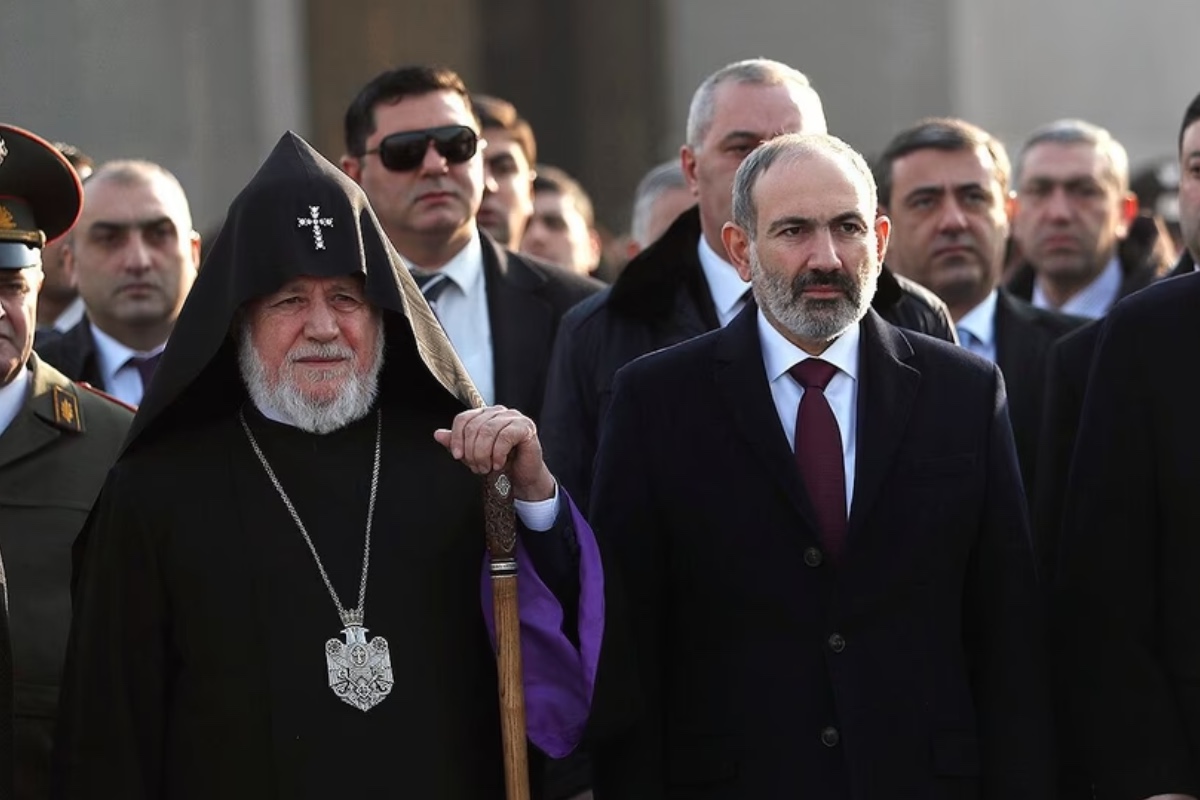
YEREVAN — The confrontation between Prime Minister Nikol Pashinyan’s government and the Armenian Apostolic Church intensified this week.
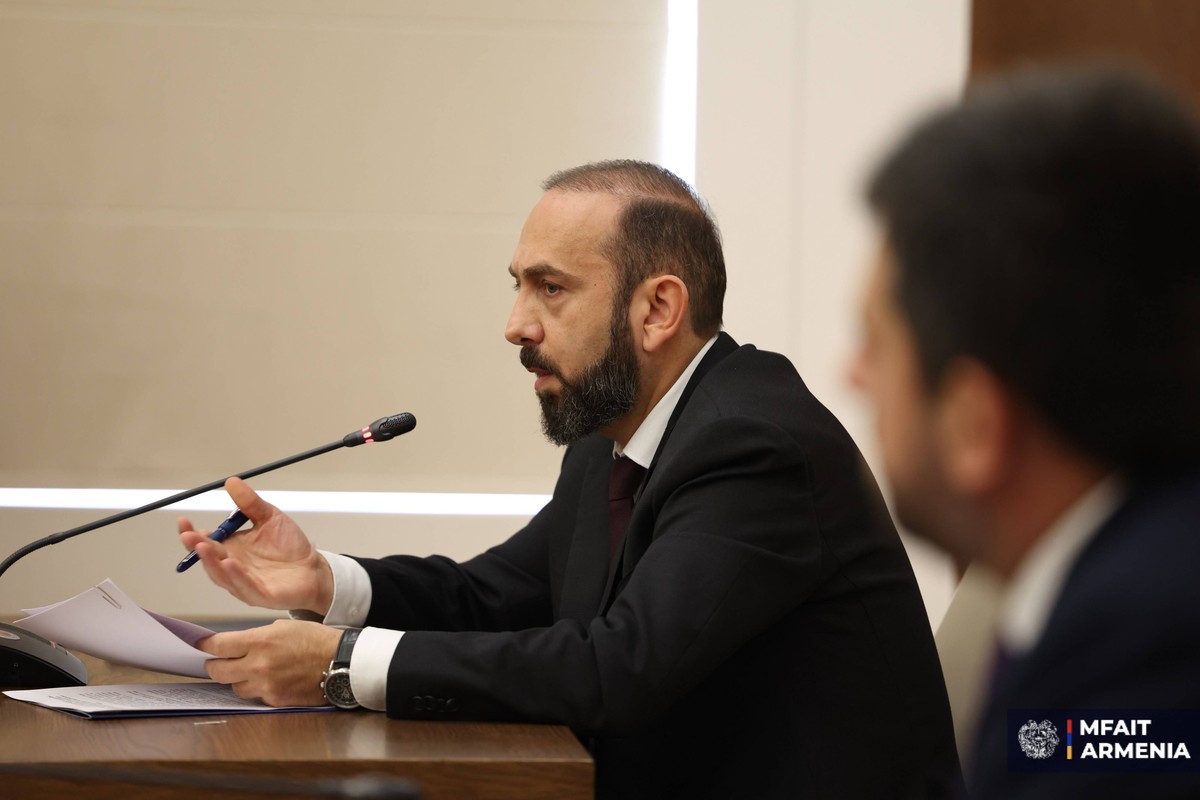
On Sept. 24, the Information and Public Relations Center of the Office of the Prime Minister published a report titled “On the Crisis That Has Emerged in the church as a Result of the Actions of the de facto Head of the Armenian Apostolic Holy Church and a Number of Senior Clergy, and on Ways to Resolve It.” The center said the report was prepared pursuant to the Armenian government’s 2026-2031 program and on the direct instruction of Prime Minister Nikol Pashinyan. The document identifies 16 issues that it describes as evidence of a crisis within the Armenian Apostolic Church.
Among them are alleged violations of clerical celibacy, arbitrary disciplinary practices and defrocking of clergy, financial opacity, misuse of church property, nepotism in clerical appointments, politicization of the altar, foreign influence and institutional failures related to church governance. The report also refers to the failure to convene the National Ecclesiastical Assembly for 27 years, the absence of a unified church constitution and divisions within dioceses in the Armenian diaspora. It concludes with a five-step proposed road map for the church’s institutional crisis.
According to Forum 18, the government program approved on Aug. 20 contains a chapter titled “Spiritual Security” that identifies the removal or retirement of Catholicos Karekin II as an objective. The program states that the government seeks reform of the church, prevention of its politicization and the election of a catholicosal vicar through established church procedures.
Pashinyan says the church has been “seized”
Several hours after the report was published, Pashinyan addressed it publicly. The prime minister said the report had been prepared on his instructions and that reviewing the document had led him to conclude that the situation within the Armenian Apostolic Church was more serious than he had initially believed.

Pashinyan said the report showed that “The Armenian Apostolic Church has been seized by Ktrich Nersisyan and a group of clergy and laypeople who support him.” He urged the public to read the report and said the government would return to the subject.
Mother See rejects government report
The Mother See of Holy Etchmiadzin responded to the government report, rejecting its findings and challenging the state’s involvement in church affairs. In its statement, the Mother See described the report as unconstitutional, anti-canonical and unlawful in both its content and form.
Church officials said the document relied on accusations previously circulated through social media and news outlets and characterized its publication by a government body as interference in the internal life of the Armenian Apostolic Church. The Mother See reiterated the position adopted by the Episcopal Assembly earlier this year that reform within the church cannot be imposed through political pressure or state intervention.
Christian Solidarity International rejects the report
Christian Solidarity International entered the dispute with a statement rejecting the government report “in its entirety.” CSI is an international Christian human rights organization focused on religious liberty and human dignity. The organization said the authorship, methodology and motives behind the Armenian government report undermined its conclusions and argued that the document conflicted with the principle of church autonomy under Armenian and international law. CSI also disputed the government’s description of events inside the Armenian Apostolic Church.
The organization accused the Pashinyan administration of conducting a campaign against the church. CSI’s statement specifically challenged the government’s decision to have an institution within the Prime Minister’s Office evaluate the church’s internal condition and propose mechanisms for addressing it.
Church dispute reaches the Council of Europe
The confrontation received international attention again on Sept. 28 during a session of the Parliamentary Assembly of the Council of Europe (PACE) in Strasbourg. During a debate concerning Armenia’s June parliamentary elections, British parliamentarian Sir Edward Leigh raised the mistreatment of the Armenian Apostolic Church.
Leigh said the church faced an “unprecedented threat” from Armenia’s government and accused the Pashinyan administration of abandoning the boundary between church and state. “Armenian governments have never before persecuted the church or tried to establish control over it. But the current government is putting bishops in custody and bringing charges against the Catholicos. Whatever the truth about these accusations may be, the situation itself raises serious questions. For Armenia and its international reputation, especially in the eyes of Christians like me, a situation in which bishops are held in custody looks extremely negative. I believe the Council of Europe should speak out more clearly and consistently on this issue,” Leigh said.
Civil Contract lawmaker Hripsime Grigoryan, a member of Armenia’s delegation to PACE, responded during her own intervention. Grigoryan called Leigh’s remarks regarding the Armenian Apostolic Church “very ill-informed.” “In fact, what the Armenian government and the Armenian state are doing is protecting the church,” Grigoryan told the Assembly.
Grigoryan said the government’s position concerned the activities of the person currently serving as Catholicos. She alleged that the Catholicos was directly involved in unlawful actions aimed at overthrowing the Armenian state. Grigoryan also alleged that the Catholicos’s brother was “an agent, an international agent,” and said her assertion was supported by facts and documents. She did not complete that portion of her remarks before being interrupted by the chair.
PACE President Elisabetta Gardini, who was presiding over the session, stopped Grigoryan and instructed her to remain on the subject of the debate. Grigoryan then continued by addressing criminal cases involving Armenian bishops. “The bishops are not arrested for being bishops,” she said. Grigoryan said criminal cases had been opened against them and emphasized that courts, rather than politicians, would determine the outcome.
She described the cases as involving allegations of terrorist acts against Armenian civilians, referring to the criminal proceedings against Archbishop Bagrat Galstanyan and 17 other individuals.
Criticism following the PACE debate
ARF Bureau member and chair of the National Assembly’s Standing Committee on Human Rights and Public Affairs Lilit Galstyan, criticized Grigoryan’s remarks, saying that statements made by elected officials — particularly on international platforms — carry significant public, legal and political responsibility.
Galstyan argued that Grigoryan’s intervention at PACE contained “misleading statements” and claims that, in her view, were inconsistent with principles of human rights, human dignity and the presumption of innocence. Galstyan specifically referred to Grigoryan’s statement that Catholicos Karekin II was “directly engaged in unlawful actions towards overthrowing the state of Armenia.”
According to Galstyan, that characterization did not correspond to the criminal proceedings currently brought against the Catholicos. She argued that the charges against Karekin II relate to alleged obstruction of the enforcement of a judicial act rather than actions aimed at overthrowing the state.
She also criticized Grigoryan’s statement regarding the Catholicos’s brother, whom the Civil Contract lawmaker described as “an agent, an international agent,” saying the phrase did not represent a recognized criminal-law category and that no judicial finding had established such a designation.
Regarding the criminal proceedings involving Archbishop Bagrat Galstanyan and 17 other individuals, Galstyan argued that the defendants had been charged under provisions relating to the alleged preparation of terrorism and alleged preparation to usurp state power, rather than with carrying out completed terrorist acts. Galstyan said the distinction was significant when discussing ongoing criminal proceedings and the presumption of innocence.
Galstyan further argued that Grigoryan’s statements at an international forum should not be viewed as personal opinions because she was speaking as a representative of Armenia’s governing political majority. She said that such statements could affect public perceptions of senior clergy before court proceedings had concluded and accused the government of damaging the reputation of the Armenian Apostolic Church and interfering with its autonomy.
The government has rejected accusations that it is attacking the church, arguing that its actions are aimed at addressing alleged institutional problems and ensuring accountability within the Armenian Apostolic Church.
Criticism has also come from within the Armenian Apostolic Church. Fr. Gabriel Vardanyan said the Catholicos is elected by the National Ecclesiastical Assembly and consecrated according to the church’s canonical tradition, making the position fundamentally different from that of a secular officeholder. “The Catholicos of All Armenians is not simply an ‘elected leader,’” Vardanyan said. “He is a Patriarch elected by the church, consecrated through the sacred order of the church and called to serve within the Church of Christ.”
He argued that questions concerning the tenure of the Catholicos therefore fall within the authority of the church’s canonical institutions. Vardanyan also warned that political pressure over church leadership could establish a broader precedent for outside intervention in ecclesiastical affairs. “If today an attempt is made to remove a Catholicos elected and consecrated by the church through street pressure, political pressure or public demand, tomorrow the same mechanism could be applied to any matter concerning the church,” he said.


It’s not a Church-State dispute.
It’s a Western duped Armenians-Orthodoxy dispute.
Pashinyan’s acolytes know that in order to turn Armenia into a Western client puppet state, they must overturn all the civilisational and institutional structures that bind Armenia to Orthodoxy.
They have no chance of installing Western type capitalism when the Church stands in their way.
That’s what all this is about.
The geographical illiteracy of the Western duped Armenians will destroy Armenia.
Armenians must stand with the Church!
The Armenian church is the four pillars of the Armenian Apostolic Church and its off shoots Armenian Catholic and Armenian Evangelical churches. The Armenian Church is well. Hoory Manoyan has it wrong. This conflict is NOT between the Armenian State and the Armenian Church, but between the seating Government and the seating Etchmiadzin hierarchy. I believe it to be true that the Catholicos Karekin II has broken his vows for celibacy and has fathered a daughter he does not deny but does not acknowledge either. I believe it to be true as well that his election and occupation of the highest ecclesiastical seat is not sanctioned by Armenian Church cannon laws. I understand Christian Solidarity International is a Swiss based civic organization that supports religious liberty and human dignity, and also assists victims of religious persecution and natural disasters I am surprised that Christian Solidarity International stands by Catholicos Karekin II.
You’ve made some serious accusation and possible misinformation. What’s your research? Websites? Hard copy documents? AI? How do you back up what you’ve stated here?
Pashinyan’s villification and targeting of the Armenian Apostolic Church, Catholicos Karekin II and the clergy, aligns closely with the propaganda of Azerbaijan and Turkey against them.
His attempt to discredit its Christian and historical mission, purging the Catholicos and the clergy, and stripping the Church of the influence and role it holds as a fundamental national institution, from the Armenian constitution, and as one of the pillars of Armenian national identity and nationalism, is exactly the same aim of Azerbaijan and Turkey.
Pashinyan’s desire to purge and neutralize the Armenian Apostolic Church, the Catholicos, and the clergy is precisely what Azerbaijan and Turkey propagate and demand as part of their broader efforts to neutralize and bring Armenia under their control by stripping it of its national consciousness, nationalism, and genuine independence.
The failure to reunify the Armenian church outside of Armenia from the Soviet era schism driven by issues of state freedom and polity not theological issues once Armenia became independent is a failure that is Armenia s and Armenian peoples around the world fault. Even the Russian Orthodox church abroad, a schism result of the bolshevik revolution reunified with the Russian Orthodox church in 1994 . Perhaps like the prevarication and indicisision over Arktash seems to be a trait in proverbial foot dragging.
I found it very telling that the British sided with the Armenian church, the British of course deny the Armenian Genocide.
Instead of going after The Catholicos and meddling in Church affairs that he has NO business in interfering with, how about getting those being wrongly imprisoned in Baku on b/s charges released. How about taking care of the citizens of Armenia, like a real Prime Minster should. How about not giving away ancestral lands to appease those 2 countries on the left and right of us. Instead of making it more difficult on those in the Diaspora who want to come and make Armenia their home, how about welcoming the Diaspora to become more integrated. Shame on you for treating your people this way. The longer he stays in office, the less of a country we will have to call our own
Pashinyan is clearly taking lessons from Donald Trump and his maga buddies. Pashinyan doesn’t like the church, or believe in the church. His “civil marriage is over”. Civil marriages don’t involve the church!! Also as I research him, he was an orphan? Raised by a step-aunt? What is his true ancestry? Looks to me like his plan is to undermine and get rid of the the church so he can hand over the rest of Armenia to Turkey and Aizerbaijan. Hes taking lessons from trump and Putin. Has anyone thought about this?
Trump + 99.99% of Americans can’t find Armenia on a map.
The Seventh Cavalry is never coming.
All that the Americans ever care about is their air base in Incirlik so they’ll never upset the Turks.
I would say Pashinyan and Trump, other than both being very deceptive, are nothing alike in reality. Despite the fact that Trump is one of the most xenophobic, ignorant, right-wing and demagogue leaders the United States has had in recent years, unlike Pashinyan, he is all about America first. While Trump has consistently closed US borders to what he refers to as “undesirables”, i.e. mostly non-Europeans, and is quite blunt about it, Pashinyan has opened the doors to Armenia wide open to the world, including to our racist enemy populations, while blocking entry into Armenia at random any influential diaspora politician opposed to him and making repatriation to Armenia much more difficult for diaspora Armenians because most of them don’t approve of his destructive foreign policies.
The only resemblance between Pashinyan and Trump, the deceptive side, is the fact that while they both consider themselves very popular and democratic, one of the biggest lies ever told, Trump became a 2nd term president to avoid prison with a whole host of criminal charges against him and Pashinyan became prime minister for the 3rd time by illegal and deceptive means, such as incarcerating opposition leaders on manufactured charges to secure victory, to avoid being held criminally responsible for his treasonous activities that could have landed him in prison for life. In addition, while they both consider themselves populist leaders, they have the closest relations with dictators, as perceived by the West, or are surrounded by them. For example, Trump not only has very close relations with the leaders of Russia, China and North Korea, but that he also thinks very highly of them and in many ways identifies himself with them. Pashinyan in his turn, has very close relations with our anti-Armenian enemy terrorist leaders on both sides of the border, Er-dog-an and Aliyev two-headed snakes, and belongs to Collective Security Treaty Organization (CSTO) a Russia-led military alliance with member states such as Belarus, Kazakhstan, Kyrgyzstan and Tajikistan all led by dictators from the perspective of the West to which Pashinyan is so eager to join yet very hesitant to do so knowing full well the consequences of such a move.
The Armenian Church has always been the backbone of the Armenian nation and its last line of defense. Pashinyan apparently did not have any problem with the Armenian Church before and during his early years as prime minister. The church has all of a sudden become a major problem for him because, unlike him and contrary to his policies, the church does not consider the question of Artsakh and its ethnically-cleansed population closed and he considers the church stand as an obstacle to his complete capitulation to our Turkish and pseudo-Turkish enemies disguised under a one-sided fraudulent “peace treaty” with no third-party guarantor and enforcer!
P.S. Pashinyan was not an orphan raised by his step-aunt. I believe he lost his biological mother at a very young age and was raised by his biological father and step-mother.
Has the Soviet infantilism like comment of 99. 99% of Americans can’t find Armenia on the map actually been tested save persons from Armenia or neighbouring countries would would obviously know. Or is such a good soundbite like Russia would take Kyiv in 3 days is too good cliché to let go even if it was never actually quoted by official Russian sources… But as the poster clearly believes that it’s possible to induce an earthquake in Istanbul using missiles and that it was an honour to die for Arktash when he himself is very much alive it is perhaps ravings at work again. Since the USA doesn’t seem to trust the UK to safeguard it’s airbases it’s quite possible it doesn’t much trust Turkey either so whilst the 7th cavalry aren’t coming, “Mother Russia” has been rather a disappointment over the last few years leading to a dissolutionment with it over failed hopes and expectations. As for incirlik the USA is currently getting on better with Greece nowadays and Turkey isn’t so enamoured with Israel anymore which obviously would irk the USA, thus Turkey might not be as important to the USA as many here might assume.
I don’t know if Russian officials actually said they would take kyiv in 3 days or not, but they certainly didn’t plan the war to drag on for 4 years.