




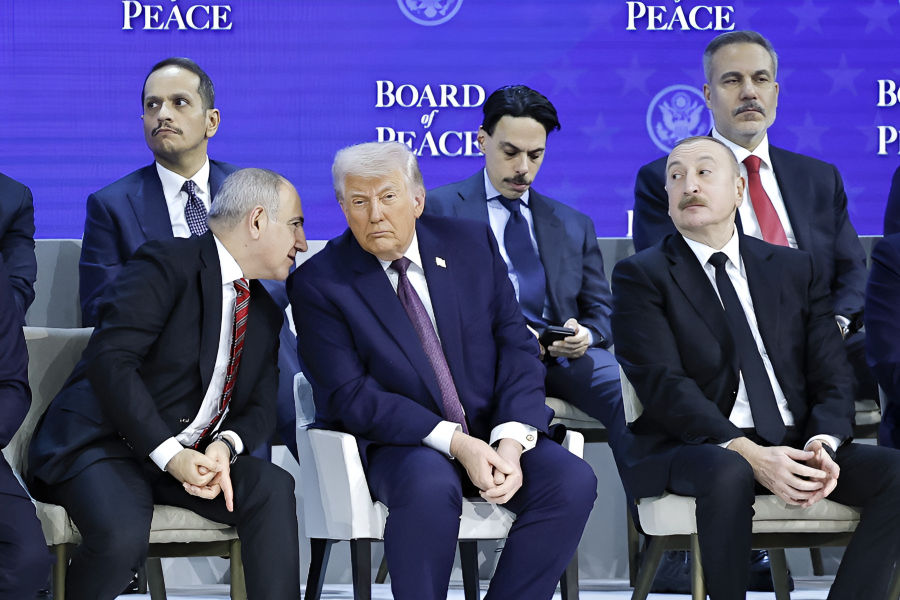
YEREVAN — While the leaders of Armenia and Azerbaijan publicly broadcast a message of peace, internal Armenian intelligence reveals a more sobering reality — one that directly contradicts the official rhetoric and suggests Azerbaijan remains a fundamental strategic threat.
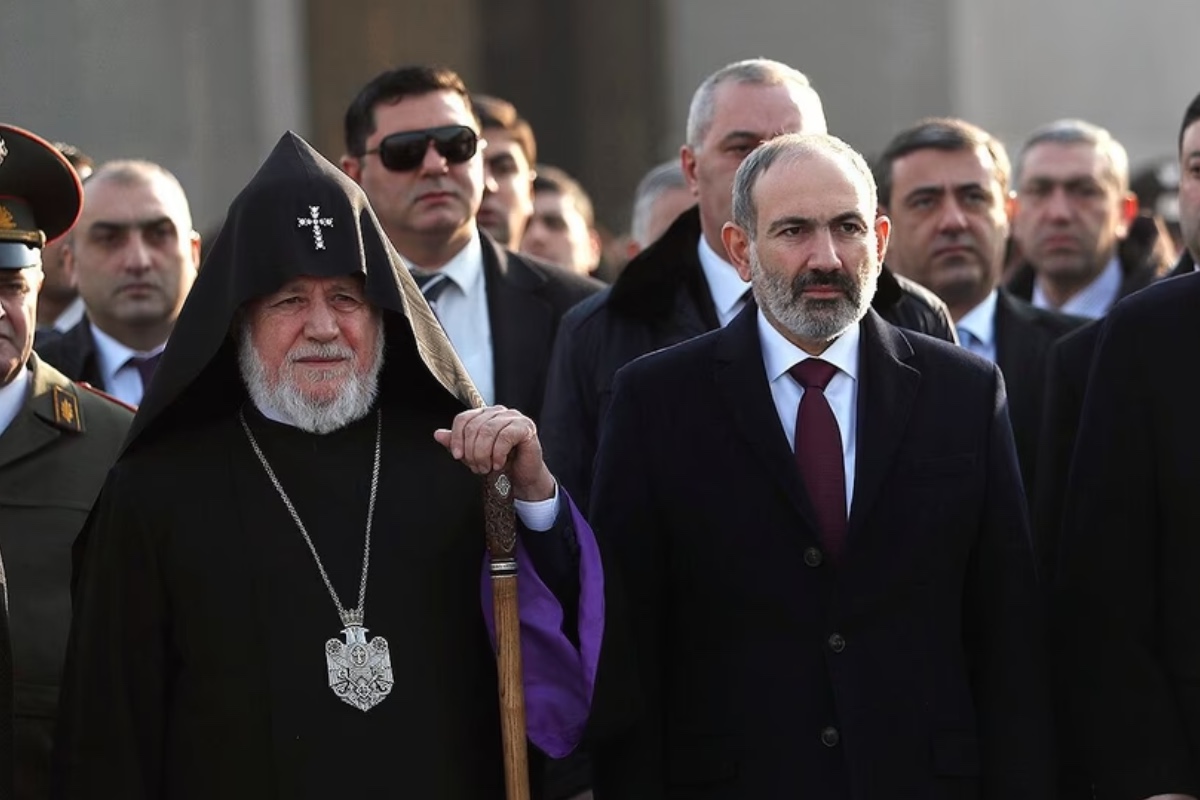
Armenian Prime Minister Nikol Pashinyan has asserted that “complete calm” now prevails along the Armenia–Azerbaijan border, while emphasizing that Armenia will “never, not for a single second,” relinquish vigilance. His remarks followed the release of Armenia’s Foreign Intelligence Service (FIS) 2026 Annual Report on External Risks, published in both Armenian and English — an implicit reminder that peace, however promising, demands constant assessment and preparedness.
Addressing domestic and international concerns surrounding sovereignty and the TRIPP initiative, Pashinyan dismissed fears as unfounded, describing the project as primarily investment-driven. “Politics is gradually moving to the background,” he said. “The project is becoming an economic one.”
Pashinyan further outlined a vision of deepening regional integration, noting that Armenian and Azerbaijani energy systems would be interconnected, operating under reciprocal and equal conditions for both imports and exports. According to the prime minister, Armenians are already experiencing tangible benefits — from lower fuel prices to wheat imports from Russia and Kazakhstan — evidence, he argued, of the practical dividends of cooperation.
Across the border, Azerbaijani President Ilham Aliyev echoed the narrative of transition, announcing in Davos that Yerevan and Baku have “closed the chapter of war” and embarked on a peace-building process.

Speaking to Euronews, Aliyev described the current moment as unprecedented in Azerbaijan’s modern history. “We have been living in peace for only five or six months,” he said. “We are still getting used to it. Throughout our independence, we have never truly lived in peace. This is a unique feeling — and a remarkable opportunity.”
Aliyev portrayed the South Caucasus as entering a new phase of development, noting that restrictions on cargo transportation to Armenia have been lifted and that Azerbaijan has begun supplying essential goods — particularly petroleum products — on which Armenia is heavily dependent. He framed these steps as mutually beneficial and indicative of a broader shift from confrontation to cooperation.
The Azerbaijani president reflected on the decision to halt the cycle of violence. “We could have continued as things were,” he said, “but that would have led to new military operations, more pain, suffering and casualties. In short, the war would never have ended. Someone had to stop it — and we decided to stop.”
Yet, Armenia’s intelligence report paints a more complicated picture. While it notes that the likelihood of military escalation in 2026 has become “almost improbable” following the Aug. 8, 2025 Washington agreement, the report highlights persistent and long-term risks.
FIS warns that Azerbaijan’s promotion of the “Western Azerbaijan” concept and the “return of Western Azerbaijanis” constitutes a significant threat to peace-building. Publications on the theme increased by 36 percent in the 138 days following the Washington declaration compared with the 138 days prior, suggesting a deliberate intensification of propaganda. Analysts are tasked with assessing whether these narratives aim to shift conflict onto Armenian territory or serve as a bargaining tool in foreign policy.
The report also highlights Azerbaijan’s continued militarization. From 2023 to 2026, the country’s military budget rose by about 44 percent, while allocations to other sectors grew by just 7.4 percent. Some nonmilitary sectors even saw declines in 2026. FIS describes the pace and prioritization of this growth as incompatible with a post-conflict peace trajectory.
The intelligence service also addresses the government-backed TRIPP initiative, offering a cautiously positive assessment of its outcomes while warning of structural vulnerabilities. The report notes that “infrastructure geopolitics” increasingly allows state actors to use economic projects to create leverage and dependency. As a result, new regional economic, infrastructure and trade initiatives in 2026 are expected to remain targets for hostile actors seeking to exert influence through physical disruption, information operations or other destabilizing actions.
Beyond the Armenian-Azerbaijani context, the report expands the threat landscape to include regional instability, particularly the Iran–Israel confrontation. FIS warns that, in 2026, the risk of renewed reciprocal strikes between Israel and Iran will persist, further complicating Armenia’s security environment and broadening the spectrum of external threats.
Against this backdrop, opposition figures argue that Armenia’s political leadership is presenting peace not as a carefully negotiated national outcome, but as a personal and electoral project.
Armenian Revolutionary Federation (ARF) Bureau Representative and “Hayastan” Alliance MP Armen Rustamyan has stated that it is impossible to speak of defending Armenia’s national interests “when Armenia is formally represented at negotiations, but Armenia itself is absent.”
According to Rustamyan, the Armenian people are excluded from the process, while decision-making is concentrated in the hands of a prime minister focused primarily on preserving his own power.
In his assessment, Pashinyan’s peace rhetoric serves a domestic political purpose: securing international praise and converting it into pre-election propaganda. He recalled that similar claims were made in 2021 — that Pashinyan had come to power to deliver peace — only for Armenia to experience successive concessions in the years that followed. The current peace promise, Rustamyan argued, is “another balloon,” inflated for public consumption using the same tactics employed after the 2021 elections.
He further alleged that external actors are now openly assisting this political narrative. “Turks from one side, Azerbaijanis from the other, have become his campaigners,” Rustamyan said, claiming that an informal electoral process has already begun to frame the current developments as a historic achievement and secure public trust at the ballot box.
Similar criticism has emerged from analysts. Azerbaijan specialist Tatevik Hayrapetyan has drawn attention to what she describes as overt political support expressed by the Turkish leadership toward Pashinyan. While noting that Turkish and Azerbaijani backing of Armenia’s current government is hardly new, she argued that, even under such conditions, a leader genuinely serving Armenian state interests would have leveraged that “patronage” to extract tangible gains — such as the release of all prisoners of war or the opening of borders.
Instead, Hayrapetyan contended, Armenia has received only symbolic and negligible gestures, such as limited fuel supplies, while Azerbaijan continues to advance expansionist narratives like “Western Azerbaijan” and pursue policies of pressure and humiliation. In her view, these actions demonstrate that the so-called peace dividends are neither reciprocal nor strategic.
Parliamentary criticism has also focused on the practical content of the peace process. ARF member and MP Arthur Khachatryan has challenged the government to provide a single historical example in which peace is established while the occupying power retains its forces on the other country’s territory.
Referring to the Aug. 8 agreement and subsequent discussions on Jan. 14 regarding the TRIPP framework, Khachatryan questioned what Armenia actually gains.
According to him, Armenia is offering Azerbaijan a multimodal transit corridor, while receiving only vague promises of “mutual benefits.” Neither the Washington document nor the TRIPP-related papers, he argued, contain any concrete provision guaranteeing Armenia unrestricted access or a genuine end to its blockade. “There is no indication anywhere that Azerbaijan is granting Armenia unimpeded passage,” Khachatryan said, describing the promised benefits as undefined and unenforceable.
While peace is being presented as an accomplished fact, Armenia’s own security institutions, lawmakers and analysts continue to identify Azerbaijan as a source of ideological, military and geopolitical risk.
In this context, the promise of peace appears less as a settled outcome and more as a contested narrative — one increasingly challenged by evidence that the structural drivers of conflict remain intact, and that Armenia’s national interests may be subordinated to political expediency rather than safeguarded through durable, enforceable agreements.


Can the supporters of TRIPP and of this so-called “peace agreement” with Azerbaijan explain what “peace” has been “achieved” and how this is a “win” for Armenia, while Azerbaijan continues to threaten and undermine Armenia, occupies 200 square kilometers of Armenian territory, holds dozens of Armenians as hostages, and has de facto lost control of the transport corridor on its own territory?
Azerbaijan has the upper hand. It is Russia’s access point to Iran. It is Russia’s middle man to sell russian gas and oil to Europe. Has Turkey backing them in relations with Russia and militerily as well. British Petrolium has big stakes there. Has a militery budget much bigger than Armenia’s. Armenia has no playing cards. let;s be real, in order for Armenia to have a transport corridor it needs to be able to keep the land itself from being taken by force. You like giving example of cards. The thing is that when the game is over Armenia is given another hand of cards to play , good or bad they have no choice. If you were in Pashinyan’s place would you take the responsibility to go to war again or would you accept another round of cards ?
I hope to God that Pashinyan hasn’t been so stupid as to pledge $1 billion for a permanent seat on the Board of Peace.
$1 billion! – If that monney is lying spare then Armenia needs it for investment in infrastructure not for some fancy organisation.
But
Pashinyan being Pashinyan will pledge that money.
Will Armenia’s agony ever end?
It’s outrageous, but not surprising, that the pathetic sycophant Pashinyan could waste $1 billion of Armenian taxpayers’ money to become a permanent member of this farcical “Board of Peace” for this doomed Gaza project, just to curry favor with Trump.
Let’s not forget while Azerbaijan was blockading and starving Artsakh with Turkey’s help, Pashinyan was sending cash-strapped Armenia’s precious aid to Turkish earthquake victims, even though Turkey has ample resources to provide aid to its own citizens!
It’s not even clear where that money will go. To this already doomed Gaza venture or to line Trump’s pockets?
Armenia will, of course, gain nothing from this, or even Pashinyan personally, which is all he cares about.
Armenia has nothing to do with Gaza and with the other Middle Eastern conflicts, and ought to stay out of them, when it faces its own urgent national security and economic problems.
Pashinyan is not a chess player, but a very bad gambler who squanders Armenia’s trump cards, money and resources, to cling to power.
Thanks Steve, Can’t be written better… a very honest analysis.
Armenia is a member of the Trump peace plan along with Azerbaijan, Turkey and Greece amongst various countries in the world.
This so-called “Trump peace plan” is like a bad joke and a farce. It is more of a Trump vanity project and an investment venture for himself and his fellow billionaire buddies, rather than a genuine peace plan. It will almost certainly spectacularly fail, like so many other Trump ventures.
Most of the countries, which accepted Trump’s invitation to participate in his Gaza “peace plan”, did not do so out of “humanitarian concerns” for Gaza, but in order to curry favor with him and to benefit from relations with the United States. The people of Gaza are an afterthought and will only receive “bread crumbs”, if anything at all.
And the devastating one-sided war, which reduced Gaza to the level of Hiroshima, can always erupt again; Israeli bombardment and the killings of Gazan civilians have never ceased since the ceasefire “formally” came into effect on 10 October 2025, but not in practice.
Those slamming Armenia could just aswell ask why Azerbaijan is doing just the same in what appears to be a shakedown hussle. Clearly the plan needed both parties to participate. It’s likely mineral rights will be covetted by the pact too.
“Across the border, Azerbaijani President Ilham Aliyev echoed the narrative of transition, announcing in Davos that Yerevan and Baku have “closed the chapter of war” and embarked on a peace-building process.” – Hoory Minoyan
I am not sure if the author monitored closely the statements made by Ilham Aliyev less than three weeks ago. In an interview conducted on January 5, 2026 by Azeri TV channels and media outlets Petro-Dictator Aliyev argued that;
– “I even said in my New Year’s address to the people of Azerbaijan that today’s world is like this: might is right.”
– “…there is no such thing as international law in today’s world. Everyone should forget about that. There is strength, there is cooperation, there is alliance, there is mutual support.”
– The United Nations – these are all rudiments; they are so outdated that clinging to them would simply be absent-minded, and anyone who clings to them is simply living in an outdated reality.
– “…that there is a real Armenia with its own borders, and until we recognize these borders, these borders don’t exist. If you remember, in order to encourage them to do this at the time, I said that the border would pass where we deemed it necessary.
There will be no GENUINE PEACE until Aliyev decides how much of the current Armenian land remains under the control of Pashinyan, and how much can be conquered and looted by the Petro-Dictator of Baku.
Remember since 2021 he has invaded Armenian sovereign territory, conquered and kept more than 200Sq Km of land acknowledged by the international community as sovereign Armenian land, and he is refusing to pull out his army based on the argument that “I decide where Armenia’s borders start and end.” Do the words and intentions of Aliyev reflect a “Genuine” interest in a “Just Peace?” Or is he trying to improve Pashinyan’s chances of success in the elections of June 2026 by trumpeting the benefits of a “Peace” he does intend to honour, once the elections are over?
Those who monitored closely the behavior of the Petro-Dictator of Baku, recall well that in October 2022, in the City of Prague, Aliyev promised “Peace” if Pashinyan declares, in the presence of Charles Michel and Macron, that Artsakh is part and parcel of Azerbaijan’s territorial sovereignty. Instead of delivering “Peace”, Aliyev conquered dozens of strategic heights some 40Km away from Azerbaijan’s border and less than 100 meters from Kapan’s Airport.
https://www.youtube.com/watch?v=fBPj5G3ejz8&ab_channel=ABCMedia
Aliyev is a maximalist leader, with grandiose dreams of territorial expansion, waiting for the right opportunity to finish what he started in 2022. Unfortunately, PM Pashinyan is not the right leader who can deliver any form of “Peace” in the new world order dominated by the “Laws of The Jungle.”
For more details read:
The Rules-Based International Order Collapsed. Can Pashinyan Adapt To The Laws Of The Jungle or The Donroe Doctrine?
https://artsakhtheinadequateresponse.blogspot.com/2026/01/the-rules-based-international-order.html
None of this is (at least to me) shocking anymore, but what is disturbing is that Pashinyan is not taking any of these threats and developments around Armenia seriously, buries his head in the sand, and acts as if everything is normal and all right.
What has startled me is that Azerbaijan is only 100 meters from Kapan’s airport, with the Azerbaijani flag flying on the hill right next to the runway.
Since the vast majority of the Armenia-Azerbaijan border remains undelimitated and has been encroached upon by Azerbaijan since 2021, this border is neither legally nor definitively established. Armenia is faced with a fait accompli by Azerbaijan and Pashinyan neither protested nor complained to the international community about Azerbaijan’s violations of Armenian territory, which is another shameful act of cowardice by him.
Having Azerbaijan and Turkey as Armenia’s neighbors, is like having a robber/rapist/murderer as your next door neighbor, who could trespass your home at any moment to rob, rape and/or murder you.
There has to be some kind of mechanism to stop Pashinyan from giving away $1 billion.
Armenia needs roads, railways, bridges not some fancy seat.
All for what?
It’s not as if the Americans will listen to anything that Armenia has to say on the Board of Peace.
I can’t believe that Pashinyan is going to fritter away $1 billion, Armenia’s hard earned money, and that nobody is going to stop him.
It is disgusting and revolting that Pashinyan could waste $1 billion of Armenian tax payers’ money for Trump’s hollow and inevitably doomed “Board of Peace” vanity project.
It is equally disgusting and revolting that Pashinyan signed away Armenia’s control and de facto jurisdiction of the “TRIPP – Trump Route for International Peace and Prosperity” transport corridor to the United States for 99 years, to the benefit of that country, Azerbaijan and Turkey, and which could be lost permanently.
Pashinyan could even name a street, park, mountain or settlement in Armenia after Trump, in his pathetic attempt to flatter Trump and to try to curry favor with him.
Normally, an Armenian leader is supposed to safeguard Armenia’s sovereignty, national interests, national security, territorial integrity, collective history, wellbeing, etc., but Pashinyan has tossed them all aside and is emasculating Armenia by appeasing its Turkic archenemies, just to stay in power for the rest of his life.
Pashinyan’s personal motto ought to be “to betray, appease and stay in power”.
I don’t know of any other country, where a traitor and coward like Pashinyan could stay in office and continue with his treachery. It’s just incomprehensible and mind-boggling.
@Steve M
It wouldn’t surprise me at all if Pashinyan decrees that Mt. Ararat is to be known in Armenia as Mt. Trump.
With Pashinyan, anything is possible. This appeaser-in-chief removed Mount Ararat from Armenian passport stamps and now emphasizes Mount Aragats, not Mount Ararat, as Armenia’s alternate national symbol, all to please the Turks who possess it.
He could very well rename Mount Aragats, Lake Sevan, Gyumri or any other place or object within the borders of the Republic of Armenia after Trump.
This incompetent fool’s appeasements and sycophancy knows no bounds. His constant one-sided appeasements have left Armenia empty-handed and only brought further humiliation to the country.
Are there any Armenian Constitutional Lawyers on here?
There has got to be something in Armenia’s Constitution that can be used to stop Pashinyan.
And yet he will.
If Pashinyan gets away with giving $1 billion to the Board of Peace and nobody even tries to stop him then Armenia deserves, absolutely deserves, to be the Turkish Vilayet of Ermenistan.
It’s wrong to make proactive provocative statements Pashinyan “might rename various Armenian features after Donald Trump ” if such a thing is actually proposed or is implemented then by all means comment otherwise it’s rumour mongering allowing one to make another insinuation and conjecture.
As for Azerbaijan controlling parts of internationally recognised Armenia remember Armenia controlled much of internationally recognised Azerbaijan 1994-2020 until forced to yield by force of arms and in the intervening years made no sincere commitment to withdrawal from areas outside of Arktash, thus a case of what goes around comes around.
As for Mt Ararat which is in Turkey due to the Soviet Union attempting to ingratiate with that country 100 years ago there unsurprisingly is no mention of this by the pro Russian posters although Gurgen and Concerned have been absent for some time now.
As to Mount Ararat “MOUNT ARARAT WITH NOAH’S ARK” is the Constitutional wording for presenting Mount Ararat. Any presentation of Mount Ararat on any Armenian official document, such as entry stamp, other than as depicted in the Armenian Constitution, obviously was and is unconstitutional.
@Vahe Apelian
Hear! Hear!
Neither Pashinyan nor Aliyev should be trusted. They are two peas in a pod. They are using each other to remain in power. They were both practically on the verge of having a civil war on their hands to force them out of power for their lack of inaction and incompetence. Aliyev had this threat hanging over his head since 2003, when he replaced his late KGB father whom we defeat and humiliated in 1994, up until 2020 when he hired Turkey’s terrorist defense ministry and half dozen other terrorist states and entities to do his dirty work to remain in power. Pashinyan felt the same ever since his disastrous handling of the joint terrorist Turkish-Azerbaijani invasion of Armenian liberated territories in 2020.
Aliyev needs weak and unpatriotic Pashinyan to remain in office to show his peasant population he is in charge and Pashinyan needs Aliyev to give people the illusion of pushing throw a fraudulent “peace” process in hopes of getting re-elected to save himself and even go as far as absolving himself of all the sins he has committed against our nation. Trump is the shrewd and cunning wheeling and dealing middleman in this who is trying to exploit the situation in region. Geopolitically, against Iran in terms of having a foothold in the region by way of Israeli-Azerbaijan cooperation, as well as suspicious TRIPP scheme, should a condition presents itself to take military action against Iran to oust the Mullahs. And, financially by drawing these two clowns into the “Board of Peace” Ponzi Scheme at $1 billion dollars a piece. Israel razed Gaza to the ground with US backing and now Trump is suggesting a bribe money from the potential “coalition of the bamboozled” to pay for Israel’s destruction of Gaza in return for the continued illegitimate grip on power of these two arch-enemies conveniently turned BFF apparently, according to Trump, and that only for a show and nothing more. After all, it was not so long ago that Artsakh was ethnically cleansed of native Armenians and that every and all Armenians from four corners of the world were considered the number one enemies of Azerbaijan by Azerbaijani con man and kleptocrat Aliyev!
P.S. That $1 billion dollar bribe money is equal to over 10% of Armenia’s annual state budget ($8-$10 billion) Pahsinyan should never be allowed to touch. He can donate that amount to his new BFF out of pocket if he so chooses but then he should be investigated for where he got that kind of cash from and be prosecuted for it to the fullest extent of the law!
Armenia will be inavaded at some point, Armenians can’t trust Azerbaijan nor Turkey, US, or Europe, the world at this point is an anarchy, they will at any point invade whole Armenia and that will be the end of independant Armenia, invite Russia to invade Armenia and be safe under Russia’s ambrella
If the West succeeds in wresting Syunik away from Armenia, it will cease to be an independent state.
Armenia will then have to beg Russia to be admitted as a member of the Russian Federation.
The only force keeping the Turks out is the Russian garrison at Gyumri – and Pashinyan is daft enough to ask them to leave.
When they go, Armenia goes.
The core argument of the article tries to suggest that Armenia’s peace messaging is somehow contradicted by its own intelligence assessments. But that’s not how statecraft works. Intelligence agencies are supposed to identify risks, even in times of calm. Peace negotiations and threat monitoring happen in parallel everywhere in the world. Presenting this as a contradiction is misleading. It’s not a sign of weakness or confusion, it’s simply responsible governance.
The piece also treats every Azerbaijani action as proof that peace is impossible. Military spending, propaganda narratives, and political rhetoric are all real issues, but none of them automatically negate diplomatic progress. Azerbaijan’s military budget has been rising for years; this isn’t new. And propaganda about “Western Azerbaijan” is concerning, but propaganda alone doesn’t equal imminent policy. The article selectively interprets these elements to push a fatalistic conclusion, while ignoring the fact that both sides have already taken practical steps to reduce tensions.
Then there’s the political commentary. The article quotes opposition figures as if their statements are objective truths rather than political attacks. Claims that Armenia is “absent” from negotiations or that Turkey and Azerbaijan are somehow campaigning for Pashinyan are accusations, not evidence. They’re part of domestic political theatre, not factual analysis. But the article presents them as authoritative, which only fuels public distrust.
Meanwhile, the economic benefits Armenia has already seen such as lower fuel prices, increased wheat imports, reduced transport restrictions, early steps toward energy interconnection are brushed aside as “symbolic.” They’re not symbolic. They’re tangible improvements that affect daily life and long‑term economic resilience. Dismissing them doesn’t make them disappear; it just reveals the bias of the commentator.
And this is exactly the environment where the $1 billion TRIPP rumour thrives. Commenters latch onto the article’s tone of suspicion and start inventing financial obligations that simply don’t exist. The article itself doesn’t make the claim that Armenia will pay $1 billion into TRIPP that part is coming from people in the comments section who either misunderstood the project or are deliberately trying to inflame the discussion. But the way the article frames the situation creates fertile ground for those kinds of rumours, because it leans heavily on a narrative of hidden dangers, secret agendas and political manipulation. Once you set that tone, it’s easy for people to jump to wild conclusions, and the $1 billion myth is a perfect example of that.
TRIPP is an investment platform designed to attract external capital, not drain Armenia’s budget. Armenia isn’t paying a “membership fee,” and it certainly isn’t handing over a billion dollars. The country’s entire annual capital expenditure doesn’t even approach that figure. There is no document, no agreement, no budget line, no leaked memo, nothing that supports the rumour. It’s a social‑media invention, not a policy reality.
The idea that Armenia “gets nothing” from these processes is equally unfounded. Armenia gains transit fees, diversified energy access, reduced isolation, new trade routes, lower import costs, and a more interconnected regional economy. Even if trust is limited and it should be, economic interdependence raises the cost of conflict for everyone involved. That’s how modern security works.
The article also leans on a historically inaccurate argument that peace cannot exist while foreign forces remain on disputed territory. That’s simply not true. Many peace processes begin before full withdrawal or demilitarization take the case of Northern Ireland, Egypt–Israel, Cyprus, Korea. The claim sounds dramatic, but it doesn’t stand up to scrutiny.
In the end, the article frames peace as weakness and diplomacy as surrender. It assumes conflict is inevitable and that any attempt to break the cycle is either naïve or politically motivated. But that worldview is strategically self‑defeating. Armenia strengthens itself through diversification, connectivity, and multilateral engagement not by isolating itself or rejecting every opportunity for cooperation.
When you strip away the rhetoric, the narrative doesn’t hold. It misrepresents intelligence assessments, treats political accusations as facts, ignores economic gains, and creates the kind of atmosphere where baseless rumours like the $1 billion TRIPP claim can spread unchecked. The article’s tone certainly encourages that kind of thinking. And the rumour itself is pure fiction.
How would Armenia defend itself economically if Russia decides to expel 2 million Armenians who live in Russia?
Nobody is saying that the $1 billion is for TRIPP.
The $1 billion, which all the commentators made clear, is the price for Armenia to have a permanent seat on the Board of Peace.
Does Armenia look like the kind of country that can afford to give away $1 billion for a seat?
And yet, Pashinyan is the kind of man who will give it away.
He must be stopped.
This is a very balanced and thoughtful, It clearly shows the contrast between the public messages of peace and the deeper security concerns highlighted by Armenia’s own intelligence and analysts. I appreciate how the article brings in multiple perspectives from official statements to opposition voices without oversimplifying such a complex situation. It’s a good reminder that lasting peace requires transparency, concrete guarantees, and trust built over time, not just optimistic rhetoric.
How would Armenia defend itself economicallly if Russia decides to expel 2 million Armenians who live in Russia, sending ”4 $billion” every year to help their families in Armenia?
Sort of relevant, USA seems poised to attack Iran possibly with the intention of causing a collapse of the clerical regime. Thus refugees and stray munitions a possibility.
The potential collapse of the Islamic Republic and the possibility of Iran descending into chaos and civil war, along with millions of refugees, instead of a peaceful and orderly transition to a moderate secular regime, even if not a true democracy, is one of the reasons why Azerbaijan and Turkmenistan have closed their land borders.
All of Iran’s neighbors genuinely fear this scenario, and given the country’s large size, its central strategic location, and its much larger and more ethnically diverse population, including its own Kurdish and Baloch separatist movements, a civil war in Iran would be worse than the civil wars in Syria, Iraq, and Libya, and an even bigger security threat for the region.
Given the Islamist regime’s violent response and bloody crackdown on protesters, a peaceful departure and an orderly transition process seems highly unlikely.
After all, once Muslim fundamentalists seize power, they never relinquish it voluntarily and democratically. There is not a single example of this in history, because followers of totalitarian ideologies see power as an end in itself and permanent. They can only be removed violently. Tough and uncertain days, weeks, months and years lie ahead.
Interestingly the pro Russian commentators seem to be rooting for the collapse of the clerical regime which has an amicable relationship with Russia and a successor likely to be less aligned to Russia and more closely aligned to the USA as has happened in Syria.
However, there is no reason why relations between Armenia and a post-Islamist secular Iran shouldn’t be friendly. I think they would continue to remain so, even after a change of the regime. I bet relations between Azerbaijan and a post-Islamist secular Iran would remain tense as they are now, for the reasons you already pointed out.
The relationship between Iran and Armenia could be described as all weather and from a traditional amicable relationship between the Armenian and Iranian people s. The shia clerical regime which enshrines protection for Armenian , Assyrian and Nestorian Christianity and Zoroastrianism and Judaism is a bulwark against sunni jihadi ideology and doesn’t seem to allow the personality cult despotism of Turanian countries. Still as I’ve stated before it’s ironic that the pro Russian commentators seem to be rooting for the collapse of the clerical regime although all the signs are its successor would be more distant from Russia than the current government. The distrustful relationship between Iran and Azerbaijan would likely remain although if Iran was to be pro Israel and USA that would make it easier to develop links. Although the value of Azerbaijan to Israel and to lesser extent the USA would likely diminish if the anti Israel and USA clerical regime is ousted which would have an interesting effect on Armenia. There is also the prospect of the Turkic peoples of northern Iran becoming more distant from Iran itself in a pan Turanian movement and closer linked to Turkey and Azerbaijan which would be detrimental to Armenia.