Waiting for Albert: A wife’s search for her missing soldier

Editor’s note: This interview is the fourth in a five-part series by journalist Shushan Papazyan, with photography by Nare Arushanyan, documenting Armenian soldiers who died in service to their homeland. Through the memories of their families, the series explores their lives, dreams, loves and the enduring weight of grief. This exclusive series will be featured in the Armenian Weekly over the coming weeks. Read parts one, two and three here.
In Lusine Khachatryan’s arms is 9-day-old Albertina, the daughter of Albert Avetisyan, who has been missing since Sept. 19, 2023. Lusine guided us to her bedroom, where her newborn’s belongings are kept. Pink clothes are carefully arranged in the closets. “My husband and I waited a very long time for Albertina,” Lusine told the Weekly. “Sometimes, I think about what Albert would feel if he knew we finally had a child.”
Lusine’s husband, 39-year-old Albert Avetisyan, and his brother Marat have been considered missing since Sept. 19, 2023. The family has received no information about their whereabouts since that day. They do not know whether the men were captured or killed. The last time Albert and Marat were seen was by their fellow soldiers at a combat position. Since then, the family has pieced together fragmentary accounts of what may have happened. Lusine says they live in uncertainty, not even knowing if they are alive.
Lusine and Albert lived in Karmir village in the Askeran region. Lusine worked at the local school. For many years, the couple tried to have a child but were unsuccessful. They traveled periodically to Armenia for treatment. Two years after her husband’s disappearance, Lusine completed the treatment process by undergoing a frozen embryo transfer. After several attempts, the procedure was successful and her pregnancy was confirmed.
She remembers every detail of the morning in September 2023 when she last spoke to her husband. As soon as she received the call, she understood it was war again and that he needed to be at his position. “Panic started at school around 11 a.m.,” she recalled. “I couldn’t reach Albert at all. My sister was at our house at that time and managed to speak to him. Albert said not to worry, that war was starting.”


Around 1 p.m., the fighting intensified. The shooting continued until about 5 p.m. “Our neighbor’s house across the street was razed to the ground. At the same time, Marat also spoke with his wife and said to go somewhere safe.”

The neighbor evacuated Lusine, her sister — who was in her final trimester of pregnancy — and her niece from the village. “I was constantly thinking about Albert,” she said. “I had no news from him or from my cousin’s son Marat. They were together. Our neighbor came and said the sounds were getting closer to the village. That meant one thing: The enemy had taken our position and it was possible that no one had survived. I felt something had happened to my husband.”
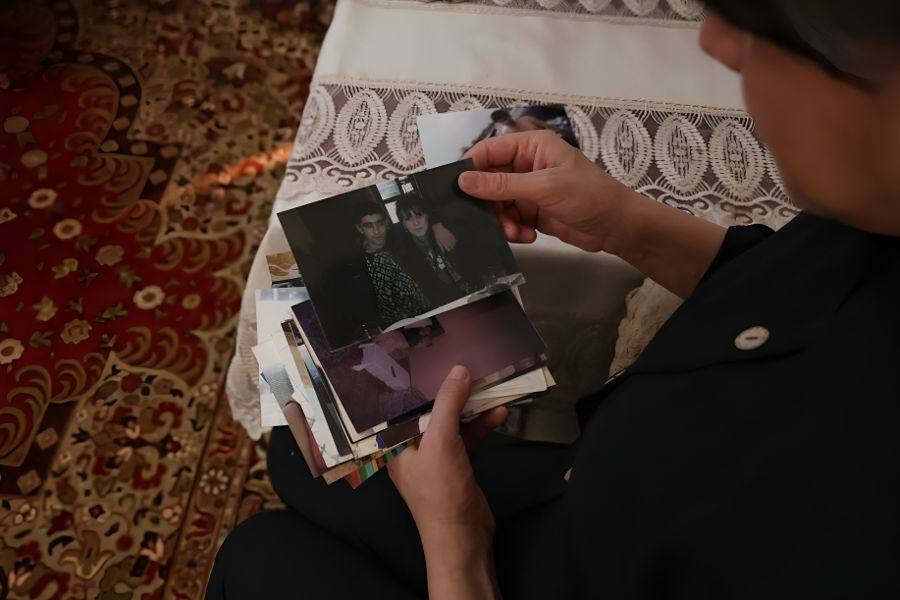
Before leaving, Lusine managed to take a few photographs and her husband’s warm jacket, which she now wears herself. “I was rummaging through our photo album, taking out the photos that had Albert in them. As if I wanted to take his memory with me.”
After arriving in Stepanakert, Lusine tried desperately to obtain any information about her husband and brother-in-law. The family continued hoping for news until Sept. 29. During that time, Lusine went to the Red Cross office and contacted Albert’s battalion commander. “He told me that Albert has either been captured or killed,” she recalled. “He knew that area by heart. If he didn’t come out, then something happened.”
Albert’s position was between the villages of Sznek and Karmir. Search operations were conducted in the area several times, but no trace of either Albert or Marat was found.

After arriving in Stepanakert, Lusine tried desperately to obtain any information about her husband and brother-in-law. The family continued hoping for news until Sept. 29. During that time, Lusine went to the Red Cross office and contacted Albert’s battalion commander. “He told me that Albert has either been captured or killed,” she recalled. “He knew that area by heart. If he didn’t come out, then something happened.”
Albert’s position was between the villages of Sznek and Karmir. Search operations were conducted in the area several times, but no trace of either Albert or Marat was found.

After her husband and brother-in-law went missing, Lusine contacted every other organization dealing with missing persons. Both men’s names appear on official lists. To date, the Azerbaijani side has provided no information. “We’ve tried everything,” Lusine explained. “We even appealed to international courts, but in vain.”

What would Albert feel if he knew he’d become a father?
After getting married, Lusine and Albert shared one dream: to bring the fruit of their love into the world. For 15 years, all attempts were unsuccessful. The couple underwent repeated treatments in Armenia.
Just days before the blockade began, they finally received hopeful news. Everything was ready for in vitro fertilization (IVF)— only the embryo transfer remained. But the blockade forced them to postpone. “After the 44-day war, we made a final decision to pursue IVF and started a new course of treatment,” Lusine reflected. “Each examination took months, we had complications. We were supposed to go for the transfer on Dec. 8, but had to postpone for a few days. Then, the blockade started.”

One year after Albert’s disappearance and her relocation to Armenia, Lusine decided to proceed with the embryo transfer in March 2024. The attempt was unsuccessful. The hospital would call saying everything was ready, but she wasn’t ready yet. “I realized I would never be psychologically ready,” she explained. “A year later, I proceeded to the final stage of transfer without Albert. I knew he would want this. We still had several frozen embryos; one of the attempts was unsuccessful, but I didn’t lose hope.”
A year later, in March 2025, Lusine underwent another transfer. This time, it succeeded. After learning about the child, Lusine decided the child should bear her husband’s name. “During the last transfer, I had an inner confidence that it would work. I had initially decided on the child’s name. If it was a boy, I would name him Albert, but since I was going to have a daughter, I decided to name her Albertina,” she explained.

Lusine had a very difficult pregnancy. Little Albertina was born by cesarean section on Dec. 1. Lusine does not speak about her husband in the past tense. Since Albertina’s birth, she said she feels Albert’s presence even more strongly.
The family continues to remember both Albert and Marat. Each year, they gather on their birthdays — August 22 for Albert and June 20 for Marat — just as they always did.
Lusine said she knows both her husband and brother-in-law well. “It’s impossible that they were killed.” She paused. “We live with hope in our hearts that we will see each other again.”