Russia’s Humanitarian Response to the Armenian Genocide
Asya DarbinyanMay 20, 2016Last Updated: February 14, 2022
9 19 minutes read
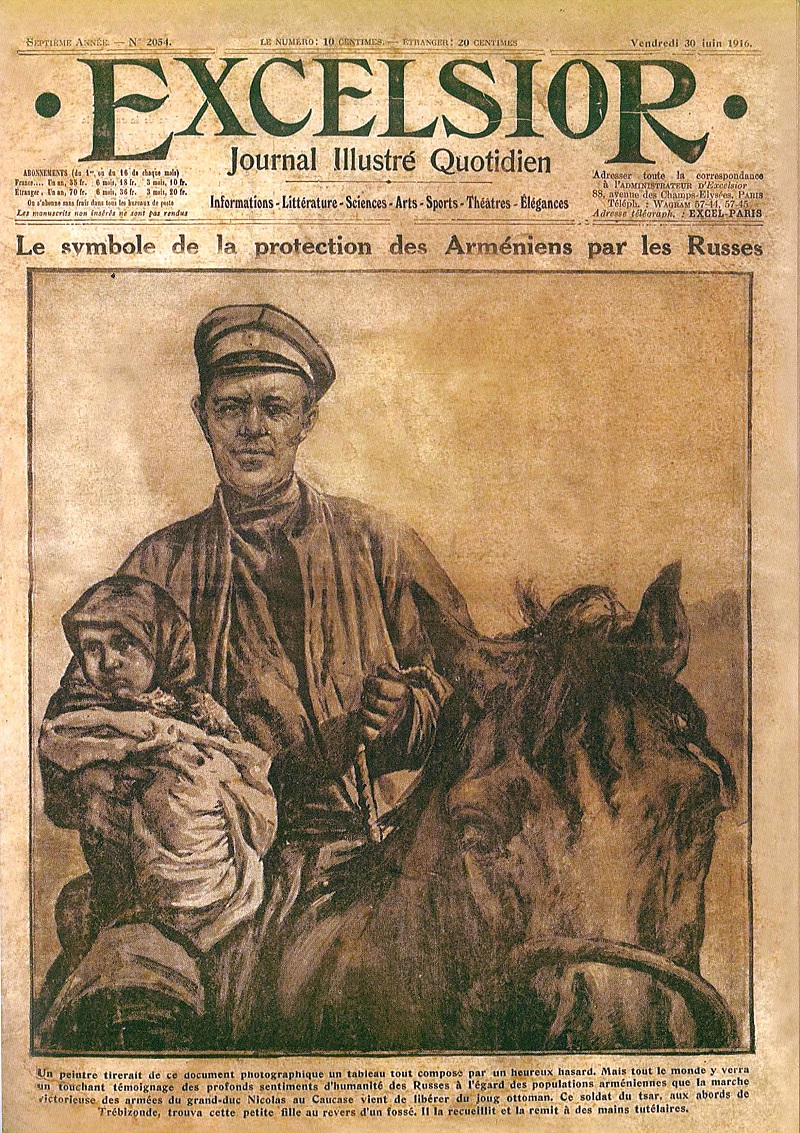
Cover of the June 30, 2016 issue of 'Excelsior' carried an illustration of a Russian soldier on horseback with a refugee child in his arms. The picture was captioned, ‘The Symbol of Protection of the Armenians by Russians.’
Humanitarianism and the Refugee Crisis on the Caucasus Battlefront During World War I
The Armenian Weekly Magazine
April 2016
Introduction
The front page of the June 30, 1916 issue of th
Dr. Asya Darbinyan is the Executive Director of Chhange (Center for Holocaust, Human Rights & Genocide Education). She earned her Ph.D. in history from the Strassler Center for Holocaust and Genocide Studies at Clark University. Prior to joining Chhange, Dr. Darbinyan worked as a Visiting Professor at the Strassler Center, where she taught courses on Genocide and Women, the Armenian Genocide, the History of Armenia and the History of Genocide. Dr. Darbinyan’s research and teaching expertise stand at the intersection of Armenian history, the history of the Russian Empire, genocide, refugees and humanitarian interventions, with a focus on the agency and actions of refugees in addressing their suffering and plight. Dr. Darbinyan is the recipient of multiple scholarships and grants: most recently, the Aurora Humanitarian Initiative’s Vartan Gregorian Scholarship to revise and expand her dissertation into a book manuscript. Dr. Darbinyan has also worked as a Postdoctoral Scholar at the Martin-Springer Institute, Northern Arizona University (NAU), a Fellow in Holocaust and Genocide Studies at Stockton University, and the Deputy Director of the Armenian Genocide Museum-Institute in Yerevan, Armenia.
Note to author/editor: there is a typographical error in the following portion of the text “organized an arts night in Marinskii Palace on March 29, 1915,” –> “Marinskii” should be spelled “Mariinsky” or “Mariinskiy”
Very impressive and interesting article, I thank the author sincerely. I always loved our Russian big brothers for helping our people in the past and up to the present. Without Russian help our people would have suffered more casualties or perhaps would have disappeared from the Eastern Armenia region. Thank you to all Russians. GOD BLESS ARMENIANS AND ALL RUSSIANS.
I enjoyed reading this interesting article. The topic is new and original. I look forward to see her dissertation published in a book form to serve as a worthy addition to the Armenian Genocide literature. My compliments to Asya Darbinyan.
Bravo! Bravo! Bravo!
…to Asya Darbinyan and all students who explore issues related to Hye Tad.
…to Prof. Taner Akcam, and all others who have the courage to support these endeavours.
I thank you all.
I am glad that this article was written. More of Russia’s instances of humanitarianism need to be documented and presented to the world. Unfortunately, most of the world only sees Russia and Russians as being heartless and cold brutes. These historical instances prove otherwise.
I am very much pleased that Assya’s research has brought to light far more attention to detail regarding horrid experiences of the fleeing Armenians murdered in cold blood in the Caucus region of Russia. Far too often the world sees Russia as an antagonistic Bear keen to wreak havoc on the weak and vulnerable.
This certainly is great news for those considering the ongoing geopolitical issues and rhetoric pertaining to the ongoing Ukrainian-Russia stalemate crisis.
Undoubtedly though, much more needs to be done in respect of the Armenian Genocide ‘blaming and shaming’ debate for record, and benefit to historical and modern Human Rights knowledge development and awareness, globally. Assya has shown a fresh and brighter light on an area of the Armenian Genocide not usually talked about in such detail, or at all, within the usual debates.







excellent analysis
Excellent article.
Note to author/editor: there is a typographical error in the following portion of the text “organized an arts night in Marinskii Palace on March 29, 1915,” –> “Marinskii” should be spelled “Mariinsky” or “Mariinskiy”
Very impressive and interesting article, I thank the author sincerely. I always loved our Russian big brothers for helping our people in the past and up to the present. Without Russian help our people would have suffered more casualties or perhaps would have disappeared from the Eastern Armenia region. Thank you to all Russians. GOD BLESS ARMENIANS AND ALL RUSSIANS.
I enjoyed reading this interesting article. The topic is new and original. I look forward to see her dissertation published in a book form to serve as a worthy addition to the Armenian Genocide literature. My compliments to Asya Darbinyan.
Bravo! Bravo! Bravo!
…to Asya Darbinyan and all students who explore issues related to Hye Tad.
…to Prof. Taner Akcam, and all others who have the courage to support these endeavours.
I thank you all.
Very nice article, Asya. You are tackling an aspect of the 1915 Genocide that has not heretofore been well-documented in English.
Very interesting article, deep analysis, keep up the good work Assya and good luck.
I am glad that this article was written. More of Russia’s instances of humanitarianism need to be documented and presented to the world. Unfortunately, most of the world only sees Russia and Russians as being heartless and cold brutes. These historical instances prove otherwise.
I am very much pleased that Assya’s research has brought to light far more attention to detail regarding horrid experiences of the fleeing Armenians murdered in cold blood in the Caucus region of Russia. Far too often the world sees Russia as an antagonistic Bear keen to wreak havoc on the weak and vulnerable.
This certainly is great news for those considering the ongoing geopolitical issues and rhetoric pertaining to the ongoing Ukrainian-Russia stalemate crisis.
Undoubtedly though, much more needs to be done in respect of the Armenian Genocide ‘blaming and shaming’ debate for record, and benefit to historical and modern Human Rights knowledge development and awareness, globally. Assya has shown a fresh and brighter light on an area of the Armenian Genocide not usually talked about in such detail, or at all, within the usual debates.