


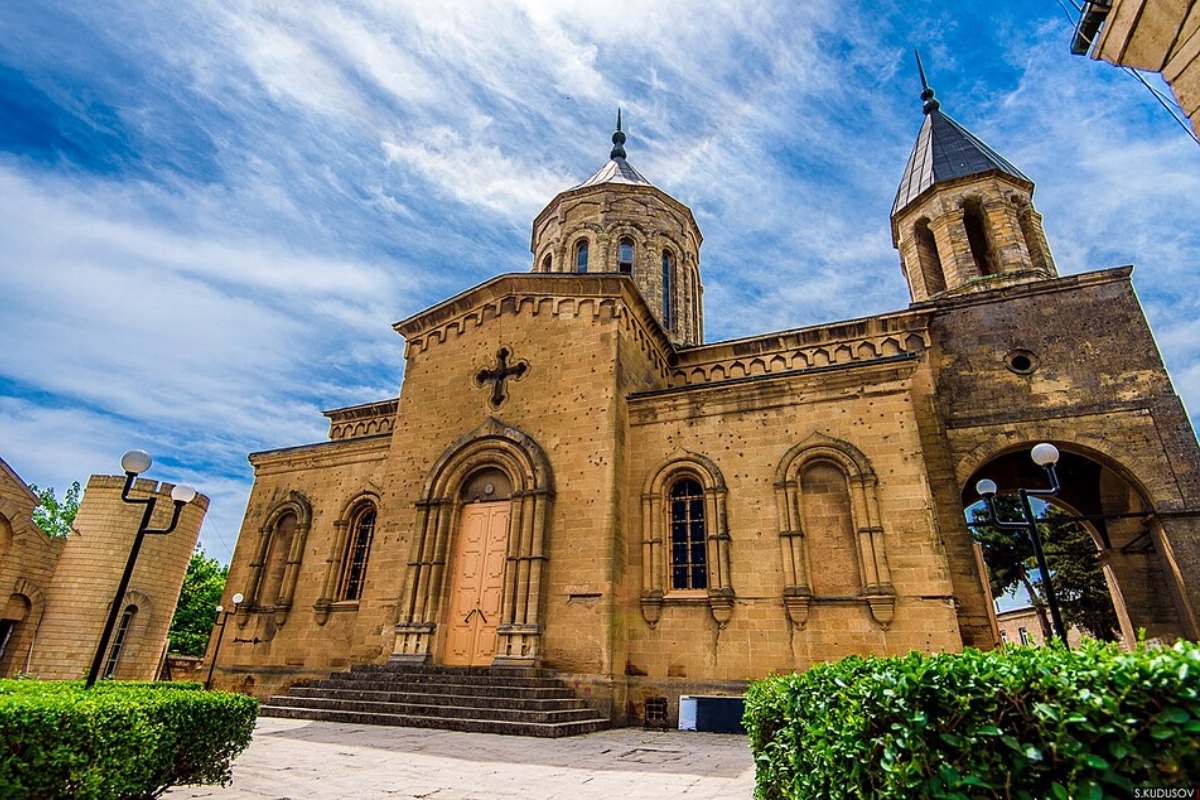
Among the numerous ancient architectural monuments of Derbent, there is one whose history remains largely unknown to the general public: the Armenian Church of the Holy Savior, Surp Amenaprkich, an outstanding monument of 19th-century Armenian religious architecture located in the historic heart of the city.
Today, few realize that the project was designed by the prominent Armenian democratic writer, Gabriel Sundukyan (1825-1912), the founder and foremost representative of realistic Armenian drama. The history of the church’s creation stands as a vivid testament to the multifaceted nature of his talent. Sundukyan’s subsequent fame as a writer, playwright, public figure and theater organizer almost entirely eclipsed his contributions to architecture.
Sundukyan developed the church design during his exile in Derbent in the 1850s. Built in the city’s historic Armenian quarter on the site of an earlier chapel, construction began around 1860 and was completed in 1871. A bell tower was later added to the structure in 1888.
Constructed from meticulously dressed local coquina limestone, the church integrates seamlessly into the architectural ensemble of ancient Derbent, a city renowned for its unique stone structures. The building represents a classic example of Armenian cross-domed architecture. At the center of the interior space, four massive stone pillars support the 12-sided drum of the main dome.
The monument’s origins are directly tied to Sundukyan’s personal destiny. In 1853, after graduating from St. Petersburg University a few years earlier, defended his thesis and serving as a translator in the chancellery of the governor-general of the Caucasus region in Tiflis, the young intellectual was dismissed for “free-thinking.” By order of the viceroy of the Caucasus, Count M.S. Vorontsov, he was exiled to Derbent under the command and supervision of Military Governor Minckwitz. Sundukyan was appointed head of a department within the Derbent governor’s chancellery, ultimately spending five years in the city.

Sundukyan’s tenure in Derbent left a notable mark on the city’s history. By virtue of his position, he maintained direct contact with the local population and supervised construction and urban development projects, utilizing technical knowledge acquired in St. Petersburg.
Energetic and resourceful, the young Sundukyan accomplished much for the improvement of ancient Derbent. His name is associated with the architectural designs of several buildings, the landscaping of the city square and various streets, and the installation of a city clock on the central square, which even then chimed every 15 minutes.
During the Russian Civil War (1917-1922), the church suffered severe damage, resulting in the destruction of its dome and bell tower. In 1975, the building was recognized as an architectural monument under state protection. A comprehensive restoration followed between 1976 and 1982, including the reconstruction of the lost architectural elements.
Relatively little material has been published regarding the Derbent period of Sundukyan’s life. Galina Musakhanova, a senior researcher at the Institute of History, Language and Literature of the Dagestan Branch of the USSR Academy of Sciences in the 1970s, corresponded on this matter with the Armenian Studies Center at Yerevan University. I was stationed in Derbent in 1979. It is highly symbolic that 125 years later, this very church — which remained inactive during the Soviet era — was scheduled to open as an art museum.
During our meeting, Galina Musakhanova expressed regret that Sundukyan’s letters from his Derbent period had not been sufficiently studied and that many had not been published. At that time, in the late 1970s, preparations for the museum’s opening were nearing completion. She believed it was only just to perpetuate the memory of the famous writer, who had also proven himself a talented architect. However, even the Derbent Museum of Local Lore failed to reflect the facts surrounding Sundukyan’s stay in the city, despite the subsequent successful staging of his play “Pepo” on the stages of Dagestan’s national theaters.
Currently, the Church of the Holy Savior is part of the Derbent State Historical-Architectural and Archaeological Museum-Reserve and is home to the Museum of Carpets and Decorative and Applied Arts. At the same time, the temple has not completely lost its religious significance; since 2009, the Armenian community of Derbent has periodically held religious services, baptisms and weddings here.
As part of the historic center of Derbent, the church is located within the boundaries of a UNESCO World Heritage Site, underscoring its exceptional historical, architectural and cultural value.
Why, after so many years, have I found it necessary to write about this? In early 2026, devastating floods affected Derbent over the course of several months. A legitimate question arises: What has become of the Church of the Holy Savior? Did this unique architectural monument suffer damage? What condition is it in today?
The purpose of this article is to once again draw attention to this outstanding monument of Armenian historical and cultural heritage, inextricably linked to the name of Gabriel Sundukyan. Even though the church is under state protection and forms part of a UNESCO World Heritage Site, its preservation requires constant vigilance and international cooperation. It is essential that the government of the Republic of Armenia, the Armenian Apostolic Church and the state authorities of the Republic of Dagestan unite their efforts to monitor, preserve and promote this unique monument, which holds exceptional significance for the history of Armenian culture and architecture.
P.S. In contrast to these preservation efforts, Turkey and Azerbaijan are currently pursuing a policy of systematic destruction of Armenian cultural and historical heritage on ancient Armenian lands.
Against this backdrop, the stance of Dagestan deserves special recognition. Despite the fact that the republic is a predominantly Muslim region, the local community and leadership took an active part in the preservation and reconstruction of this unique monument of Christian architecture.