


ANC-International publishes updated paper on Artsakh conflict
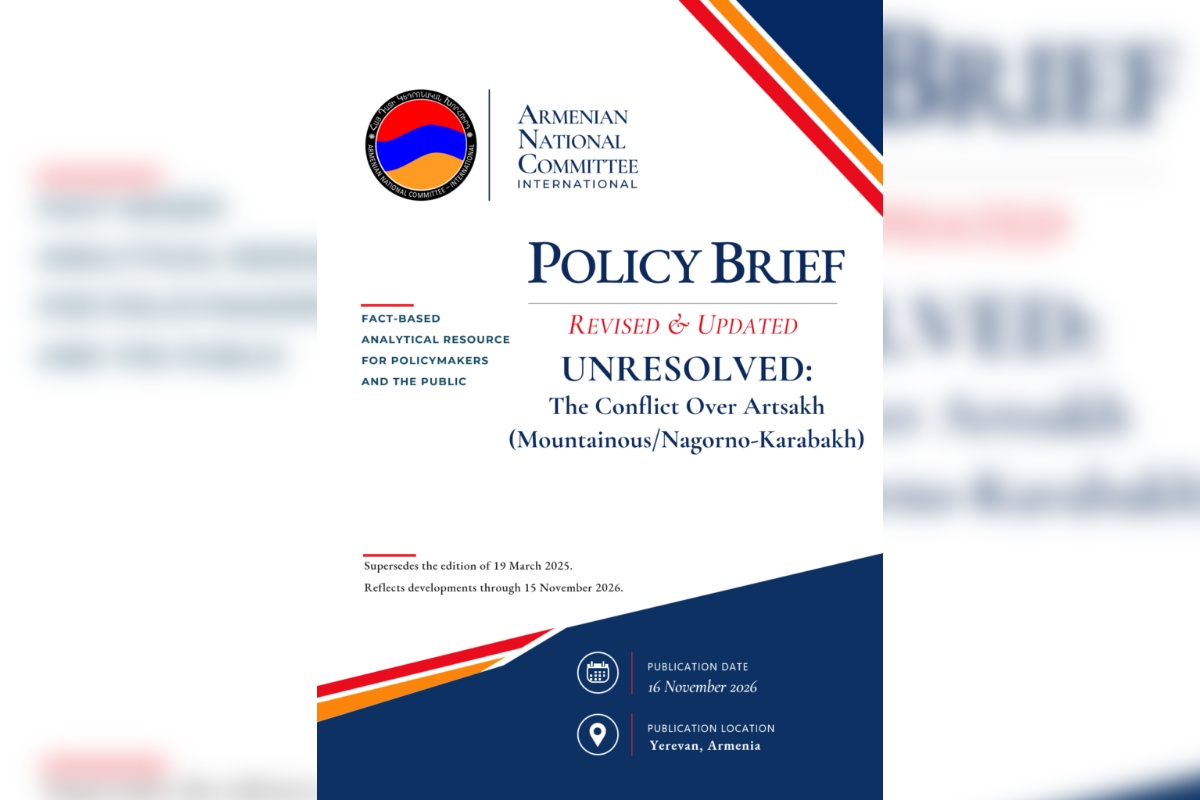
The Armenian National Committee-International (ANC-International) published an updated edition of its advocacy paper “UNRESOLVED: The Conflict Over Artsakh (Mountainous/Nagorno-Karabakh).” The new edition revises the paper of March 19, 2025, and documents what has happened to Artsakh and its people since then.
Three years after Azerbaijan’s blockade and military offensive forced more than 100,000 Armenians from their homeland, the paper concludes that the conflict remains unresolved. Military force changed who controls the territory. It did not settle the rights of the people who lived there.
What the update finds:
- Recognition without guarantees. In Prague on Oct. 6, 2022, and explicitly in May 2023, the Armenian government recognized Nagorno-Karabakh as part of Azerbaijan without any agreed guarantee for its people. The agreement initialed in Washington on Aug. 8, 2025, is silent on their right of return, security, property and heritage, and on the Armenian hostages. It remains unsigned as Azerbaijan adds new preconditions, including a change to Armenia’s Constitution.
- No international format. The OSCE Minsk Process was closed on Nov. 30, 2025, leaving no internationally mandated format in which the rights of the Armenians of Artsakh are on the agenda.
- A government in retreat. The Armenian government has declared the return “not realistic” and the Karabakh movement closed, and it has moved against Artsakh’s representative institutions in exile.
- Hostages and sham trials. Azerbaijan holds 20 Armenian hostages, including eight former leaders of Artsakh sentenced to life or 20 years after trials that fell far short of international standards, and it has cut them off from independent access.
- Erasure. Stepanakert’s Holy Mother of God Cathedral and other churches and memorials were destroyed in 2026 in breach of binding orders of the International Court of Justice, while Azerbaijan presents Armenian monasteries to foreign diplomats as “Caucasian Albanian.”
- Displacement entrenched. Some 150,000 Armenians have been forced from Artsakh since 2020. Azerbaijan is repopulating the region with its own citizens while denying the Armenians their right of return and the displaced face growing hardship in Armenia.
“The expulsion of the Armenians of Artsakh did not end the conflict; it compounded the injustice,” said Hagop Der Khatchadourian, chairman of ANC-International. “No agreement that leaves 20 hostages in Baku, closes the road home and erases a people’s heritage can be called peace. We call on governments to treat Artsakh as the unresolved issue it is, and to put the rights of its people back on the international agenda.”
What ANC-International calls for:
The paper closes with 13 demands addressed to Azerbaijan, the international community and the government of Armenia. Among them:

- the immediate and unconditional release of all 20 Armenian hostages and, until then, independent humanitarian access to them, and a full accounting for the disappeared and the missing;
- the collective, safe and dignified return of the Armenians of Artsakh under international guarantees, with protection of their property, identity and heritage, as the International Court of Justice has ordered;
- a new internationally mandated format, under the OSCE or the United Nations, with Artsakh’s own elected representatives at the table, and the convening of the peace forum mandated by the Swiss Parliament;
- accountability rather than impunity, with no settlement that extinguishes the claims of the displaced and the detained;
- protection of Armenian heritage, including an independent UNESCO mission, and no legitimization of its reattribution;
- the withdrawal of Azerbaijani forces from the sovereign territory of the Republic of Armenia and an end to Azerbaijan’s preconditions; and
- from the government of Armenia, a defense of these rights, an end to pressure on Artsakh’s institutions, and a long-term policy for the displaced population.
The updated paper traces the conflict from its origins to the present, with every factual statement referenced to numbered sources.