Selected research papers from the Armenian Students for Artsakh competition
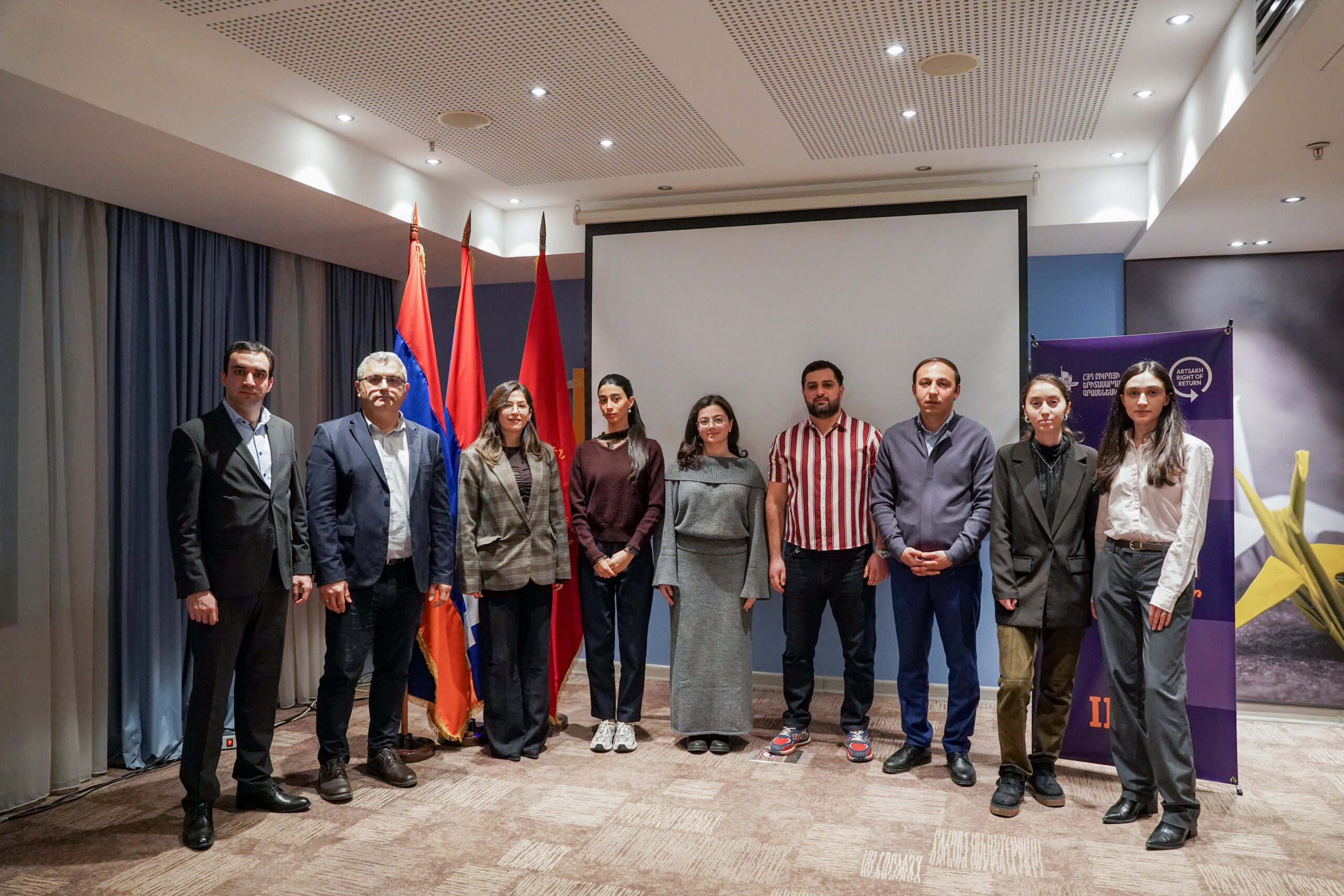
At the initiative of the ARF Bureau Youth Office, the second edition of the “Armenian Students for Artsakh” research competition was held in 2025-2026, bringing together several dozen students from countries around the world. The primary objective of the program is to unite Armenian students around the right of return of the people of Artsakh, taking into account the urgency of the issue and recognizing the need to direct the professional potential of Armenian students toward advancing this cause.
This article presents the summaries of the five top-ranked research papers from the 2025-2026 “Armenian Students for Artsakh” competition, including the first-, second- and third-place winners.
Stella Pashyan of the United States, recipient of the competition’s first scholarship prize, authored the research paper “The Right of Return: Artsakh Armenians, the Indigenous People of Nagorno-Karabakh.” Academic adviser: Dr. Kevork Hagopjian, Esq., Ph.D. in international law and member of the Armenian Legal Center’s Board of Directors in the United States.
The right of return: Artsakh Armenians the Indigenous people of Nagorno-Karabakh
Introduction
The initial Nagorno-Karabakh War occurred roughly around 1988 to 1994 and was considered an Armenian victory. Another Nagorno-Karabakh War occurred in 2020 and lasted for 44 days and was considered an Azerbaijan victory. In Sept. 19, 2023, Azerbaijan enacted another military offensive against Nagorno-Karabakh, considered to be ethnic cleansing, leading to forced displacement and casualties of all the ethnic Armenians in the area.

The current research question explores whether Artsakh Armenians have the right to return to the land, Nagorno-Karabakh, they were forcibly displaced from. Is the right to return applicable to Artsakh Armenians in Nagorno-Karabakh? I argue that Artsakh Armenians have a right to return to Nagorno-Karabakh lands due to the right of return being the main condition to respect the right to land of Indigenous peoples.
Literature review
Defining the Artsakh Armenians in Nagorno-Karabakh as Indigenous people is essential to our argument. The qualifications to be considered an Indigenous people are: “(1) historical continuity with pre-invasion and/or pre-colonial societies that developed on their territories, (2) cultural distinctiveness, (3) non-dominance, and (4) a determination to preserve, develop, and transmit to future generations their ancestral territories and identity as people in accordance with their own cultural patterns, social institutions and legal system” (Panossian, 2024, pg. 154). Artsakh Armenians have historical continuity, cultural distinctiveness, non-dominance and they self-identify as an Indigenous group to the Nagorno-Karabakh region (Panossian, 2024).
According to Article 26 of the Universal Declaration of the Rights of Indigenous People (UNDRIP), “Indigenous peoples have the right to the lands, territories and resources which they have traditionally owned, occupied or otherwise used…” (A/RES/61/295., 2007, pg. 8).
The right of return is protected under human rights law in the Universal Declaration of Human Rights, the International Covenant on Civil and Political Rights, and the International Convention on the Elimination of All Forms of Racial Discrimination (Zedalis, 1992). Applying the right of return to Indigenous peoples, Article 10 of the UNDRIP states that “Indigenous peoples shall not be forcibly removed from their land or territories… with the option of return” (A/RES/61/295., 2007, pg. 5).
Methodology
The research design is qualitative, and data collection will be through archival research. The theory will be supported by a legal foundation through evidence collected from primary resources, such as UN legal documents. This will explain why Artsakh Armenians have the right of return to Nagorno-Karabakh lands under international law, through Indigenous people’s rights and the right to self-determination.
Analysis
Artsakh Armenians are considered an Indigenous people to the Nagorno-Karabakh lands under the Cobo factors. Artsakh Armenians follow the four factors: historical continuity, cultural distinctiveness, and a determination to preserve their ancestral lands.
Land rights and the right of return are clearly defined as rights in the UNDRIP in Articles 26 and 10. The right of return is also implied through the land rights defined in the UNDRIP.
An example of support for the right of return of Artsakh Armenians is the UN International Court of Justice mandating that Azerbaijan guarantees the right of Artsakh Armenian refugees to return to their homeland in Nagorno-Karabakh in November 2023, Case Number 180 Application of the International Convention on the Elimination of All Forms of Racial Discrimination (Armenia v. Azerbaijan), document number 180-20231117-ORD-01-00-EN. The right of self-determination is also closely linked to the right to land and can be used to continue justifying the right of return for Artsakh Armenians.
Discussion and conclusion
Artsakh Armenians meet all the criteria and therefore are an Indigenous people, meaning all of the rights in the UNDRIP can be applied to the Artsakh Armenians. We specifically isolated the right to land and the right of return highlighted in Article 26 and Article 10 of the Declaration.
The right of self-determination justifies the right of return, and the ICCPR highlights that self-determination is a right that Indigenous people possess. The counterargument that territorial integrity interferes with Indigenous self-determination is refuted under UNDRIP Article 46.
This research was therefore significant because it protects Artsakh Armenians’ right to return to their Indigenous lands and ensures their freedom and rights through international pathways. The right to return is applicable to Artsakh Armenians due to it fulfilling Indigenous people’s right to land through the mechanism of self-determination, which is justified by the right to land and strengthens the right to return. The caveat to this, and something to further explore, is the difficulty of enforcing a feasible right of return and the safety of Artsakh Armenians.
Liana Pohanian of France, recipient of the competition’s second scholarship prize, authored the research paper “What Is Hindering the Implementation of the Right of Return for Displaced Persons From Artsakh, Despite the Guarantees Provided by International Law?” Academic adviser: Dr. Philippe (Raffi) Kalfayan, Ph.D. in international law, legal counsel, associate researcher and lecturer at University of Paris Panthéon-Assas in France, with the honorable participation of Minister of State Artak Beglaryan and Artsakh Representative in France Hovhannes Guevorkian.
What is hindering the implementation of the right of return for displaced persons from Artsakh, despite the guarantees provided by international law?
The right of return is a fundamental right guaranteed by international humanitarian law, which affirms that no one may be arbitrarily prevented from returning to their own country.1 Article 13(2) of the Universal Declaration of Human Rights and reaffirmed in Article 12(4) of the International Covenant on Civil and Political Rights This right of return arises in the context of the conflict over the enclave of Nagorno-Karabakh (Artsakh), located in the South Caucasus. The origin of the dispute dates back to 1921, when J. Stalin assigned Nagorno-Karabakh to the Soviet Socialist Republic of Azerbaijan, under the status of autonomous oblast (NKAO), despite its Armenian predominance. The conflict has its roots in demands for self-determination that were first voiced in 1988. It led to a bloody war in 1991 after the collapse of the USSR, followed by a ceasefire in 1994, when Artsakh became a de facto self-proclaimed independent republic. In 2020, war broke out again and has so far resulted in an Azerbaijani victory and a major territorial setback for the Armenians. The blockade imposed in 2022, followed by the military offensive in September 2023, led to a mass displacement of the Armenian population from their land and the dissolution of the Republic of Artsakh on Jan. 1, 2024. Despite widespread international condemnation, no effective measures have ensured the return of displaced people. This paradox raises a central question: What prevents the implementation of the right of return for Artsakh’s displaced population despite its clear recognition under international law?
A legally recognized but structurally ineffective right of return
The right of return for forcibly displaced persons rests on a robust international legal framework, closely linked to the right of peoples to self-determination.2 Article 1 of the International Covenant on Civil and Political Rights: self-determination presupposes the ability of a population to remain on or return to its territory in order to exercise collective political agency. Despite this clear normative framework, the Artsakh case illustrates a persistent gap between legal recognition and practical enforcement, revealing the structural limitations of international law.
Guarantees affirmed by international law
International humanitarian and refugee law explicitly prohibit forced displacement and require return in safe and dignified conditions.3Article 49 of the Fourth Geneva Convention bans forcible transfers and mandates return once hostilities cease, while Article 147 classifies unlawful deportation and destruction of civilian property as grave breaches. Under the 1951 Refugee Convention, as expanded by the 1967 Protocol, displaced Artsakhtsis qualify as refugees entitled to durable solutions. International jurisprudence reinforces these obligations. In Sargsyan v. Azerbaijan (2015), the European Court of Human Rights held Azerbaijan responsible for ongoing violations of displaced persons’ rights despite security arguments. The Pinheiro Principles (2005) further affirm the right to voluntary return and property restitution. Nevertheless, as illustrated by Cyprus v. Turkey (2001), the effectiveness of the right of return ultimately depends on political will, exposing a structural disconnect between legal guarantees and their implementation.
The absence of binding enforcement mechanisms
Although recognized internationally, the right of return is not self-enforcing and remains dependent on state cooperation and political will. International judicial bodies4 Including the ECHR and U.N. mechanisms. lack effective coercive powers, and their decisions are often left unenforced. Comparative cases such as Palestinian refugees and the Chagos Archipelago illustrate this structural gap.
The marginalization of the Artsakh issue in international forums
Since the 1994 ceasefire, the Artsakh issue has been largely marginalized in international forums. The decline and formal dissolution of the OSCE Minsk Group in 2025 left no multilateral framework capable of addressing security guarantees or the right of return. Geopolitical and economic interests have further weakened international engagement. Since 2022, Azerbaijan has been reinforced as a strategic energy partner for the European Union, while Russia’s influence has receded. Despite the mass displacement of Armenians in 2023, reactions have remained largely declaratory, with no sanctions or coercive measures adopted. This prioritization of energy security and regional stability over legal obligations shows that the right of return is politically inconvenient and effectively unenforceable.
A hostile geopolitical context and a hidden annexation strategy
Baku’s refusal to consider an Armenian return
Azerbaijan has consistently refused any Armenian return under conditions excluding its political or security control, despite repeated international warnings. The blockade of the Lachin corridor (2022-2023) and the subsequent September 2023 military offensive deliberately created humanitarian conditions forcing the Armenian population to flee. Despite an International Court of Justice order requiring the unimpeded movement of people and goods, and alerts from international bodies warning of genocidal risks, Baku maintained its strategy. This policy of blockade, intimidation and force reflects a deliberate intent to render Armenian return impossible and consolidate irreversible control over Nagorno-Karabakh.
Detention of prisoners as a means of intimidation
Azerbaijan uses the arbitrary detention of Armenian political figures and civilians as a strategy of intimidation aimed at deterring any return to Artsakh. The continued imprisonment of Artsakh representatives, conducted without fair trial guarantees and following the expulsion of the ICRC, sustains a climate of fear among displaced Artsakhtsis. Such practices5 Prohibited under Article 34 of the Fourth Geneva Convention and qualified as war crimes under the Rome Statute function as political leverage rather than lawful prosecution. By signaling that return would expose Armenians to arrest and prosecution, these detentions constitute a direct and deliberate obstacle to the effective exercise of the right of return.
The absence of mediators or protectors
The right of return is further undermined by the absence of credible international mediators. Russian peacekeeping mechanisms collapsed after 2020, while Western actors, constrained by geopolitical rivalries and energy interests, adopted a largely passive stance. Simultaneously, active military support to Azerbaijan by third states eliminated any possibility of impartial mediation, leaving displaced Artsakhtsis without effective protection.
An enterprise of cultural erasure making return materially and symbolically difficult
Destruction of Armenian heritage: a deliberate strategy
The systematic destruction and denial of Armenian cultural heritage in Artsakh constitutes a strategy of cultural erasure aimed at preventing return. Condemned by the European Parliament and documented by independent monitors, the destruction of churches, cemeteries and monuments eliminates both material traces and symbolic anchors of Armenian presence, making return unsafe, illegible and politically undesirable.
Rewriting the territory and eliminating traces of Armenian identity
Azerbaijan systematically erases Armenian traces in Artsakh by renaming streets, banning Armenian script and appropriating property, to intimidate displaced populations and make return unthinkable. This policy of demographic and symbolic erasure, reinforced by official rhetoric, ensures Armenians cannot safely or peacefully reclaim their homes.
A will to erase demographically and psychologically
Azerbaijan’s policies aim to cement the forced exodus of Armenians and erase Artsakh’s population through demographic, territorial and political measures. Multilateral normalization agreements, without guarantees for sovereignty, security or prisoner release, risk legitimizing ethnic cleansing and make the right of return practically impossible.
Sofia Aydinyan of Russia, recipient of the competition’s second scholarship prize, authored the research paper “Comparative Analysis of Precedents for the Implementation of the Right of Return of Forcibly Displaced Persons and Lessons to Be Learned: The Specificities of the Issue of the Artsakh Armenians (If Any).” Academic adviser: Karnig Kerkonian, international lawyer and expert in international law in the U.S.
Comparative analysis of precedents for the implementation of the right of return of forcibly displaced persons and lessons to be learned: The specificities of the issue of the Artsakh Armenians (if any).
Finding real opportunities to implement the right of return of forcibly displaced persons through economic negotiations and building new international partnerships.
This research paper examines the implementation of the right of return of forcibly displaced Armenians from Artsakh by shifting from a traditional narrative based on law and historical arguments to a framework of economic negotiations. The central research question explores whether Artsakh can be conceptualized as a strategic asset to be influenced through complex international deals, rather than reclaimed through moral appeals. The findings indicate that the territory is now firmly integrated into Azerbaijan’s economic sphere as a valuable asset of natural resources and transit corridors, offered to international partners who prioritize stability and profit over legitimacy. It is emphasized that Armenia’s leverage lies in reorienting its own strategy: offering tangible value through infrastructure projects like the Syunik corridor, energy diversification and professional lobbying to make the Armenian cause align with the economic interests of powerful global actors. Justice, the article argues, must be made profitable to become politically viable.
In order to delve deeper into the topic, we conducted two interviews: one with Samvel Shahbazian, orientalist, specialist in international relations and global studies, and the second with Karapet Nalbandian, a lawyer, researcher at the Institute of Asian and African Countries of Moscow State University and a Ph.D. candidate at the Faculty of Global Processes of Moscow State University.
The researchers shared their vision of the problem and possible ways to solve it. Sharing many of each other’s conclusions, each participant in the interview brought their own unique perspective, which helped to create a complete picture of what is happening and the prospects for the return of Armenians to Artsakh and Artsakh to Armenia.
The questions were divided into three blocks: Geopolitical analysis. International context; Analysis of Artsakh as an “asset” (What have we “lost”). Parties involved and their motivations; Strategic implications for Armenia. The readers have the opportunity to read clear and bold answers from experts, where Karapet focuses mainly on the theoretical and legal basis of the issue and Samvel adds a modern point of view on geopolitics and practical advice for building an Armenian strategy toward Artsakh.
The proof of these professionals’ words was found in a real-life case. We explored how a British company benefited from Artsakh lands and built wealth that could be Armenian but was overlooked and neglected. From the case of Anglo Asian Mining PLC studied in the paper, it is clear that Azerbaijan’s long-term agreements with the company have become the basis for support in gaining control over Artsakh. At the same time, the potential business opportunities prompted the counterparty to resort to blatantly unethical methods of influence. Analyzing such cases, we should not blindly follow the experience of Azerbaijan surrounded by economic allies of different quality. We must separate important and useful lessons from cruel practices that, going back to our DNA, contradict our Christian identity and basic morality. The main takeaway from this case for Armenians is to realize the importance of trusting fruitful cooperation and to learn not only to ask for protection, but also to be truly useful.
The present study gives the reader an idea of, one may think, an unfair but objective reality: the fate of territories is mainly determined not by historical right or moral appeal, but by economic value and strategic utility. The case of Artsakh is a tragic testament to this thesis. As the expert interviews and the legal case study of Anglo Asian Mining PLC clearly illustrate, Azerbaijan learned this lesson well and, in addition to paying attention to building the image of a reliable partner, it competently “packaged” its offer on Azerbaijani Karabakh to foreign counterparties, presenting the territory as a valuable and attractive asset, rich in both natural resources and transit potential.
Yerevan needs to conduct a revision of its policy and base it on pragmatic calculations and the establishment of economic ties. As the experts explain, Karabakh now is a universally recognized asset under the control of Baku, actively integrating into global energy and logistics chains. Therefore, Armenia’s levers of influence lie not in appealing to history, but in the strategic representation of its own undervalued assets. This new strategy directly depends on the transformation of the established patterns of state behavior. No complex multilateral deal will be possible without stable institutions, professional management and an appropriate state image.
Moreover, the diaspora should be mobilized from a cultural network into a powerful force for professional lobbying and deal negotiations. Justice for the displaced Armenians of Artsakh must be transformed into a proposal that meets the economic and strategic interests of external players. The goal should be to make Armenia so indispensable as a security, trade and energy hub that its influence grows, thereby creating future opportunities for negotiations from a position of strength.
Giving parting words, we insist that our victory will not be in attempts to imitate Europe, the United States or Russia in the desire for being seen and accepted, but in patient, methodical steps, which, if not now and not in 10 years, but perhaps in a few generations, will allow our children to grow up in their native land and be present in the place where the Armenian spirit can be found in every tree and handful of soil.
Vika Kafyan and Erika Kafyan of Artsakh, recipients of the competition’s third scholarship prize, authored the research paper “The Importance and Practical Possibilities of Preserving Artsakh’s Historical and Cultural Heritage Within the Framework of the Right of Return.” Academic adviser: Lernik Hovhannisyan, former minister of culture, youth affairs and tourism of the Republic of Artsakh.
The importance and practical possibilities of preserving Artsakh’s historical and cultural heritage within the framework of the right of return
The mass destruction of Armenian cultural heritage was deliberately carried out throughout the 20th century. The majority of Western Armenian cultural values — churches, monasteries, khachkars and other monuments — were subjected to vandalism. According to the official list of the Armenian Patriarchate of Constantinople from 1912-1913, the number of Armenian churches and monasteries in the Ottoman Empire exceeded 2,000, most of which were looted, burned and destroyed by the Turkish authorities during the genocide in the early 20th century. According to UNESCO data from 1974, of the 913 Armenian monuments that remained standing, 464 disappeared, 252 were left in ruins and 197 required restoration. In Turkey and Azerbaijan, the objective of cultural ethnic destruction has been not only the physical extermination of the Armenian people and the appropriation of their territories, but also the eradication of their cultural heritage. This policy constitutes part of a genocidal program aimed at leaving no trace of Armenian cultural presence in these regions. Today, the preservation of Artsakh’s heritage is a primary challenge for Armenia, Artsakh and Armenians worldwide. In Azerbaijan, the appropriation of Armenian heritage has become an element of state policy, encompassing not only physical destruction but also alteration, renaming and distortion of historical realities. The ultimate goal is to legitimize territorial claims by creating a myth according to which Azerbaijanis’ ancestors have inhabited the region for centuries, ignoring the documented fact of the Armenians’ centuries-long presence and cultural heritage (from the 6th century AD to the present). The political non-recognition of the Republic of Artsakh, the state of war, prevailing security concerns and exclusion from international cooperation and institutions have consistently posed serious obstacles to the preservation and internationalization of cultural heritage, subordinating this field to defense priorities. Nevertheless, since the May 1994 ceasefire, Artsakh undertook efforts to organize the preservation of both tangible and intangible cultural heritage under conditions of relative peace, which were through relevant legislative frameworks. In previous years, the state implemented measures in the cultural sector aimed at preserving cultural values, improving professional capacity and social conditions, and ensuring accessibility to heritage. Between 1994 and 2020, the Artsakh authorities initiated research and restoration works on religious and secular structures, including churches, monastic complexes, memorials, fortresses, palaces and bridges.
The protection of intangible cultural heritage during war from a human rights perspective
During and after the war, the protection of Artsakh’s intangible cultural heritage was not fully ensured either by national legislation or by UNESCO conventions. Therefore, its protection should be grounded in human rights norms, emphasizing the interconnection between cultural heritage and cultural rights. Culture, cultural heritage and rights are closely interrelated not only in terms of preservation, but also in the realization of cultural rights. These include freedom of expression, the transmission of language and traditions, and the right to participate in the cultural life of the community. Access to tangible and intangible cultural heritage and the right to participate in cultural life are enshrined in international human rights law, as evidenced by UNESCO and the UN Human Rights Council. As a result of the war, the cultural life of the people of Artsakh was disrupted, leading to violations of fundamental cultural rights enshrined in Article 27 of the Universal Declaration of Human Rights and the Fribourg Declaration on Cultural Rights, including the right to participate in cultural life and to express one’s identity.
The 2005 Faro Convention presents cultural heritage as an opportunity to engage with heritage and enrich it through personal experience. According to British scholar of cultural law K. Hausler, the deliberate destruction of any element of cultural heritage violates cultural identity, the right to use one’s language, the right to education and the right to develop in accordance with one’s traditions. Thus, the war undermined the right of the people of Artsakh to live in accordance with their cultural identity. By violating Artsakh’s cultural heritage, Azerbaijan infringed upon the cultural rights of the Armenians of Artsakh, as communities and individuals were deprived of the opportunity to engage with their heritage. Displaced persons are unable to access, interpret or “construct” their heritage. During wars, the protection of intangible heritage encompasses not only values themselves, but also the physical and mental integrity of the people who practice and transmit that heritage. International humanitarian law protects both individuals and cultural heritage; however, Azerbaijan respects neither the heritage nor the rights of those who bear it. Ethnocultural and religious discrimination is one of the major challenges of modern warfare, rendering communities vulnerable not only physically but also in terms of cultural identity. The war unleashed by Azerbaijan against Artsakh on Sept. 27, 2020, was accompanied by a policy of ethnic cleansing aimed at undermining the social cohesion and identity of the Armenians of Artsakh. Intangible cultural heritage plays a crucial role in preserving identity, continuity and social cohesion, yet it is particularly fragile in times of war. Pursuing an anti-Armenian state policy, Azerbaijan continues to destroy and appropriate Armenian cultural values in the occupied territories, in violation of the Hague and Geneva Conventions. Christian structures and monuments dedicated to Artsakh’s liberation struggle have been deliberately targeted in an effort to erase historical memory and evidence of victory. These actions demonstrate a systematic state policy aimed at the destruction of cultural heritage and identity, threatening not only the heritage of the Armenians of Artsakh, but also a part of the world’s cultural heritage. In occupied territories, cultural heritage is protected by international humanitarian law, which applies to both international and non-international armed conflicts. This body of law defines rights and obligations during armed conflict, incorporates the Hague and Geneva Conventions and customary norms, and ensures accountability for violations. By opposing the use of violence, international humanitarian law safeguards fundamental human rights, including cultural rights, and does not grant states permission to harm individuals or communities. Cultural heritage is a unique expression of human creativity, and its destruction or damage constitutes a violation of these rights both during and after armed conflict. During and after the war, the ministries of Armenia and Artsakh repeatedly appealed to UNESCO, ICOM, WMF, ICOMOS, BSI, ICCROM, EAA, ALIPH and other international organizations to prevent the destruction and desecration of Artsakh’s cultural heritage. One of the most prominent Armenian cultural targets during the war was the Holy Savior Ghazanchetsots Cathedral in Shushi. The attack was condemned by the authorities of Armenia and Artsakh, while UNESCO expressed concern on Oct. 9, 2020, and called for compliance with the obligations of the 1954 Hague Convention. The World Monuments Fund described the attack as unacceptable, and The Art Newspaper emphasized the targeting of heritage bearing Armenian identity. Following the Nov. 9 ceasefire agreement, vandalism continued in the territories that came under Azerbaijani control, violating not only the cultural rights of the present generation but also those of future generations.
The deliberate destruction of cultural heritage is condemned by the 2003 UNESCO Declaration, the 1954 Hague Convention, UN Security Council Resolution 2347 (2017) and the Rome Statute, which defines such acts as international war crimes. The response of international organizations has largely remained at the level of expressions of concern, underscoring the need for a coordinated and adequately resourced strategy by the Armenian side to protect cultural heritage. The war unleashed by Azerbaijan on Sept. 27, 2020, and the subsequent forced displacement of communities and targeting of civilians were aimed at the destruction of the identity of the Armenians of Artsakh. The war caused damage not only to tangible but also to intangible heritage, including rituals, traditions, knowledge, skills and everyday practices. The protection of intangible heritage during armed conflict is of vital importance for preserving community identity and continuity. Intangible cultural heritage is the most vulnerable target of cultural destruction, as it is harmed both by the targeting of civilian populations and by displacement or the destruction of tangible heritage. The actions of Azerbaijan and Turkey demonstrate a strategic, ideologically driven state policy aimed at the destruction of Armenia and Armenian identity. Azerbaijan disregards the Hague and Geneva Conventions and treats cultural heritage as an object of retribution. Artsakh’s cultural heritage is not only a component of the community’s identity and history, but also an integral part of world civilization. The documented damage affects the heritage of all humanity, highlighting the necessity of its international protection.
Tigran Arakelyan of Georgia, recipient of the competition’s third scholarship prize, authored the research paper “Necessary International Prerequisites for the Realization of the Right of Return of Artsakh Armenians.” Academic adviser: Dr. Gevorg Ghukasyan, ARF Central Office program coordinator for the Armenian Cause – Armenia.
Necessary international prerequisites for the realization of the right of return of Artsakh Armenians
Introduction and context
This research paper is dedicated to the analysis of the legal and political prerequisites for the realization of the right of return of the indigenous Armenian population of Artsakh following their forced displacement. The war unleashed on Sept. 27, 2020, followed by the blockade of the Lachin Corridor starting in December 2022, and the military aggression on Sept. 19, 2023, led to the complete depopulation of Armenians from Artsakh. These actions, according to the author and international assessments, correspond to the definitions of ethnic cleansing and genocide. The aim of the work is to analyze the necessary international mechanisms for the realization of the right of return, comparing them with geopolitical realities.
Legal bases for the return of Artsakh Armenians
The research states that international law provides clear framework for ensuring the right of return:
- U.N. Guiding Principles on Internal Displacement (1998), which are considered a norm of customary international law, define the state’s obligation to ensure the voluntary, safe and dignified return of displaced persons.
- The Fourth Geneva Convention and Additional Protocols prohibit the forcible transfer of civilians and mandate their return immediately after the cessation of hostilities.
- Case law of the European Court of Human Rights (ECHR), specifically the judgments in the cases of “Chiragov and Others v. Armenia” and “Sargsyan v. Azerbaijan” (2015), confirm that the absence of a political settlement does not exempt the state from the obligation to respect property rights and the right of return.
The author notes that while Azerbaijan’s legislation recognizes the right of return for displaced persons, in practice, these norms are not applied to Armenians.
The role of international structures
- U.N. Security Council (UNSC): The Security Council has the authority to apply enforcement measures (sanctions, peacekeeping missions) under Chapter VII of the U.N. Charter. The paper draws parallels with the cases of Bosnia, Kosovo and East Timor, where UNSC resolutions served as a basis for the return of refugees. However, in the case of Artsakh, despite discussions in 2023, no binding resolution was adopted, limited only to press statements. The qualification of the situation as genocide by former ICC Prosecutor Luis Moreno Ocampo and other experts could create a legal basis for UNSC intervention.
- International Court of Justice (ICJ): Within the framework of the case Armenia v. Azerbaijan, the International Court of Justice issued a binding order on Nov. 17, 2023, obliging Azerbaijan to ensure the safe, unimpeded and expeditious return of Armenians. Despite the binding nature of the order, the lack of implementation mechanisms and the lack of international political pressure hinder its realization.
- OSCE and the Minsk Group: The author emphasized the preservation of the OSCE Minsk Group mandate, which was the only international format attesting that the conflict is not resolved. In the light of the above-mentioned Azerbaijan’s demand to dissolve the Minsk Group was viewed as an attempt to legitimize the displacement.
Geopolitical factors and power centers
The work analyzes in detail the positions of regional and global players in the context of a multipolar world order.
- European Union (EU): The EU has provided significant humanitarian aid (more than 30 million euros) and supports the integration of displaced persons in Armenia. However, energy security issues and gas deals with Azerbaijan (2022 memorandum) limit Brussels’ possibilities for political pressure. The European human rights agenda is often subordinated to economic interests.
- France: France acts as the most active defender of the Artsakh Armenians’ right of return through diplomatic and humanitarian support. However, France is constrained by the common EU foreign policy.
- Iran: Iran officially recognizes the right of return of Artsakh Armenians, viewing it in the context of regional stability. Tehran opposes border changes and the so-called “Zangezur Corridor,” which could cut Iran’s connection with Armenia.
- U.S., Russia and China: In a multipolar world, the South Caucasus has become a theater of competition. The U.S. seeks to reduce Russia’s influence and contain Iran by supporting energy and transport projects (“Middle Corridor”). Russia’s positions have weakened due to the war in Ukraine, which allowed Azerbaijan to implement a policy of “fait accompli.” China is guided by economic interests (“Belt and Road”) and does not interfere in human rights issues.
Conclusion and recommendations
The author concludes that the issue of the return of Artsakh Armenians is caught between legal bases and conflicting geopolitical interests. While international law (erga omnes obligations) requires ensuring return, political realities hinder it.
As practical steps, the work proposes:
- Diplomatic initiative: Armenia should assume the role of a mediator to create a dialogue platform between Iran and the EU, utilizing its transit potential and reducing the significance of Azerbaijan’s energy monopoly.
- Legal struggle: Parallel to interstate complaints by Armenia, it is necessary to encourage the filing of individual lawsuits by displaced Artsakh Armenians against Azerbaijan in international courts.
Thus, the realization of the right of return of Artsakh Armenians requires a comprehensive approach, combining international legal pressure with flexible foreign policy.
Author biographies
Stella Pashyan is a graduate of the University of Illinois Urbana-Champaign, where she earned a Bachelor of Arts in political science and psychology on a pre-law track in May 2026. Born in Wyoming, Michigan, she currently lives in the Chicago suburbs. Beyond her academic pursuits, Pashyan is actively involved in Armenian diaspora cultural organizations in the Chicago area, contributing to the preservation and promotion of Armenian heritage and community engagement. Her research interests focus on international relations, conflict resolution, alliances and human rights. She has presented her work at the University of Illinois Urbana-Champaign Undergraduate Research Symposium, including “Allied and Non-Allied Mediators: The Case of Armenia and Azerbaijan” in 2024, mentored by Jinwon Lee, and “Immune by Association: Does Alliance Structure Decrease Human Rights Condemnation in the United Nations?” under the supervision of professor Gino Pauselli. Through her research, she explores the intersection of international politics, diplomacy and global human rights advocacy.
Liana Pohanian is a second-year undergraduate student at Sciences Po Paris, where she majors in politics and government. She will pursue an exchange year at City, University of London’s School of Law in 2026-27. Her academic interests focus on justice, rights and political institutions. Alongside her studies, she is an active volunteer at the Maison de la Culture Arménienne in Alfortville, France, where she contributes to cultural programming and communications.
Sofya Aydinyan was born Sept. 18, 2003, in Moscow, Russia. She graduated with honors from the Moscow State Institute of International Relations in 2025, earning a bachelor’s degree in international law and comparative legal studies. Her academic interests focus on international law, comparative legal systems and global legal affairs. Through her studies, she has developed a strong foundation in legal analysis and international legal frameworks, preparing her for further research and professional engagement in the field.
Vika Aleksandri Kafyan and Erika Aleksandri Kafyan were born in the village of Vank, Martakert region, Republic of Artsakh. In 2012, they enrolled in Gurgen Hayrapetyan Secondary School in Vank. Following the events of 2023 and the forced displacement of the population of Artsakh, they were uprooted from their homeland and resettled in the town of Charentsavan, Kotayk province, Republic of Armenia. During the 2023-24 academic year, they continued and completed their secondary education at Mesrop Mashtots School in Charentsavan. In 2024, they were admitted to the Faculty of Accounting and Taxation at the Armenian State University of Economics, specializing in accounting and audit, where they are currently second-year students.
Tigran Mkhitari Arakelyan was born April 26, 2000, in the village of Agana, Javakhk region, Georgia. From 2018 to 2022, he studied at the Faculty of International Relations of Yerevan State University, earning a bachelor’s degree in international relations. Between 2022 and 2024, he simultaneously pursued a master’s degree in world politics at the same faculty of Yerevan State University, as well as a master’s degree in criminal law and procedure at the Faculty of Law of Eurasia International University. From February to March 2022, he completed a professional internship at the National Assembly of the Republic of Armenia, and from November to December 2023, he undertook a professional internship at the Department of Neighboring Countries of the Ministry of Foreign Affairs of the Republic of Armenia. From 2018 to 2022, he served as president of the YSU Committee of the Javakhk Student Union. Since 2019, he has been a founding member of HAHEN and, since 2023, a member of the Center for Strategic and Security Studies. He is proficient in Armenian, English and Georgian and has a working knowledge of Turkish with the assistance of a dictionary. His primary fields of interest include Armenian-Georgian relations, conflicts within the territory of Georgia, the key issues of Armenia’s foreign policy and contemporary geopolitical challenges.