ArtCulture

From battlefield to brushstroke, Ashot Avagyan’s “Persistent Struggle”

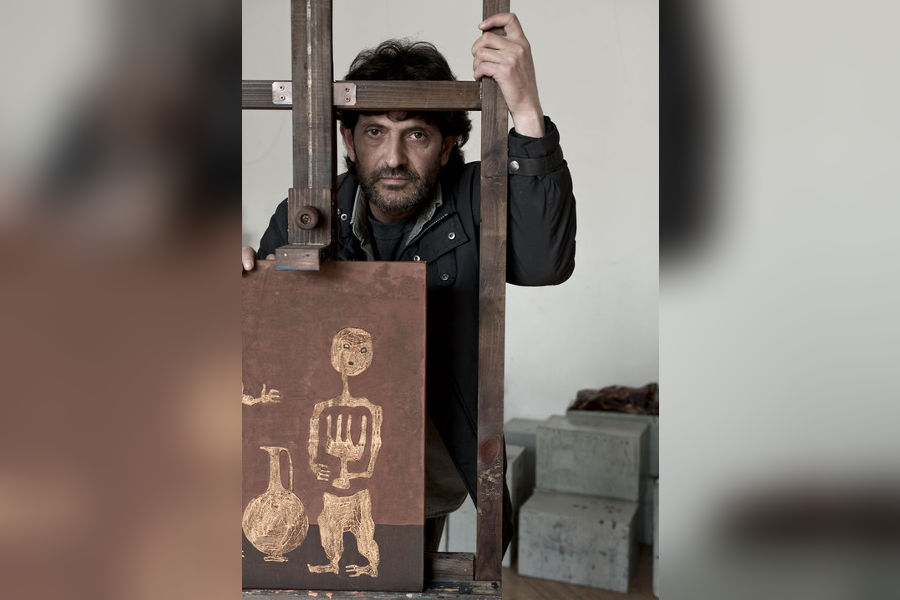
To introduce Ashot Avagyan, a few facts are enough: he is a veteran of the Artsakh liberation war, a long-time member of the Armenian Revolutionary Federation (ARF) and an artist who has participated in all the modern wars in Artsakh. In 2013, he was awarded the State Prize for his mural Mashtots, which still adorns the symposium hall of the Matenadaran.

Ashot Avagyan’s Mashtots mural

The Avagyan family has lived in Sisian for 300–400 years, with maternal roots from Nakhichevan and Artsakh, and paternal roots from Khoy. Last month, Yerevan’s Latitude Art Space featured Avagyan’s works in an exhibit titled Persistent Struggle.

In his art, loss, defeat, dignity and struggle flow into a single personal narrative — a narrative that becomes the centerpiece of our conversation.

Ashot Avagyan in 1992

Performances born from defeat

Advertisement

The artist explains that the series is rooted in oil-painted canvases:

Related Articles

“For me, this was more of a propagandistic work,” he told the Weekly. “After the defeat — the 44-day war of 2020 — I realized that, one day, we must win again. And to win, preparation is necessary. I posted the works on social platforms as a kind of ideological struggle.”

A stone from Aghavno became the central symbol of the exhibition. Covered in barbed wire, it was titled Besieged Artsakh.

This slideshow requires JavaScript.

When I asked him about the storied city of Shushi, he recalled:

“In 2012, I brought stones two to three times larger than those from Sisian and made an installation… My student, Grigor, had been killed… I left the painting unfinished, and later in Shushi, I sacrificed it to the fire in memory of all the fallen.”

This story itself is a creative manifesto: sometimes art must burn for the pain to remain.

Later, he saw Aliyev walking in the same area, unaware that the stones surrounding him were left by an Armenian artist. “They are probably still there,” Avagyan added.

April 1993, Karvachar – Sisian squad: fighters Manvel Hovhannisyan (Askolka Manvel), Ashot Minasyan (Yerkat), Vardan Gevorgyan (Godoli Vardan), Ashot Avagyan (Komisar)

Months after the 44-day war, he could not open his military backpack: “For six or seven months, I did not touch it. Finally, I thought it was time to unpack it. Suddenly, the water container came out. I remembered that I had filled that water from Hadrut.”

That water became central to his ideological series for years to come. During performances, he would anoint participants with it:

“Water holds immense significance for our people. I would say: let me anoint you, too. Water is sacred in all nations. Remember the old epic of David of Sassoun, where Sanasar and Baghdasar were mighty warriors born from water.”

This slideshow requires JavaScript.

Avagyan noted that when children participated in the performances, he anointed them, as well: “So that their right hand may be strong for future battles.”

From the same water arose handwritten notes containing excerpts from Daniel Varoujan, William Shakespeare and patriotic songs, meticulously paired with each canvas.

This slideshow requires JavaScript.

The Multiplication Table: The first warning

“In December 2018, I realized we were heading toward a sad place. After the elections — on Dec. 21 — I performed a piece related to the sunrise. The simple truth for children — the multiplication table — was read by the heroine from start to finish. The idea was that the people had made a mistake: we do not see the simplest truths,” the artist explained.

“The reason for creating my canvases was defeat. There is a sense of dignity in all of us — and that was trampled upon.”

This slideshow requires JavaScript.

He is used to being honest, often blunt. When speaking about politics, his voice seems to grow heavier:

“Today’s authorities are instilling a defeatist mentality. That causes me pain. They have led us to defeat — preordained.”

There is no political pathos in these words, only the uncompromising truth of someone who has witnessed war firsthand. He also presents works dedicated to Armenian prisoners of war held in Baku:

“I knew two of them — Davit Ishkhanyan [President of the Artsakh National Assembly] and Davit Manukyan [Deputy Commander of the Artsakh Defense Army]. Even if they are in prison, their presence and strength will awaken in us one day,” Avagyan asserted.

This slideshow requires JavaScript.

The stones of Aghavno and the counsel of final hope

The stones in his art are both material objects and spiritual burdens: “I already knew that we had ceded Artsakh. I brought the stone with me to at least do something that would give me peace.”

When I asked, “Does hope die?” he paused, then answered: “No.

Although I consciously know it is unlikely I will walk through Karabakh again, I do not abandon hope. This is the last fight — that’s how it feels. I don’t know…”

This slideshow requires JavaScript.

Ashot Avagyan’s Persistent Struggle series captures more than art; it records military psychology, the tragedies endured by a people and uncompromising dignity.

“Struggle is a noble thing; it must continue. There will be revenge; it will certainly come.” The artist’s parting words offer a powerful, indomitable cry of an entire generation.

This slideshow requires JavaScript.

For more on Ashot Avagyan and his art, follow his Facebook pages at @Ashot Avagyan Art and @epikentron58, as well as Instagram @ashot.avagyan.art

All photos are courtesy of Ashot Avagyan unless otherwise noted.

Anzhela Sedrakyan

Anzhela Sedrakyan is a journalist and master’s student in journalism at Khachatur Abovian Armenian State Pedagogical University. She writes on cultural, social and political topics, combining research and analytical approaches. Alongside her studies, she continuously deepens her professional knowledge and participates in trainings to further develop her skills in the field of journalism.

One Comment

Leave a Reply

Your email address will not be published. Required fields are marked *


Back to top button