


What I learned interviewing Arman Tsarukyan
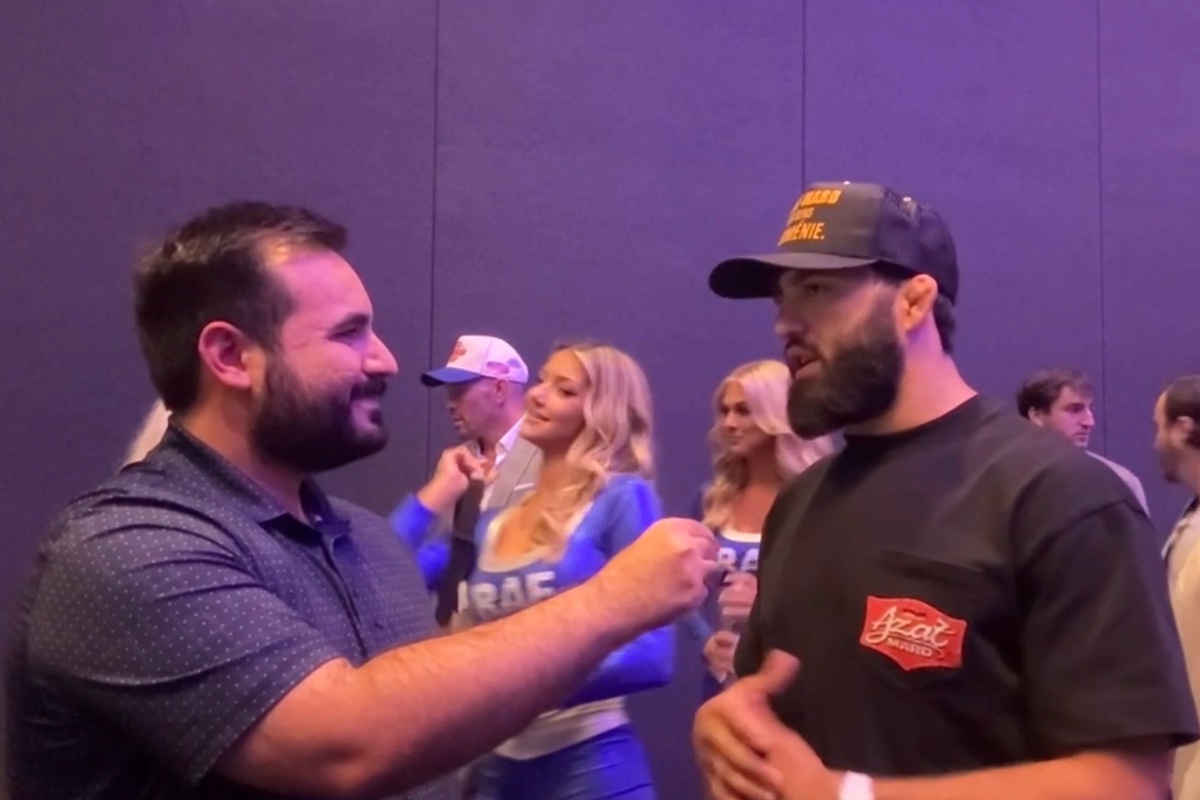
My hands were shaking as I tried setting up my phone and microphone. Arman Tsarukyan had just agreed to give me a quick interview following the Real American Freestyle (RAF) press conference in Dallas. I had done hundreds of interviews throughout my journalism career, including with professional athletes, but this one felt different.
Before the interview even started, I told Arman I was Armenian. He responded in Armenian, “Do you speak Armenian?” I answered him in Armenian, “A little bit, but my Armenian is not that good.”
“Lav a, akhpers,” he said, which means, “That’s good, brother.”
Arman’s friend, Armenian boxer Rafayel Simonian, was standing nearby and jumped into the conversation, saying I spoke Armenian well. Arman then asked if I was from Dallas. I told him, “No, I’m from Glendale,” and he clapped his hands in approval.
His manager, Pucho, eventually walked by and reminded us of Arman’s time crunch.
“Davai, davai, davai,” he said, basically urging us to get rolling.
I still think about those two minutes three months later.
My Texas trek began around 2:30 a.m. in Fresno. At the time, I was working as a full-time television news reporter. I drove to my workplace, left my car and walked about a mile to the airport before catching my flight.
A few hours later, I landed in Texas for the first time, picked up a rental car and tried to figure out the Dallas toll roads.
The press conference was a new experience. I was surrounded by big names in combat sports, including Kurt Angle, Chael Sonnen, Merab Dvalishvili and Arman. I also noticed how many young and independent journalists were covering the event because they loved wrestling and wanted to be there.
After years in traditional television journalism, with a well-established way of doing things, RAF felt different. Independent reporters and content creators were working alongside accredited professionals, and everyone was making it happen.
Before the presser, we were told athletes wouldn’t have much availability afterward. I could have accepted that and moved on, but I noticed Arman speaking with Alexis Wilkins after the event. I saw Pucho nearby and figured there was no harm in asking.
I introduced myself and asked if I could interview Arman when he was done. He said that if Arman said yes, he had no problem with it.
So I asked, and Arman said yes.
That was when my adrenaline rushed. I opened the interview with some fun. Arman was late to the press conference, so I asked if getting a haircut on a private jet had anything to do with it. From there, I asked if he remembered his first RAF experience and how it compares to now.
He talked about how RAF treated its athletes like stars. When I asked if that was something he had experienced elsewhere, he said he had received similar treatment in the UFC, but that it was rare in the wrestling world.
I then asked who his dream wrestling opponent would be if he could choose anyone.
His answer was Jordan Burroughs.
A few months later, Burroughs made his RAF debut in Cleveland, which made Arman’s answer from our conversation in Dallas even more interesting.
I ended the interview by thanking him in Armenian and shaking his hand. Almost immediately, Arman had to move on because RAF and one of its sponsors were waiting for him to take a photo onstage.
It was only two minutes, but I took a lot of pride in those two minutes.
My first in-person event covering Armenian Sports News was UFC 300 in April 2024, when Arman defeated Charles Oliveira. At that event, I was sitting roughly 100 feet away from him inside a massive press conference and was fortunate enough to get called on to ask him a question.
At the time, that felt like a major moment for me and Andre Khatchaturian, founder of Armenian Sports News. A little more than two years later, I was standing face-to-face with him for our first one-on-one interview.
Progress can be difficult to notice when you are constantly working. You are always thinking about the next story, the next interview or what you could have done better. Sometimes it takes a moment like that to look back and realize how far you have come.
The interactions I had that weekend also went beyond Arman.
After the press conference, I walked up to Mugzy, who would face Arman the following night. I introduced myself and told him I was with Armenian Sports News. I explained that while we were obviously there to cover and support Arman, I wanted to show him respect and wish him nothing but the best in the match.
What started as a regular handshake turned into a dap and a hug. Mugzy seemed to genuinely appreciate that I had gone out of my way to say something.
That interaction stuck with me because sports can make it easy to view everything through an us-versus-them mentality. We were Armenian Sports News and he was competing against one of the most popular Armenian athletes in the world. That did not mean I had to treat him like an enemy.
Arman ultimately defeated Mugzy, but there was a fiery moment during their match when the two went head-to-head and people wondered if there was legitimate tension between them. Whatever happened did not last long. By the next day, Mugzy was on Arman’s private plane eating breakfast and hanging out with him.
We were Armenian Sports News and he was competing against one of the most popular Armenian athletes in the world. That did not mean I had to treat him like an enemy.
After the press conference, I was completely drained. I had been awake since 2:30 in the morning, flown across the country and gone almost directly into covering the event.
I stopped at the hotel bar and saw Garen, the owner of Armenian clothing company Azat Mard. Garen and I had crossed paths about a decade earlier when Azat Mard sent me a care package filled with clothes. I still have some of those items today.
We started talking about the Champions League and eventually he and some of the people around Arman invited me to have lunch.
I hesitated at first. I was there as a journalist and always want to maintain that level of professionalism with the people I cover. At the same time, there is a difference between doing your job objectively and refusing to get to know people. So I joined.
I met Pavel Saharevsky, who handles public relations for Arman. He told me he was familiar with Armenian Sports News and enjoyed our content. Sitting across from me was Complex Sports reporter Matthew Welty, who is both Polish and Armenian. We connected immediately over our backgrounds, work and sports.
That experience challenged some of the assumptions people can make when looking at successful athletes from the outside. You see the private planes, money, followers and everything else that comes with being a star athlete, but my experience with the people around Arman was positive and unexpected.
They welcomed me to their table and seemed to appreciate that an Armenian journalist had traveled to Texas to cover Arman.
The trip also gave me experiences that had nothing to do with journalism. Andre had bought me a ticket to see the Texas Rangers at Globe Life Field. He knew I had never been to the stadium and wanted me to actually enjoy part of the trip instead of spending every waking hour working.
They welcomed me to their table and seemed to appreciate that an Armenian journalist had traveled to Texas to cover Arman.
The Rangers scored four runs in the first inning, so I got to see the home crowd celebrate. I stayed for a while, walked around the stadium and took in another new ballpark before eventually leaving early. I had somewhere else I wanted to be.
My childhood friend Chrystian Verano, who I had not seen since our college years, was waiting to meet up with me.
Chrystian is Peruvian, and we went to school together from first grade all the way through 12th grade. We spent our childhood growing up together before eventually going in different directions. When I realized I was going to be in Dallas, I reached out.
We ended up at Truck Yard, grabbed some drinks and caught up on life. It had been years since I had seen him in person, yet it was one of those friendships where the conversation came back naturally.
I remember thinking about how strange and great life can be. Armenian Sports News had brought me to Texas for a wrestling event, and that same trip allowed me to sit down with someone who had known me since I was a little kid.
I had another interaction that weekend that reminded me why I love journalism.
Merab Dvalishvili had finished speaking with a group of reporters when I realized nobody had asked him about fellow Georgian Khvicha Kvaratskhelia and his Champions League success. I was surprised it had not come up considering what Kvaratskhelia means to Georgian sports fans.
After the scrum ended, I approached Merab and was able to get a separate interview with him. I asked him about Kvaratskhelia, and it became a piece of content that did extremely well for Armenian Sports News despite neither athlete being Armenian.
I was proud of that because good journalism is not always about asking the question you came into the room planning to ask. Sometimes it is about listening to what everyone else is asking and realizing what has been missed.
Armenian Sports News has also taught me that being an Armenian sports outlet does not mean we have to put ourselves inside a box. Our main goal will always be to tell the stories of Armenian athletes and connect the diaspora through sports, but sports constantly create connections between different cultures and communities.
Arman appeared at the post-match press conference wearing a cowboy hat. Once again, he made himself available to reporters and answered questions. When everything was over, I shook his hand and Pucho’s hand one more time before leaving.
Then I returned to Fresno and my full-time job as a television reporter. I was back to covering shootings, car accidents and the everyday cycle of general news.
I learned a tremendous amount during my years in local television and met people whose stories I will never forget, but Dallas reminded me of the direction I originally wanted to take when I decided to become a journalist.
I wanted to travel somewhere new, cover sports, meet people, reconnect with old friends and ask questions I genuinely wanted to hear the answers to.
More than anything, Dallas reminded me not to let expectations make decisions for me.
We were told there probably would not be individual athlete availability, but I asked anyway and interviewed Arman. Mugzy was the opponent of the Armenian athlete I was there to support, but I introduced myself and ended up building a relationship with him. I could have kept to myself when I saw people from Arman’s group nearby, but instead I joined them for lunch and made connections I never expected.
At the time, I also had a full-time television job. That did not mean I had to wait until someday to pursue the kind of sports journalism I loved. I found a way to do both.
Of course, taking a chance does not guarantee anything. You can ask and be told no. You can introduce yourself and have the conversation go nowhere. Not every trip will become a defining experience.
More than anything, Dallas reminded me not to let expectations make decisions for me.
But I would rather find out than decide the answer for myself before trying.
I went to Dallas hoping to cover a wrestling event and interview Arman Tsarukyan. I came home remembering much more than that. The trip reminded me how much can happen when you put yourself in a new place, talk to people and give yourself the opportunity for something unexpected to happen.
You have to show up first.