



Aleppo and the collapse of a shared future
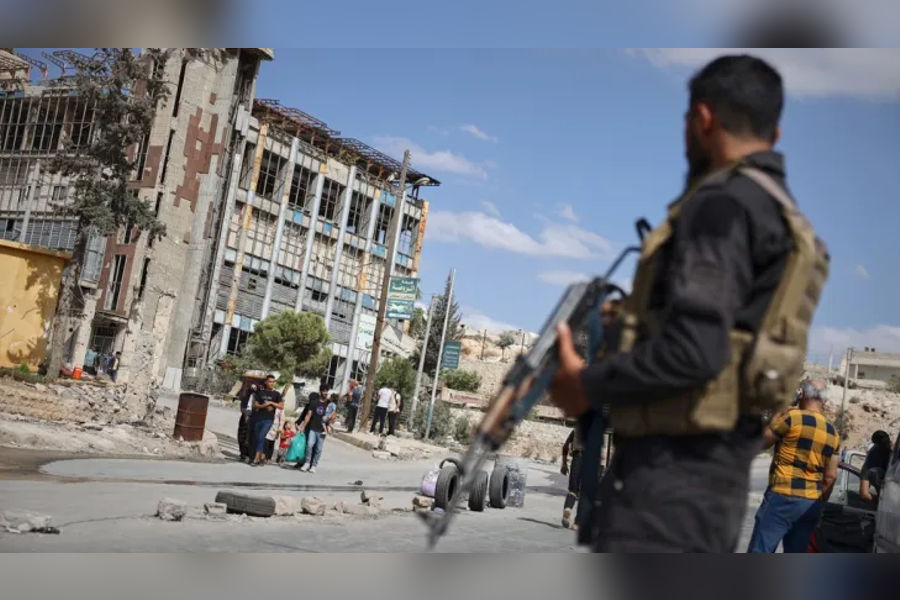
The Autonomous Administration of North and East Syria (AANES) emerged during the Syrian civil war as a multi-ethnic system of governance, representing Kurds, Arabs, Syriacs, Armenians, Assyrians, Yazidis and others. Its decentralized, gender-inclusive structure rests on local councils. Sheikh Maqsoud and Ashrafieh — two Kurdish-majority neighborhoods in Aleppo — were part of the AANES.
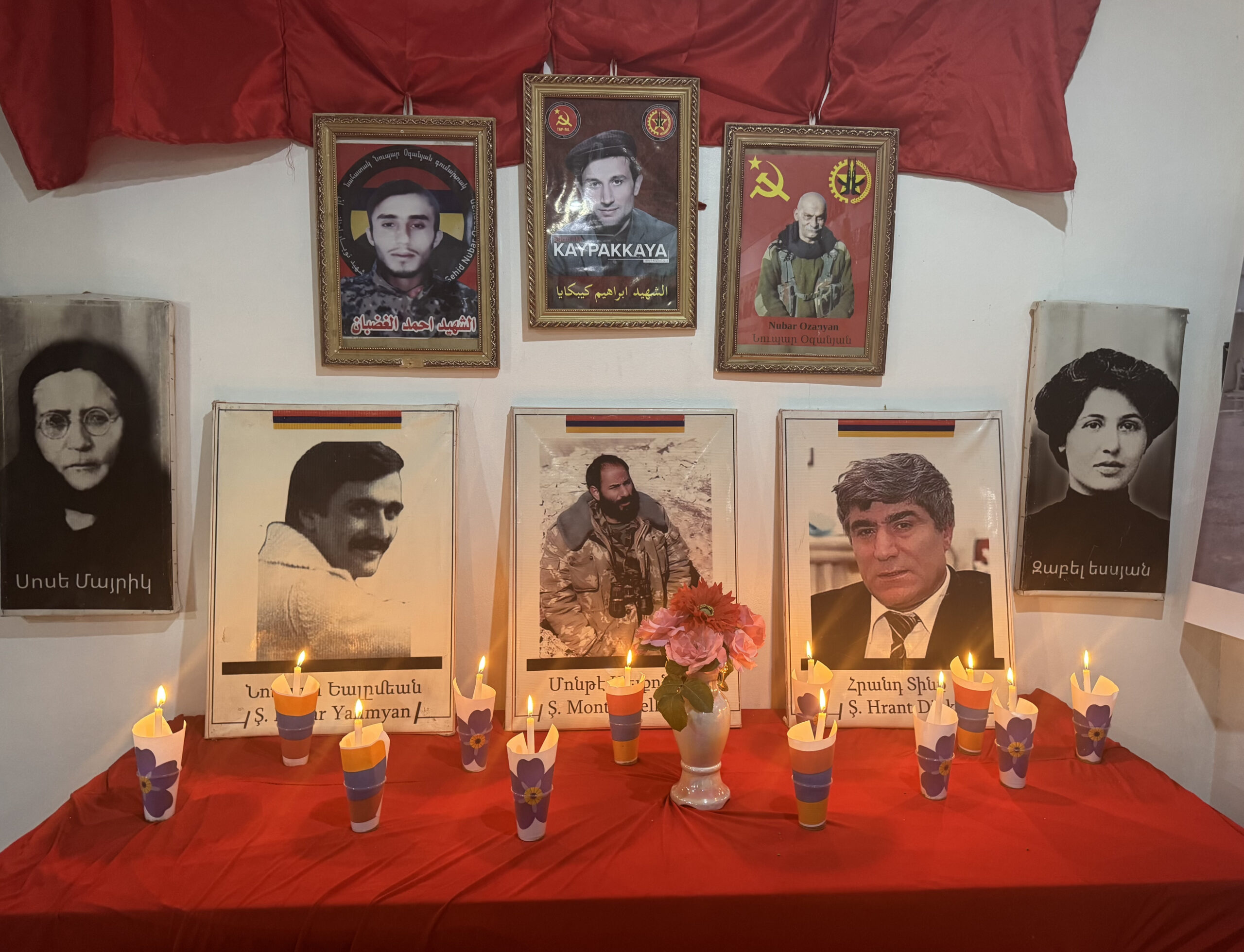
In 2022, an ethnic Armenian military commander serving in the Autonomous Administration of North and East Syria (AANES), also known as Rojava, traveled with an Armenian fighter to a village near Tal Tamr, near the Turkish border. He had been asked to mediate on behalf of a Kurdish family facing eviction. This mediation — an Armenian commander advocating for a Kurdish family — was emblematic of the kind of cross-ethnic cooperation the AANES institutionalized, not as rhetoric, but as practice.
Three years earlier, the family had fled their hometown of Serekaniye (Ras al-Ayn), about 40 kilometers away, during Turkey’s 2019 military offensive, finding shelter in an abandoned house. Now, the local Tal Tamr Military Council had informed them that the house needed to be requisitioned for military use. Already displaced once and now facing eviction again, they reached out to the Armenian commander for help.
“The family had nowhere to go,” the commander told me. “After the Turkish operation, many displaced people had moved into empty homes all across the area.” Those empty homes had belonged to Assyrians who fled ISIS’s advance in 2015 and never returned.

After speaking with the family, the commander and his fighter prepared to leave and approach the military police to begin negotiations when artillery shells began landing nearby — just 400 meters away. Turkey had launched another round of bombardment against AANES-held territory.
When I asked the commander what they did next, he laughed. “We were relaxed. We’re used to this,” he said. The fighter, equally unfazed, had turned to him and asked calmly, “Should we maybe go?”
The family, however, was frightened — and despairing. “They said, ‘We escaped Serekaniye to get away from Turkish military aggression,’” the commander recalled. “They asked, ‘Where are we supposed to go to avoid it now?’”
Turkey’s salami tactics and the normalization of proxy violence
That shelling in 2022 was not an isolated incident. It was part of a long-running campaign by Turkey to steadily weaken the AANES through salami tactics: small, incremental offensives designed to alter realities on the ground without attracting too much attention or provoking international pushback.
In the Armenian context, the term has been used to describe Azerbaijan’s gradual territorial encroachments in Nagorno-Karabakh and Armenia itself. In AANES, it describes Turkey’s, Turkish-backed militias’ and now Syria’s successive military operations: the capture of Afrin in 2018; Tal Abyad and Ras al Ayn (Serekaniye) in 2019; Tal Rifaat and Manbij in 2024; and now, in 2026, Aleppo.
Each operation narrows the space for autonomous, multi-ethnic self-rule — one slice after another. A defining characteristic of this strategy is the legitimization of proxy violence. Turkey pursues its objectives through jihadist and paramilitary structures, without assuming direct responsibility, while simultaneously pressuring Damascus to advance its aims.
Turkey’s incremental offensives eroded not just territory, but a political model. The AANES represented an alternative to both Bashar al-Assad’s centralized dictatorship and the ethno-sectarian fragmentation that has defined much of the region. For Turkey, Kurdish autonomy across the border threatened to embolden its own Kurdish population; for Damascus, it challenged centralized control.
Federalism as a red line
This territorial erosion set the stage for a different kind of challenge. After Assad’s fall, the AANES faced mounting pressure to relinquish its autonomy and submit to a centralized state. In talks with the transitional government in Damascus, it held a consistent position: a unified Syria, organized as a federal system that would preserve its political autonomy.
That autonomy had allowed the AANES to establish democratic governance, advance women’s rights and institutionalize ethnic pluralism. It repeatedly stressed that it was not a separatist project and posed no threat to Syria’s territorial integrity.
But these negotiations unfolded against a rapidly darkening backdrop. Communities within the AANES watched as government-backed forces killed an estimated 1,500 Alawite civilians along the coast in March 2025. Just months later in July, more than 940 Druze were killed in sectarian violence in and around Sweida, with government forces actively participating.
These massacres clarified what kind of unity was taking shape in post-Assad Syria — one that would not tolerate autonomous communities, whether Alawite, Druze or Kurdish. The AANES’s federal model offered a different path, but it required Damascus to accept limits on centralized power.
These events reshaped political calculations on the ground. When I spoke with Armenians and Assyrians in the AANES, communities long wary of what they see as “Kurdish” leadership, they told me without hesitation that they preferred AANES governance to rule by al-Sharaa. Whatever its shortcomings, the AANES had protected them from the violence they had just witnessed elsewhere. With this, the AANES gained further legitimacy; not only through ideology, but through protection.
Still, implementation of agreements with Damascus stalled; talks were repeatedly postponed or canceled, while Turkish pressure on Damascus to deny any degree of autonomy for the AANES appeared to intensify.
To ease tensions, the AANES withdrew all SDF units from Sheikh Maqsoud and Ashrafieh in April 2025. In return, it secured explicit non-aggression guarantees and the preservation of civilian self-administration. Only lightly armed internal security forces — the Asayish — remained, tasked with civilian protection, not warfare.
Nevertheless, tensions escalated. On Dec. 23, 2025, the Syrian government cut electricity to the neighborhoods entirely.
Sheikh Maqsoud and Ashrafieh were home to tens of thousands of Kurdish residents, many displaced from Afrin during Turkey’s 2019 offensive. Their stories echoed that of the family in Tal Tamr: displaced once and under siege again.
Aleppo, January 2026
Two weeks later, on the evening of Jan. 6, 2026, while al-Sharaa was meeting with European officials, armed factions backed by Turkey launched a major assault on Sheikh Maqsoud and Ashrafieh, violating the non-aggression agreement. The following day, Damascus declared the areas “closed military zones” and designated the Kurdish forces inside as “legitimate targets.”
What followed was not a battle between two armies; it was an overwhelming assault. Around 42,000 troops, including Turkish-backed militias such as the Sultan Murad and Hamza divisions — the same groups that sent mercenaries to Artsakh — advanced against an estimated 300 Asayish defenders.
These pro-government forces committed numerous war crimes, including the execution of civilians and the mutilation of corpses. The Khalid Fajr Hospital was repeatedly struck by tanks, drones and rockets, even as hundreds of wounded civilians were being treated inside. Turkish drone strikes were also reported, marking the first direct Turkish attacks in Syria in months.
The violence directed at Kurdish communities, particularly women fighters, is not out of the ordinary, but rather represents a shared political mentality connecting Turkey’s century-long policies toward Kurds with the practices of ISIS and various militias.
On Jan. 11, a ceasefire was announced. While details remain unclear, pro-government militias appear to have taken full control of Sheikh Maqsoud and Ashrafieh. Many residents who refused to leave their homes were subsequently subjected to abductions by pro-government forces.
The Asayish later confirmed the death of their commander, Ziyad Heleb, along with other fighters who stayed behind knowing they would likely be killed. Many were also from Afrin. They died defending the self-administered neighborhoods because those neighborhoods were inseparable from the community itself: the cross-ethnic networks, women’s institutionalized participation and the social fabric that made self-administration real.
With their deaths and the withdrawal of remaining forces, the AANES’s presence west of the Euphrates effectively came to an end.

After Aleppo
The assault on Sheikh Maqsoud and Ashrafieh was not an isolated military event. It revealed what kind of state was taking shape in post-Assad Syria: one that would tolerate no autonomous spaces, no models of pluralistic self-governance and no alternatives to centralized control.
The displaced family from Serekaniye, the Armenian commander mediating across ethnic lines and the Asayish fighters who stayed behind knowing they would die — all were part of a political experiment that challenged the region’s authoritarian and ethno-sectarian defaults. What fell in Aleppo was not just two neighborhoods, but the possibility they represented: that Kurds, Arabs, Armenians, Assyrians and others could govern themselves together.
The attack made clear who would be excluded from Syria’s future — anyone unwilling to accept that the only choice was between authoritarian unity or majoritarian rule.
Aleppo also exposes a deeper failure: the inability to move beyond a highly centralized, Arab Sunni Muslim–dominated nation-state toward something more representative of Syria’s actual diversity.
The international green light
As war crimes unfolded in Aleppo, European Commission President Ursula von der Leyen met al-Sharaa, praising the country’s ‘journey toward hope’ and pledging €620 million in reconstruction aid, without mentioning the massacres of Druze, Alawites or Kurds.
The omission wasn’t ignorance; Western complicity is central to what happened.
Europe’s calculations are pragmatic. It wants Syrian refugees to leave. Far-right parties have been making electoral gains, fueled by anti-refugee sentiment. By encouraging returns, European leaders hope to weaken the political foundation of these movements, even if it means legitimizing a government committing atrocities.
Europe also accepts al-Sharaa for security reasons, treating his forces as partners in tracking jihadist networks while sidelining the AANES, despite its proven role in dismantling ISIS at immense human cost. For the West, a single centralized authority in Damascus is preferable to a decentralized political landscape. State consolidation, even if authoritarian and violent, is assumed to be safer than autonomy or pluralism.
If the AANES falls, everyone loses
The displaced family from Serekaniye, forced to flee twice by Turkish operations, gains nothing from European reconstruction funds that legitimize the forces displacing them. In the long run, this approach risks producing exactly the instability it claims to prevent. There is little evidence that the lessons of Syria’s last decade — about repression, exclusion and consequences — are being learned at all.
What died in Aleppo wasn’t just a Kurdish project. It was the possibility for Syria’s diverse communities to govern themselves together.
The resistance in Sheikh Maqsoud and Ashrafieh revealed something Western policymakers have failed to grasp: defense cannot be reduced to military force. What allowed 300 lightly armed defenders to hold out against an overwhelming assault was legitimacy — the trust of residents and collective resilience built through years of democratic practice.
In the AANES, defense is comprehensive — bringing together arms, society, healthcare, education and memory into an inseparable whole. This is why Europe’s focus on centralized authority in Damascus is strategically misguided. The AANES defeated ISIS through social organization that turned defense into a shared civic capacity.
By sidelining this model in favor of state consolidation, Western powers are undermining the very form of stability they claim to seek — one rooted in legitimacy rather than violence.
If the AANES collapses, all Syrians lose. The question the displaced family asked — “where are we supposed to go?” — now has an answer: nowhere.



This is what happens when you rely on Americans. They pump and dump you.
Just like when the French promised help for Cilicia. Just like when the Americans and British promised help for western Armenia.
As Kissinger said, ” it’s ‘dangerous to be America’s enemy’ but ‘fatal’ to be its friend”
The only part of Armenia that remains was under Russian rule.
Historical Armenia, which the so-called west promised help for, is under fanatical Islamic rule.
FACTS
Only gullible Armenians would ever trust the West.
The remaining Armenians who have endured 13 years of civil war and are still stuck in Syria, need to flee that country ASAP. The vast majority of the Armenians fled that country for good, either to the West or to Armenia, when the Syrian Civil War started in 2011.
In a Syria run by Islamists and which is effectively a puppet state of Turkey, there is no future for Armenians, as well as for Assyrians, Alawites, Druze, Kurds, Yazidis, secularists and democrats. Apart from jihadi terrorism constantly threatening all these groups, they are additionally targeted by the Islamist Syrian government and its patron Turkey, which is calling the shots. And in this highly problematic country (and region), another bloody and devastating civil war is always a possibility.
The same applies to Iraq, Iran, Lebanon and Turkey, which along with Syria, are the worst possible places for Armenians to live, and Armenians should seek every opportunity to emigrate, rather than constantly live with fear and insecurity.
In fact, before the Syrian Civil War and the US-British invasion of Iraq, Christians used to number around 1.5 million each in both countries, and Yazidis used to number around 500,000 in Iraq. After the imperialist powers meddled and both countries descended to civil war and Islamist terrorism, the Christian population in Syria fell from 1.5 million before 2011 to 300,000 today, the Christian population in Iraq fell from 1.5 million before 2003 to 150,000 today, the Yazidi population in Iraq fell from 500,000 in 2003 to 70,000 today, and the Yazidi population in Syria fell from 50,000 in 2011 to 10,000 today. It has been a constant exodus of non-Muslims from the Middle East, not only the past decades, but the past two centuries.
P.S. Assyrians, Syriacs, Chaldeans or Arameans are different names for the same ethnolinguistic group. They self-identify as either Assyrians, Syriacs, Chaldeans or Arameans for cultural, linguistic, religious, denominational, geographic and historic reasons. Likewise, their language is called Aramaic, Syriac, Chaldean or Assyrian for the abovementioned reasons, and is divided into many dialects. They also adhere to many different Christian denominations: Syriac, Oriental Orthodox, Eastern Orthodox, Eastern Catholic and Eastern Protestant Christianity, and a minority is Muslim.
If Armenia had a government of patriots instead of traitors, there’d be an open invitation to every Armenian in every part of the World to come home to the Motherland – Hayastan.
Every Jew has the right of return to Israel. Every Armenian must have the same right to Armenia.
Exactly! Instead of encouraging and assisting Armenians from the diaspora, especially those from the Middle East, to immigrate to Armenia, and thus contribute to the country’s development, the traitor Pashinyan is causing Armenian emigration from Armenia, and adding insult to injury, including the refugees from Artsakh, who were thrown under the bus by him and made feel unwelcome and a “burden”!
As the new regime in Syria of which Russia was the first to recognise is more aligned to the USA and Israel it’s obvious that the reasons for the USA supporting a separate entity in Syria has diminshed.
Trusting anyone is gullible any right minded person ought to know that. So whilst Armenia has had let downs from the western nations it’s had let downs and betrayals from Moscow such as signing away western Armenia to Turkey of which it gained little rewards from Turkey actually and assigned Arktash to Azerbaijan and in recent years in trying to woo that country Russia sold many weapons to be used on Armenia and concurred with its on attack Arktash in 2020 and once again interestingly the Turkic peoples have distanced from Russia after having got what they wanted but the shills here obviously aren’t paid to say that i have noticed the absence of dedicated posters Gurgen and Concerned. Also whether Russia learns anything from its duplicity insincerity strategy going far beyond a legitimate balance of interests and ingratiating with the Turkic peoples at Armenians expense actually rewards them and the animosities have allowed Russia to take Armenia for granted.
As for those in Syria if they want to go to Armenia should be welcome. It’s worth noting that when banished the Syrians gave sanctuary.
Way to go Charles, minimizing western betrayal of western guarantees for Armenia
No wonder your wife left you for Tyrone
Chinese Friend, back trolling with your nonsense for the Kremlin just for me?
I guess the realisation for Moscow that the old tricks regarding Armenia which have worked well for decades but no longer effective is rankling rather?
Keep it up as one might end up like Gurgen and Concerned who have been absent for a while now perhaps have been drafted into the war in Ukraine or the pay wasn’t worth them time??
🇦🇲🙏👍👍
One thing we forget, that the Strong Dictates.
trust no one in politics, humanity is at the mercy of murderers in suits, we have to trust the good powers of the universe, and ourselves, our military, our culture, our language, and our divine roots.