


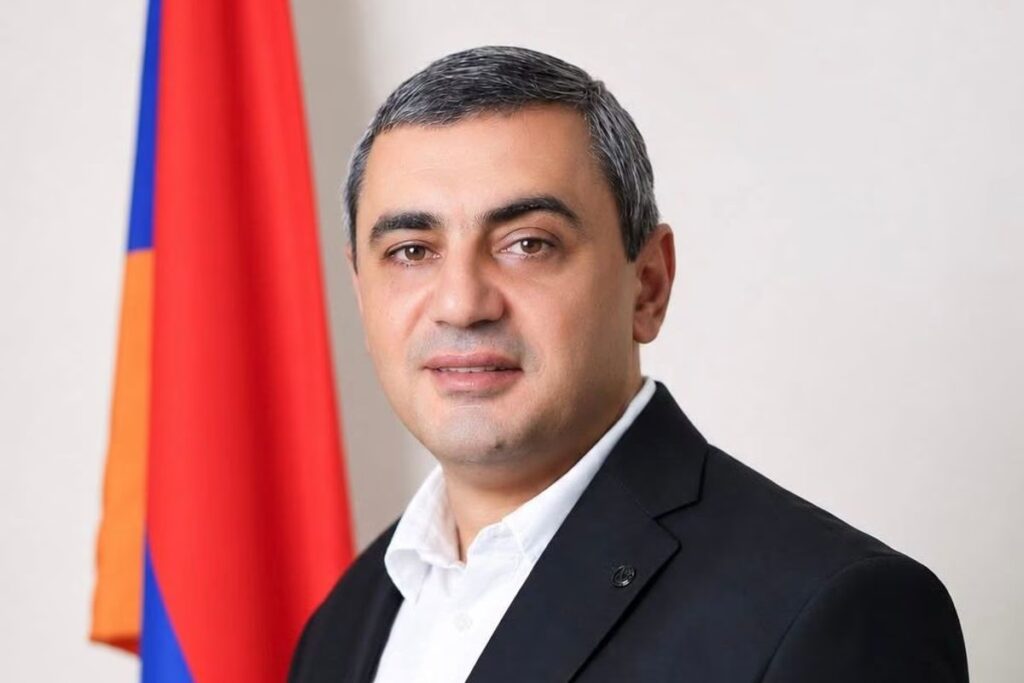
YEREVAN — On Nov. 10, 2026, Arsen Gevorgyan, a 46-year-old Armenian opposition politician, died at Yerevan’s Nubarashen prison. Less than three weeks earlier, he had been preparing to run in local elections as the Strong Armenia party’s candidate in Stepanavan. Instead, he spent the final days of his life behind bars, awaiting trial on criminal charges he denied.
His death has renewed outrage over allegations of political persecution under Prime Minister Nikol Pashinyan’s government. It has also revived memories of other troubling deaths involving government critics during his administration.
Gevorgyan was arrested Oct. 21, four days before the Oct. 25 municipal elections, and accused of electoral bribery. A court ordered him held in pretrial detention for two months. He died Nov. 10, before the case against him was resolved.
For his family, the loss is personal and irreversible. For his political allies, his death represents the latest and gravest consequence of what they describe as a systematic campaign against opposition figures.
The government disputes allegations that criminal proceedings are politically motivated. Yet Gevorgyan’s death raises questions that political denials alone cannot answer.

The final hours of Arsen Gevorgyan
According to Armenia’s Penitentiary Service, Gevorgyan’s health suddenly deteriorated on the morning of Nov. 10. His death was recorded at approximately 8:30 a.m. The account has been challenged by lawyers, who say his deteriorating condition was not addressed with sufficient urgency and question whether timely access to qualified medical care was provided.
On Nov. 11, penitentiary authorities released a more detailed chronology based on surveillance footage recorded near his cell. According to that account, a nurse entered at 7:43 a.m.; ambulance personnel arrived at the prison at 8:10 a.m. and entered the cell at 8:13 a.m.; Gevorgyan was removed on a stretcher at 8:23 a.m.; and his death was formally recorded during an assessment between 8:27 and 8:33 a.m.
Authorities deny that medical assistance was improperly withheld. Gevorgyan’s lawyers maintain that the response was inadequate and have demanded an independent investigation. A criminal investigation has been initiated, and a forensic examination ordered.
Arsen Gevorgyan is not the first politically prominent detainee or government critic to die while under the control of Armenia’s justice system during Pashinyan’s premiership. In January 2019, Mher Yeghiazaryan, deputy chairman of the Armenian Eagles: United Armenia party and an online media publisher, died at Nubarashen prison after a prolonged hunger strike.
Yeghiazaryan had been arrested in December 2018 on criminal charges he denied. He began a hunger strike shortly after his arrest and continued for approximately 44 days before ending it Jan. 17. Nine days later, he was dead.
Three years later, another tragedy unfolded not inside a prison cell but in an Armenian courtroom.
Armen Grigoryan, a prominent composer, producer and outspoken critic of Pashinyan’s government, collapsed during a court hearing on July 15, 2022.
He had been detained in May on criminal charges related to his public remarks. His lawyer was seeking his release when he lost consciousness. Emergency medical personnel arrived but he could not revive him.
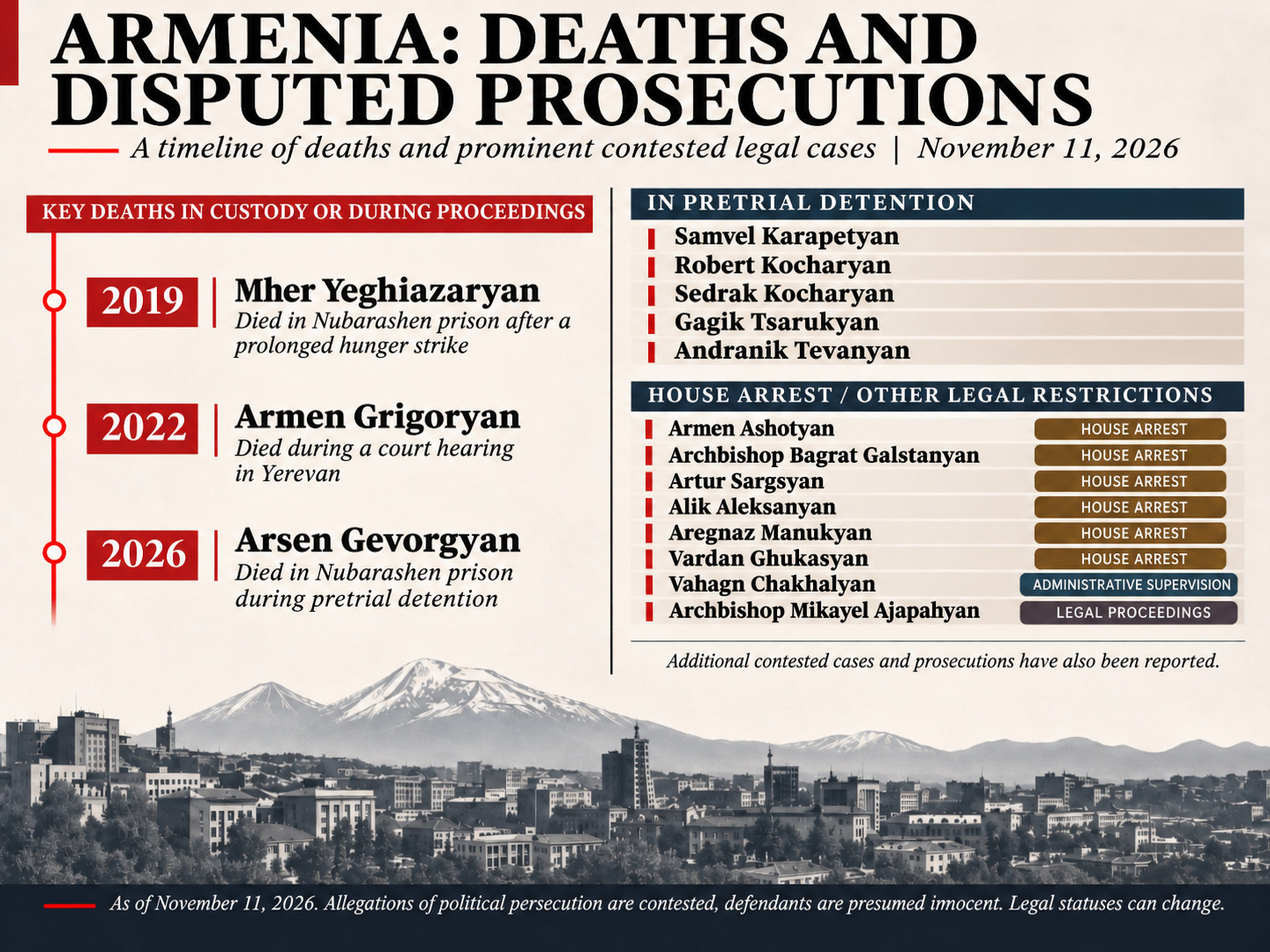
The circumstances of these three deaths differ. Together, however, they raise an enduring question about the treatment of people whose liberty has been restricted by the state. When the state deprives individuals of their freedom, it also assumes direct responsibility for the conditions in which they are held, the medical attention available to them and the safeguards intended to protect their life.
The Committee for the Rights of Persons Persecuted on Political Grounds, established in July 2026, documented cases involving 32 individuals and examined allegations of detention, house arrest, criminal prosecution, interference with political participation, restrictions on movement and pressure against government critics.
Among politicians, activists and religious leaders identified in the report are Robert Kocharyan, Archbishop Bagrat Galstanyan, parliamentarian Artur Sargsyan, Andranik Tevanyan, Avetik Chalabyan, Alik Aleksanyan, Davit Ghazinyan, Vahagn Chakhalyan, Gagik Tsarukyan, Ishkhan Saghatelyan and several others.
The report raises substantial questions about Armenia’s democratic institutions. Its authors argue that the timing and concentration of cases against opposition figures point to a recurring pattern rather than unrelated judicial decisions.
Strong Armenia takes its protest to the European Union
The controversy over Gevorgyan’s death has unfolded against an already tense political backdrop. Only days earlier, on Nov. 4, Armenian authorities arrested businessman and opposition leader Samvel Karapetyan, who had been under house arrest in connection with separate criminal proceedings. On Nov. 5, a court ordered his return to pretrial detention.
Karapetyan, founder of the Tashir Group and leader of Strong Armenia, was initially arrested in June 2025.
His latest arrest concerns allegations of embezzlement, money laundering and financial losses involving Electric Networks of Armenia. Investigators allege that 36 individuals were involved in wrongdoing resulting in more than 64.5 billion drams in losses.
On Nov. 11, one day after Gevorgyan’s death, members and supporters of Strong Armenia gathered outside the European Union delegation in Yerevan, demanding justice for their deceased colleague and urging European institutions to respond.
Demonstrators carried banners bearing the slogan “Justice for Arsen Gevorgyan.”
Participants called for accountability from Armenian officials over Gevorgyan’s death and demanded the release of other defendants arrested in connection with the same electoral bribery investigation.
Harutyun Harutyunyan, a Strong Armenia member and chairman of the parliamentary committee on European integration, said the demonstration was not directed against EU Ambassador Vassilis Maragos or the delegation itself. Rather, the protest sought to draw European institutions’ attention to what the opposition describes as a deterioration of democratic standards and the use of criminal proceedings against political opponents.
Armenia’s government has repeatedly presented closer ties with Europe as part of its commitment to democratic reform, the rule of law and stronger institutions. The protesters were asking whether those same democratic standards were being applied with sufficient seriousness when opposition figures faced arrest, detention or criminal prosecution.
Justice Minister’s statements
Armenian Justice Minister Srbuhi Galyan’s response to Arsen Gevorgyan’s death has provoked severe backlash from political analyst Suren Surenyants, who criticized the minister for making two misleading claims about the use of pretrial detention and the existence of political persecution in Armenia. In a public statement Nov. 11, Surenyants challenged the minister’s assertion that pretrial detention is employed only as an exceptional measure. He cited judicial statistics indicating that approximately 88% of detention requests submitted in 2025 were granted either fully or partially, arguing that the figure undermines the government’s portrayal of detention as an exceptional measure.
Surenyants was equally critical of Galyan’s categorical denial of political persecution. “We have always said, and the truth is, that no political persecution is taking place,” Galyan told journalists while addressing the circumstances of Gevorgyan’s death.
Surenyants contrasted that assertion with criminal proceedings and detention measures involving numerous opposition figures. According to his assessment, leaders of four opposition political forces were in detention, while the vice chairman of another opposition party remained under house arrest. He also cited earlier cases involving opposition politicians, including the detention of Gyumri’s opposition mayor and Mamikon Aslanyan, who was arrested after the municipal elections in Vanadzor. Surenyants argued that the circumstances surrounding Gevorgyan’s arrest were particularly troubling because they occurred immediately before the Stepanavan elections.
Referring to Sergei Magnitsky’s death in Russian pretrial detention and the subsequent development of international sanctions mechanisms targeting serious human rights abuses, Surenyants argued that similar questions of accountability should be raised regarding the Armenian authorities.
Surenyants concluded that Galyan’s statements, rather than resolving those concerns, had reinforced suspicions that the government was more concerned with avoiding political responsibility than ensuring full transparency about the circumstances of Gevorgyan’s death.
When justice itself is on trial
A state has the right to prosecute crimes. It does not have the right to turn detention into punishment, political opposition into a liability or its responsibility for those in its custody into an afterthought. Gevorgyan entered prison presumed innocent. He never came out alive.
The question is whether those entrusted with administering justice can themselves be held accountable.