


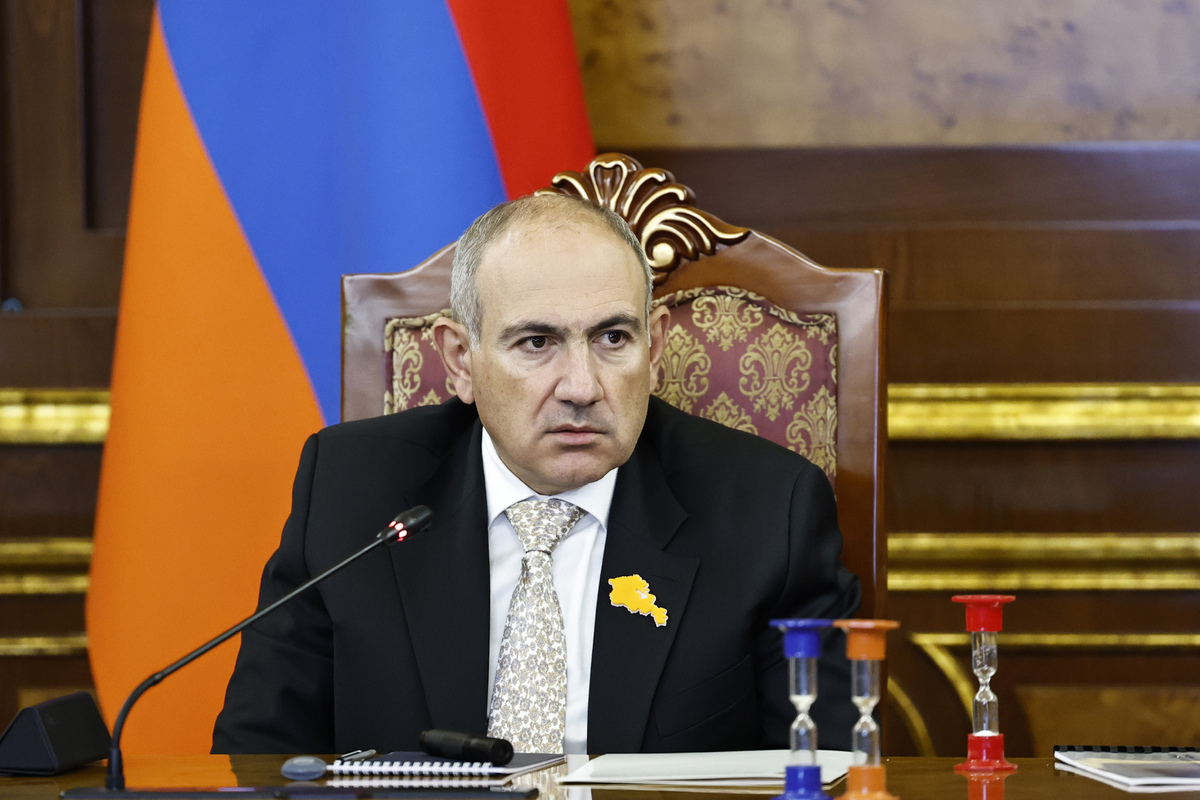
YEREVAN — Prime Minister Nikol Pashinyan outlined a new vision for peace with Azerbaijan on Wednesday, proposing territorial exchanges, the reopening of regional transport links and the mutual abandonment of historical and territorial claims. The announcement was the latest step in his government’s effort to present normalization with Baku as the foundation of Armenia’s long-term security and sovereignty.
The vision was expansive. Armenia and Azerbaijan would complete the delimitation of their borders, eliminate enclaves through exchanges of equivalent territories and establish reciprocal transport connections. Disputes that have dominated bilateral relations for decades would give way to a framework of coexistence based on internationally recognized boundaries.
Pashinyan said recent discussions with Azerbaijani President Ilham Aliyev had given him preliminary grounds to believe such an arrangement was achievable.
The peace agreement initialed in Washington in August 2025 has yet to be formally signed or ratified. Azerbaijan continues to demand amendments to Armenia’s Constitution as a prerequisite for concluding the treaty, while critical questions concerning border security, territorial arrangements and the rights of Armenians displaced from Nagorno-Karabakh remain unsettled.
These unresolved issues have taken on renewed urgency following an armed attack on an Armenian family in Syunik, where a mother suffered devastating injuries protecting her children from an Azerbaijani serviceman who had crossed the border.

The attack in Shaki: A warning that never reached the family
On Oct. 1, 39-year-old Ani Avetisyan rushed from Sisian to her home in the village of Shaki, in southern Armenia’s Syunik province. An armed stranger had entered the property, where her two children were alone.
According to her account to Azatutyun, the intruder had held the children at gunpoint for approximately 15 minutes before she arrived.
The man fired at her as she approached. One shot missed. When he subsequently aimed his assault rifle at her son, Avetisyan grabbed the weapon to redirect it. The resulting gunfire severed her left thumb and seriously damaged her other fingers.
Despite her injuries, she continued resisting with a knife. The attacker allegedly threw her onto a bed and struck her. When he aimed the rifle toward her chest, Avetisyan pushed the weapon downward, and another shot struck her leg.
Even after she fell, the man attempted to reload before eventually fleeing.
The attacker was later identified as Nasimi Musayev, an Azerbaijani serviceman who had left his military post and crossed into Armenia.
Avetisyan said he remained silent throughout the confrontation. She had no idea he was Azerbaijani.
Speaking from a Yerevan hospital, where she faces three further operations, she said she believed her intervention had prevented the deaths of her children and herself.
According to Armenia’s National Security Service, Azerbaijani authorities notified their Armenian counterparts on Sept. 29 that a serviceman had abandoned his post and might have crossed the border.
Musayev was apprehended on Oct. 1.
During those two days, Avetisyan said, residents were not warned about the potentially armed individual in the area. She told Azatutyun that she would not have sent her children to school or remained in Shaki had she known.
The notification from Azerbaijan did not establish Musayev’s precise location or intentions. Nevertheless, it meant Armenian authorities had advance information about a possible security threat.
The prime minister’s response and a disputed police timeline
The public controversy deepened following Pashinyan’s remarks in parliament on Oct. 7.
The prime minister characterized the shooting as an ordinary criminal incident, arguing that it should not be interpreted as evidence of renewed interstate hostilities.
He also questioned Avetisyan’s decision to confront the intruder rather than wait for police officers.
“I understand that maternal instinct is strong, but when you call the police, you have to wait for the police to act,” he said. The statement drew attention because Avetisyan’s account described a situation in which she believed her children faced an immediate threat to their lives.
Avetisyan maintains that she contacted police before leaving for Shaki but reached the house before officers arrived. She said her aunt arrived after the attack, followed approximately five minutes later by police.
The Ministry of Internal Affairs disputes the suggestion of a delayed response.
On Oct. 13, ministry spokesperson Narek Sargsyan said Avetisyan called the community police officer responsible for Shaki at 2:05 p.m. on Oct. 1.
Although the officer was off duty and resting at his home in Sisian, the ministry maintains that he reached the property in less than 10 minutes.
Other police teams also arrived, officials said, before a subsequent notification was registered through the 112 emergency response center.
Constitutional reform and Azerbaijan’s outstanding demand
The Shaki controversy has unfolded alongside another significant development in Armenia’s relationship with Azerbaijan.
On Oct. 13, the ruling Civil Contract party’s executive board, chaired by Pashinyan, discussed matters related to the draft of a new Armenian Constitution. The meeting was confirmed publicly by the party.
The following morning, Joghovurd reported, citing unnamed ruling-party sources, that Justice Minister Srbuhi Galyan had briefed officials on the draft’s provisions and the remaining steps before publication. The reported details of her participation have not been independently established.
The constitutional initiative predates this week’s meeting. In March, Galyan said a draft had already been prepared and would undergo further discussion within the governing party before being released.
The proposed reforms include changes to institutional oversight and judicial procedures. Their precise implications cannot be assessed until the complete text becomes public.
Of particular political importance is whether the new Constitution will retain its reference to Armenia’s 1990 Declaration of Independence. Azerbaijan has repeatedly demanded the removal of that reference. Pashinyan has publicly supported excluding the reference from the new Constitution while insisting that the initiative reflects Armenia’s domestic political priorities rather than external pressure.
The opposition’s challenge: What has Armenia conceded in the name of peace?
For Armenia’s opposition, the central question is what Armenia has surrendered in pursuit of peace, what it has received in return and whether the process has produced the security guarantees repeatedly promised by the government.
The criticism intensified following an Oct. 7 parliamentary exchange in which Pashinyan challenged opposition lawmakers to identify what his government had conceded to Azerbaijan.
Armenian Revolutionary Federation (ARF) Armenia Supreme Body chairman and lawmaker Ishkhan Saghatelyan responded with an extensive account of territorial withdrawals, military setbacks, diplomatic commitments and political decisions undertaken since the 2020 Nagorno-Karabakh war.
The most consequential diplomatic developments followed in Prague in October 2022 and Granada in October 2023. Pashinyan’s recognition of Azerbaijan’s territorial integrity within its internationally recognized borders, encompassing Nagorno-Karabakh, forms a central element of Saghatelyan’s criticism.
The opposition figure argues that Armenia accepted this position without first obtaining sufficient guarantees concerning the security and rights of Nagorno-Karabakh’s Armenian population. Pashinyan’s government maintains that recognizing territorial integrity is necessary to secure Armenia’s sovereignty within its internationally recognized boundaries.
Azerbaijan’s September 2023 military offensive ultimately brought the territory under Baku’s control and prompted the displacement of more than 100,000 ethnic Armenians.
Saghatelyan accuses the Armenian government of abandoning responsibility for protecting the population during the offensive and of subsequently removing the rights and return of displaced Armenians from the negotiating agenda.
Border demarcation, detainees and the cumulative cost of compromise
Saghatelyan’s account also addresses the 2024 border-delimitation process in Tavush.
Under arrangements negotiated with Azerbaijan, Armenian forces withdrew from positions associated with four formerly Azerbaijani villages.
Saghatelyan also raises the issue of Azerbaijani servicemen previously detained inside Armenian territory. He cites the Feb. 28, 2024, return of Azerbaijani serviceman Ruslan Penakhov, who had crossed near Tegh, without a corresponding prisoner exchange. He further criticizes the return of two Azerbaijani servicemen who had entered Armenia in 2023, one of whom had been convicted in connection with the killing of an Armenian civilian near Kapan.
For the opposition, these cases raise questions about whether the government has used its available leverage effectively to secure the release of Armenians detained in Azerbaijan.
The issue remains particularly sensitive given the continued detention of Armenian prisoners and former Nagorno-Karabakh officials in Baku.
Saghatelyan also includes Armenia’s transfer of minefield records among the concessions he believes were insufficiently reciprocated. His statement refers to 972 minefield records provided to Azerbaijan on five occasions during 2021, followed by eight additional records in January 2024. He argues that the information was strategically valuable because mapping minefields substantially reduces the time and resources required for clearance.
Saghatelyan’s critique also encompasses provisions negotiated as part of the Armenian-Azerbaijani peace settlement.
He identifies Armenia’s willingness to support the dissolution of the Organization for Security and Co-operation in Europe Minsk Group as another concession to an Azerbaijani demand.
The Minsk Group served for decades as the principal international negotiating format concerning Nagorno-Karabakh. Its role became increasingly limited following the 2020 war and Azerbaijan’s establishment of control over the territory in 2023.
The opposition argues that abandoning the framework removes an international mechanism previously associated with the conflict’s political settlement.
Shaki and the opposition’s accusation of official minimization
The attack on Ani Avetisyan and her children has brought these longstanding arguments into a more immediate context.
ARF Armenia Supreme Body member and former lawmaker Garnik Danielyan accused the government of circulating explanations that, in his view, minimized the conduct of the Azerbaijani serviceman responsible for the attack.
Danielyan visited Shaki with fellow ARF Supreme Body member and opposition lawmaker Kristine Vardanyan to examine the circumstances and speak with residents.
Following the visit, he raised questions about how the armed serviceman crossed Armenia’s border, how long he remained inside the country, how he reached the village and why security operations had not located him before the attack. He also questioned whether the authorities were attempting to limit accountability to individual dismissals rather than explain the wider institutional response.
Danielyan challenged Pashinyan’s suggestion that the serviceman might have crossed the border after becoming lost, arguing that such an explanation did not address the subsequent armed confrontation inside the family’s home.
Danielyan also criticized Pashinyan’s refusal to consider exchanging the detained serviceman for Armenians held in Azerbaijan. He argued that the authorities should examine every available opportunity to secure the release of Armenian detainees.