



YEREVAN — On Sept. 11-12, the fourth anniversary of the Azerbaijani attacks on Armenia’s sovereign territory, Azerbaijani authorities organized a large-scale diplomatic tour of occupied Artsakh, bringing foreign representatives into a territory from which virtually its entire Armenian population had been forced to leave three years earlier.
Around 150 representatives from 58 countries and nine international organizations participated in the visit, accompanied by Hikmet Hajiyev, assistant to Azerbaijani President Ilham Aliyev and head of the Presidential Administration’s Foreign Policy Affairs Department.
The delegation traveled through Stepanakert, Shushi, Martakert and Karvachar, including visits to the medieval Armenian monasteries of Gandzasar and Dadivank. Azerbaijani state media described it as the 22nd diplomatic visit organized to territories under Azerbaijani control since 2020. The official program showcased roads, tunnels, residential construction, businesses, infrastructure and Azerbaijani resettlement, presenting foreign representatives with Baku’s account of reconstruction and development.
More than 100,000 ethnic Armenians arrived in Armenia in less than a week after Azerbaijan’s September 2023 military operation. UNHCR later recorded 101,848 refugees from Karabakh as having arrived in Armenia.
The International Court of Justice subsequently ordered Azerbaijan to ensure that people who left Nagorno-Karabakh after Sept. 19, 2023, and wished to return could do so in a “safe, unimpeded and expeditious manner.”

The concern raised by Armenian religious institutions, cultural specialists, displaced Artsakh organizations and opposition figures is not limited to the physical absence of Armenians. Their broader accusation is that Azerbaijan is attempting to sever Artsakh’s surviving cultural landscape from its Armenian historical identity.
Critics increasingly describe that process as de-Armenianization: the removal of a population followed by the reinterpretation, appropriation or alteration of the historical markers that demonstrate that population’s centuries-long presence.
Gandzasar and Dadivank recast as “Caucasian Albanian”
At Gandzasar and Dadivank, Hajiyev did not present the monasteries to foreign diplomats as monuments of medieval Armenian Christianity. He described them as part of the Christian heritage of Caucasian Albania.
Hajiyev described Hasan Jalal Dawla, who commissioned Gandzasar’s principal church in the 13th century, as a “Caucasian Albanian ruler” and characterized the monastery as evidence of the centuries-old Christian heritage of Caucasian Albania. Hajiyev also accused Armenians of compromising the monuments’ architectural authenticity through restoration work conducted during the period of Armenian administration.
The setting gives the statements their political significance.
Physical possession of a monument permits the state controlling the territory to decide which history foreign visitors hear, which terminology appears on signs and official materials, which identity is emphasized and which identity is gradually pushed to the margins.
Gandzasar stands at the center of that dispute. Its history is connected to the medieval Armenian principality of Khachen, the Hasan-Jalalian dynasty and centuries of Armenian ecclesiastical life.
Dadivank likewise contains Armenian inscriptions and has functioned for centuries within the Armenian Christian and cultural landscape of the region.
The issue is the contemporary use of that history to detach surviving Christian monuments from their documented Armenian institutional, linguistic, religious and cultural history.
Armenian Revolutionary Federation (ARF) member and lawmaker Artur Khachatryan described the process as the continuing “Albanianization” of Armenian churches in Artsakh. He argued that the same historical narrative could eventually be directed against monasteries and churches within the internationally recognized territory of the Republic of Armenia.
Garnik Danielyan, a member of the ARF Armenia Supreme Body, described Hajiyev’s conduct at Gandzasar as another manifestation of a policy directed “not only against our cultural heritage, but against Armenian identity in general.”
The Mother See of Holy Etchmiadzin strongly condemned Hajiyev’s portrayal of Gandzasar and Dadivank as Caucasian Albanian, calling it “blatant falsification and an encroachment upon the historical memory and spiritual heritage of the Armenian people.”
The Mother See also criticized the participation of foreign diplomats and called on the Armenian authorities to take concrete steps to defend Artsakh’s cultural heritage.
The spectacle of the “blank manuscripts”
During the diplomatic visit, Hajiyev opened books displayed inside the museum and showed the delegation blank pages. Members of the visiting group could be seen laughing during the presentation. The spectacle appeared designed to cast doubt on Armenian claims concerning the manuscript tradition associated with Gandzasar. The books, however, were not ancient manuscripts.
Matenadaran Director Ara Khzmalyan subsequently explained that original manuscripts had never been displayed at the Gandzasar branch because the facility lacked the preservation and security systems necessary to store them. The objects exhibited there were reproductions created specifically for museum display. The original manuscripts and archival documents are held at the Matenadaran in Yerevan.
Khzmalyan responded: “We have no blank pages in our manuscripts or our history.”
Former Artsakh Culture Minister Lernik Hovhannisyan likewise described Hajiyev’s presentation as manipulation, explaining that valuable books and other cultural materials had been removed for safekeeping during the 2020 war, while exhibition materials remained at the branch.
Foreign diplomats and the normalization of a new reality
The participation of about 150 foreign representatives transformed the visit from an Azerbaijani domestic presentation into an international political event. Diplomats were not simply visiting reconstructed infrastructure. They were being shown a version of post-2023 Artsakh in which Azerbaijani reconstruction and resettlement occupied the foreground, while the displaced Armenian population largely disappeared from the visual and political narrative.
Artsakh organizations have argued that such visits risk normalizing the consequences of the population’s displacement. The Committee for the Protection of the Fundamental Rights of the People of Artsakh summarized the problem: Homes were being presented without their owners and churches without their faithful.
The Committee also said it was equally astonishing and deeply troubling that none of the diplomats who took part in the visits publicly addressed the fate of Armenian prisoners of war, civilians and political hostages illegally held in Azerbaijan or the trials being conducted against them.
The Committee also stated: “The destruction of churches in Stepanakert, the desecration of the historic Armenian cemetery in Shushi and the deeply troubling fact that the centuries-old Armenian monastery of Gandzasar is presented as ‘Albanian’ cannot go unnoticed.”
Yerevan’s response
The Foreign Ministry did not initially issue its own formal statement challenging Hajiyev’s presentation. Foreign Minister Ararat Mirzoyan later said the government believed the “necessary steps” had been taken and emphasized that the Matenadaran was the institution better equipped to address the historical question.
Asked specifically why the Foreign Ministry had not issued a statement, Mirzoyan said the authorities were “very satisfied with the position and conduct of the Matenadaran” and pointed to the subsequent visit of EU Special Representative Magdalena Grono to the institution.
That response is precisely what critics have challenged.
Their argument is not that historians or the Matenadaran should remain silent. The criticism is that a cultural institution was effectively left to answer a political operation conducted by the Azerbaijani presidency before representatives of dozens of foreign governments.
Prime Minister Nikol Pashinyan eventually addressed the controversy in parliament on Sept. 16, saying the Armenian side’s position regarding the origin of Gandzasar had already been presented by the director of Yerevan’s Mesrop Mashtots Matenadaran Institute of Ancient Manuscripts, whom he described as the “most competent official” on the matter.
Sergey Shahverdyan, president of the Artsakh Tourism and Culture Development Agency, placed responsibility partly on official Yerevan, arguing that the absence of sustained Armenian state advocacy creates space for Azerbaijan’s interpretation to spread internationally. He summarized his criticism with a stark formulation: “Cultural genocide is legitimized not only in Baku. It becomes possible where Yerevan remains silent.”
Magdalena Grono and the danger of reducing history to “competing narratives”
EU Special Representative Magdalena Grono became a focal point of the controversy after participating in the Azerbaijani-organized visit. Following the trip, she referred to “deeply diverging views and narratives” regarding the origins of certain cultural sites.
The formulation provoked criticism because it appeared to reduce a question involving inscriptions, manuscripts, architectural history and centuries of documented Armenian ecclesiastical activity to a competition between two contemporary national narratives.
Grono subsequently visited the Matenadaran in Yerevan and clarified that she did not dispute the Armenian historical presence in Karabakh or its “rich footprint.”
The episode nevertheless illustrates the effectiveness of the diplomatic environment Azerbaijan has created.
Ruling party challenges the ARF’s role in Armenian political thought
Only days after the controversy surrounding Azerbaijan’s presentation of Armenian cultural heritage in Artsakh, another dispute over Armenian political identity erupted in Armenia’s National Assembly.
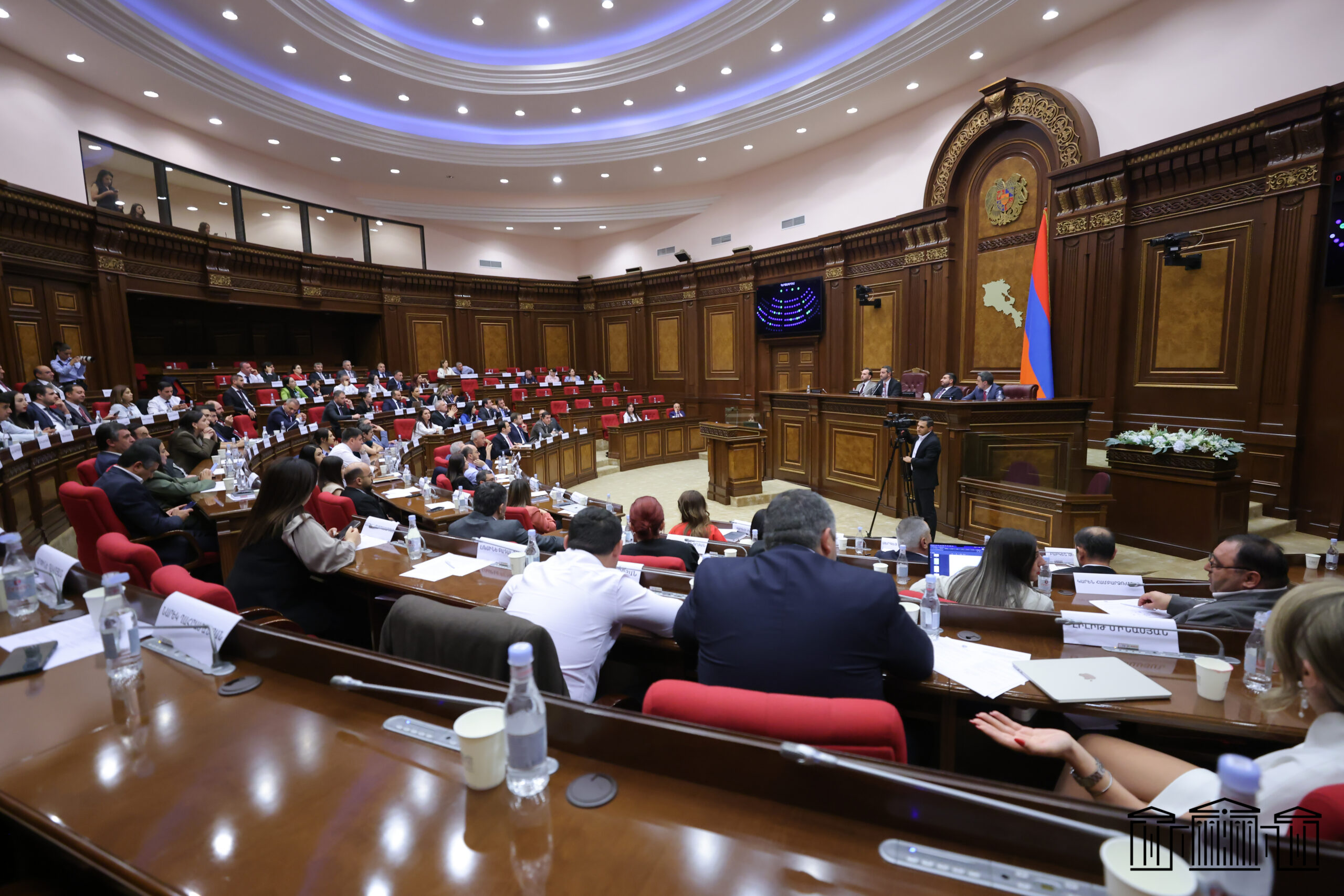
During debate over amendments concerning the oath of government members, Civil Contract lawmaker Arman Yeghoyan turned to the Armenian Revolutionary Federation and declared that, for Armenia’s perpetuity, independence and sovereignty, “Dashnak ideology must be uprooted from Armenian political thought,” telling ARF lawmaker and Armenia Supreme Body member Kristine Vardanyan that she should be “the last Dashnak.”
Vardanyan responded saying Yeghoyan had torn away the governing party’s mask.
“No matter how much you fight against the ARF and its ideology, the ARF will only become stronger,” Vardanyan said. “Just as the Turks did not succeed in their program, neither will you,” she said.
Vardanyan labeled the governing faction “Young Bolsheviks,” accusing it of combining objectives of the Young Turks with Bolshevik political methods.
“During these 135 years, there have been many Arman Yeghoyans,” she said. “Forces much greater than you have fought against the ARF. Try. Try again. I repeat: you are only making us stronger.”
Critics quickly drew a parallel around the language of erasure: While Armenian institutions were protesting attempts to remove Armenian identity from Artsakh’s historical narrative, a member of Armenia’s governing majority was speaking from the National Assembly podium about “uprooting” a 135-year-old Armenian political ideology from Armenian political thought.
From political opposition to attempts at ideological erasure
Yeghoyan’s remarks were also met with applause and laughter from members of the Civil Contract faction.
Former State Revenue Committee Chairman and Wings of Unity governing council member Davit Ananyan made this distinction particularly clear. He stressed that he is not an ARF member and has reservations about some of the party’s recent political decisions, while describing its contribution to Armenian identity, Diaspora organization and the continuity of Armenian national institutions as undeniable.
For political scientist Edgar Elbakyan the ARF is not the beginning of Armenian national self-preservation, but one historical institutional expression of a struggle for self-defense and control over one’s homeland that long predates the party itself.
Elbakyan argued that hostility toward the ARF cannot always be reduced to criticism of the party’s mistakes or political conduct. He distinguished legitimate criticism from an effort to delegitimize the national-political ideas associated with it.
Political scientist Vladimir Martirosyan approached the controversy through historical continuity. He argued that Kristine Vardanyan would not be the final ARF member and predicted that future generations of young members would instead study today’s political actors as another temporary episode in the party’s much longer history.
Yerkir.am Editor-in-Chief Vahe Sargsyan highlighted the sharp contrast between the governing camp’s current rhetoric and Pashinyan’s own assessment of the ARF only seven years earlier. In his January 2019 message to the ARF’s 33rd General Congress, Pashinyan described its historical path as heroic, tragic and at times controversial, while emphasizing that the party had “always shared the fate of its people.” Later that year, during a meeting with ARF representatives in Los Angeles, Pashinyan again said he “highly appreciated” the party’s work in safeguarding Armenian identity and described preservation of that identity as an essential mission.

Genocidal Azerbaijan got away with its war crimes and crimes against humanity of bombarding, blockading, starving, massacring and ethnically cleansing Armenians, and of systematically destroying Armenian heritage in Artsakh – because of geopolitics and hydrocarbons (as a transit country for these from Central Asia to Europe). Far from being really condemned, let alone sanctioned by the so-called “international community” and particularly by the preachy and “holier-than-thou” West, this genocidal regime has been practically rewarded by their callous indifference and vested Machiavellian interests. This situation lays bare the blatant hypocrisy and profound moral bankruptcy of the parties in question. Compare this to the West rushing to the “rescue” of Kosovo Albanians like a “knight in shining armor”, again because of geopolitics disguised as “humanitarianism”. The Armenians of Artsakh became the sacrificial lambs of international Machiavellian geopolitics. Pashinyan’s role in this has been to act as a pawn in order to sacrifice them.
Yes and no, it’s worth remembering that when Armenia controlled areas of Azerbaijan outside of Arktash 1994 – 2020 the Azeri population was forced to leave and Armenia had no UN sanctions over the issue which it mistook for tacit support but was infact indifference the same indifference applied to Armenians in Arktash who were forced to leave 2020 and 2023 when the tables had turned.
As for why did the USA and it’s NATO hangers on go so out of their way over Kosovo is murky and believed to be linked to maintaining NATO relevance, CIA heroin markets, a dig at a pro Russian country as a way of exposing the consequences of such choices. Whilst there are minerals there it’s landlocked and it’s main hydrocarbon resource is lignite or brown coal which is of low quality and no international market for. Nevertheless the Kosovo Albanians despite a recent cooling of relationships with the USA still have good reasons to have high regard for them as without their championing their cause was unlikely to succeed.
The south/trans Caucasus isn’t going to be of as much interest from a Euro Atlantic perspective as the Eastern Europe as shown by the Yugoslav interference and the support provided to Ukraine, thus when Azerbaijan was ailing in 1994 , there was a collective shrug although the concurrent Yugoslav wars were inevitably going to receive much more attention in western politics. Even the Islamist jihad weren’t as interested in supporting Muslim Azerbaijan against Christian Armenia as they were for the Bosnian Muslims against the Christian Serbs and Croats, although Azerbaijan Shia tradition would have counted against them on that one.
Cilicia, Western Armenia, Nakhichivan, Artsakh – all areas where Armenian identity has been extinguished
This is what happens when you are naive enough to trust the Turks.
And we are led by a dhimmi, Pashinyan, who is deep in their pockets.
Nothing will change if Armenians don’t get realistic about the Turks.