FeaturedAYF

Camp friends become family

My Camp Haiastan story began in the summer of 1989, during Session II. I was 7 years old, and I went with my older cousin, Talyn.

To understand how completely unprepared I was for camp, you have to understand my very limited 7-year-old concept of going away. There were family vacations to the Wildwoods in New Jersey and, once, to Lake George. At best, I assumed I was going somewhere that looked like a Days Inn.

Boy, was I wrong.

Somehow, I arrived without a sleeping bag and spent those two weeks under one of the wool blankets Camp provided. For those who remember, yes — the itchy ones that could be found at the back of the director’s quarters.

Thankfully, I wasn’t walking into that cabin completely alone. Simoné was there that first summer, along with some family friends and friends from Hovnanian School, where I was a student at the time. They were familiar faces in a very unfamiliar place.

Related Articles
Advertisement Donate Today!

They made it better.

But I still cried. A lot.

I missed my parents. I missed home. I couldn’t understand why anyone thought sending me away for two weeks was a good idea.

Which makes the next part somewhat remarkable: Somehow, I went back.

I don’t remember how my parents convinced me to return the following summer. But in 1990, there I was again in Franklin. The tears were fewer, and something — or more accurately, someone — helped make Camp feel different.

My ungerouhi that summer was U. Kristi.

Nora and Kristi in 1990.

More than three decades later, I still remember how kind and caring she was to a little girl who wasn’t entirely sure she wanted to be there.

There is something extraordinary about the role counselors play at Camp. As children, we see them as older, impossibly cool people who know the songs, dances, traditions and seemingly everything there is to know about Camp. Only later do we realize how young they actually were — and how much influence they had over whether a child felt safe and included.

I had many other counselors who shaped my experience at Camp, including Regina, Shaké, Ani B., Maral, Nevart, Hooshere and Rubina. The details of those summers have blurred over time, but the way they made Camp feel has stayed with me.

There was another constant in those years: Baron Pete B.

My Uncle Yezegiel lived in Boston while my brother, Anto, and I were in Florida, so we didn’t see him nearly enough. One summer, while he was “up top” with the Homenetmen Scouts, he dropped in with Burger King for my brother, my cousin Naz and me. Mid-session visits were decidedly not Camp protocol, and Baron Pete made clear — as only a Baron could — that this was an exception. But he let us have that afternoon together. I don’t remember what I ate that day. I remember that we got to sit together.

Another memory came during my final year as a camper. I had already stayed for two sessions, but when it was time to go home, I simply couldn’t fathom leaving.

My dad found me uncontrollably sobbing.

I asked if I could stay.

The next session was full. There wasn’t supposed to be room.

Baron Pete found me a spot.

So I stayed.

And because I stayed, I made new friends, including Noel and Mary, and another session’s worth of memories I wasn’t supposed to have.

Somewhere along the way, the place I had once cried to leave had become the place I cried to stay.

The place I knew I belonged

Although I was originally from New Jersey, my family moved to Boca Raton, Florida, during my formative years. When Camp ended, I didn’t go home to a community where I would see my Camp friends throughout the year.

I said goodbye in Franklin and, in many cases, didn’t see them again until the following summer.

At that age, a year felt like a lifetime.

This was long before text messages, FaceTime and social media. We had letters.

And I lived for them.

Letters from Diana, Ani A., Nairi, Anoush and Nicole would arrive in Florida — little pieces of the friendships I was missing. I still have them today.

As the years went on, those friendships deepened. These weren’t simply kids I spent two weeks with every summer. They were becoming some of my closest childhood friends, despite the hundreds of miles between us.

Somewhere along the way, the place I had once cried to leave had become the place I cried to stay.

Living far away was particularly hard during those awkward middle school years, when everyone is trying to figure out who they are and where they fit.

But I always knew there was one place where I fit.

Camp.

And during those years, that was enough.

Camp also made my Armenian world bigger.

With my mom in 1999. Thank you, Mom, for sending me to Camp Haiastan.

When you’re young, your Armenian universe is defined by the people and places you know. Then you get to Franklin and discover Armenian kids from communities all over the country — and the world.

Apparently, Armenians even lived in Richmond, Virginia.

Who knew?

That’s how Anthony and his sister, Angela, entered my life.

Anthony also introduced me to Garth Brooks. As a first-generation Armenian American, I had grown up listening to Paul Baghdadlian, Harout Pamboukjian and Manuel Menengichian in the car with my mom, so Garth Brooks was quite the departure from the soundtrack of my youth.

At the time, Anthony and Angela were simply two more kids I met at Camp.

That’s the funny thing about meeting people when you’re young. You have no idea which of them will keep showing up in your life.

Coming back on the other side

Eventually, I aged out. In those days, there was no teen session — just a frustrating gap between being a camper and being old enough to return as staff.

So I returned as soon as I could.

Staff life opened an entirely new chapter. We weren’t simply enjoying Camp anymore. We were working together, taking care of campers and trying to create for them the experience that had meant so much to us.

My first year on staff was spent in the kitchen with my Camp buddy, Anto. We learned from one of Franklin’s finest chefs, U. Tim, who gave us Chicken Patty Wednesdays and introduced me to the Fluffernutter.

He also taught us how to work.

Anyone who has worked in a Camp kitchen knows there is nothing glamorous about it. There are people to feed, dishes to wash and work that has to get done whether you feel like doing it or not.

For the first time, I understood that the place that had given me so much depended on people willing to give something back.

That first year on staff also changed the way some relationships took shape. Angela was still a camper, and that was when Ani J. entered my Camp world, too. At Camp, even a few years can feel like a huge age difference. But eventually, those years disappear. We grew up, became peers and friends, and went on to serve together through AYF.

Other friendships grew deeper. Lauren and I had known each other as campers, but it wasn’t until we served as counselors together that we became close. We quickly discovered that we both sunburned in strange, random patches — and that dock duty on Visiting Sunday was therefore a terrible assignment for either of us.

The following year, I returned as the Armenian School teacher.

At the beginning of each session, I would ask my campers a question:

“What makes an Armenian Armenian?”

Leading this discussion became my favorite thing I ever did at Camp.

Camp brings together children from all kinds of backgrounds and experiences with Armenian life. Some attend Armenian schools, speak Armenian at home and grow up surrounded by Armenian community life. Others know only a few words. Some may have come to Camp simply because an Armenian friend brought them along. And some may be the only Armenian kid in their school.

I understood that last experience.

“Pictures with Nene” at the Peanut Carnival in 1997 with U. Maral.

I wanted the camper who knew every Armenian word to sit beside the camper who knew none and understand that they both had a place in that room.

By then, I understood what Camp had done for me.

Now I had the chance to create that feeling for someone else.

I should note that my contributions to Camp culture were not entirely serious.

There was the time I dressed as Gwen Stefani and lip-synced at the Talent Show. There was also my appearance as Nene at the Peanut Carnival, where campers could “Take a Picture with Nene.”

I stand by both performances.

As the world got bigger, Camp made it smaller

I eventually discovered that Camp friendships didn’t stay in Franklin.

They followed you.

When I arrived at Rutgers University, my roommate was Sosé, my childhood friend and fellow camper. When everything around me was unfamiliar, someone familiar was beside me. College felt a little less intimidating because home, in a way, had come with me.

Then there were the unexpected connections.

You’d meet someone in college, mention you were Armenian and hear, “Oh, I know another Armenian.”

Apparently, there was one I absolutely had to know: the “King of Cook College.”

His name was Serge.

Did I know him?

Of course I did.

Camp.

As my world got bigger, Camp somehow kept making it smaller.

And then there was Jim Kzirian.

Dancing with Jim Kzirian in the summer of 2000.

We started dating while we were on staff together.

I married him.

Eventually.

Looking back at our wedding now, Camp was everywhere.

Simoné, who had been in my cabin that first summer, stood beside me. So did Sosé, my childhood Camp friend and college roommate; Angela and Ani J.; Rubina, once my counselor; and my two Tamars — Tamar K. and Tamar C. — whose friendships came later but were rooted in that same interconnected Armenian world.

They had entered my life at different ages and in different ways.

And there they all were, standing beside me as I married a Camp friend.

Years later, Sosé and my brother-in-law, Antranig — whom I had met long before Jim, when he was a Camp counselor — became godparents to our son, Tavit.

Anthony’s story came full circle, too.

Not long ago, Ara found an old cassette labeled “Anthony’s Camp Mix.”

His first question was, “What is this?”

I explained what a cassette was. Ouch.

Then he asked, “Did Uncle Anthony make this?”

Yes. Yes, he did.

The boy from Richmond who introduced me to Garth Brooks all those years ago is now Ara’s godfather, alongside his wife, Anny — one of my favorite people — whom Ara calls his fairy godmother.

Decades of friendship, explained to a child by an old Camp cassette.

The connections kept growing

As I grew older, I realized you didn’t even have to share a Camp summer for Camp to connect you.

Tamar C. and I never went to Camp together. But I had gone to Camp with her brother, Haig, and her cousin, Boghos — of then-Hye Photo fame — and that shared world was part of what connected us. Over the years, she became one of my closest friends. Years after standing beside me at my wedding, she was there in the hospital room when I gave birth to Tavit.

Sometimes the connection began in a cabin. Sometimes it came years later through the people and community Camp had brought into our lives.

Many of those connections carried into AYF. Through my years chairing AYF’s Central Junior Council and Junior Seminar Committee, my circle grew to include people like Tamar K. and Karine B. Today, Karine serves on the Camp Haiastan Board, while Tamar serves as secretary of the Executive Council of the Eastern Prelacy and as a world delegate to the Holy See of Cilicia.

Somewhere along the way, we went from being the kids these organizations were created for to the adults helping carry our community forward.

And we kept choosing one another.

Sosi and I had both grown up going to Camp, just not at the same time. Our paths crossed through AYF, and our friendship deepened through volunteering together in the Philadelphia Armenian community — and, admittedly, taking on more than we probably should have. At the Armenian Sisters Academy, where our children now go to school, we’ve led major events together and today serve as co-chairs of the Parent Teacher Council, with Angela beside us as treasurer.

That same thread runs through the Foundation for Armenian Youth, where I serve on the Board of Directors alongside friends I first knew at Camp, including Diana and Lauren.

Different organizations. Different stages of life. Many of the same people.

And when I think about why, I don’t think it’s nostalgia.

It’s trust.

I know how these people show up. I know what they value. I know what they’re willing to work for.

These are people I will choose, time and time again.

Camp didn’t just give us friendships worth keeping. It gave us people worth building with.

Somewhere along the way, we went from being the kids these organizations were created for to the adults helping carry our community forward.

It’s never goodbye

There is one other thing I carried home from Camp.

At the end of a session, when no one wanted to leave, there was always some version of the same reassurance:

It’s never goodbye. It’s just see you later.

As a kid, “see you later” meant next summer. Another session. Another chance to pick up where we left off.

Now — and as tough as it is to admit that I am firmly in middle age — those words mean something different.

When I said my final goodbye to my dad, I leaned in and whispered the words I had carried with me from Camp since I was a child.

“It’s not goodbye, Baba. It’s see you later.”

Seven-year-old me couldn’t have understood the weight those words might someday carry. Back then, they simply helped me leave Franklin.

Maybe that’s one of the remarkable things about growing up with a place like Camp Haiastan: The lessons grow up with you.

Some you understand immediately. Others take a lifetime.

Full circle

And now the circle has turned again.

Jim and I send our sons, Tavit and Ara, to Camp Haiastan.

The people I grew up with at Camp are now sending their own children to Franklin, where they are building friendships and memories of their own.

This past summer, my boys told me they were anxious about going to Camp.

I knew that feeling.

So before they left, I sat down with them and pulled out my old Camp photos.

I showed them the people. The cabins. The years. I told them some of the stories I’ve told here, and plenty that probably shouldn’t make it into print. I tried to explain what Camp had meant to me — not just when I was a kid, but through every stage of my life.

Camp didn’t just give us friendships worth keeping. It gave us people worth building with.

And then I told them something else.

Camp has a little bit of magic.

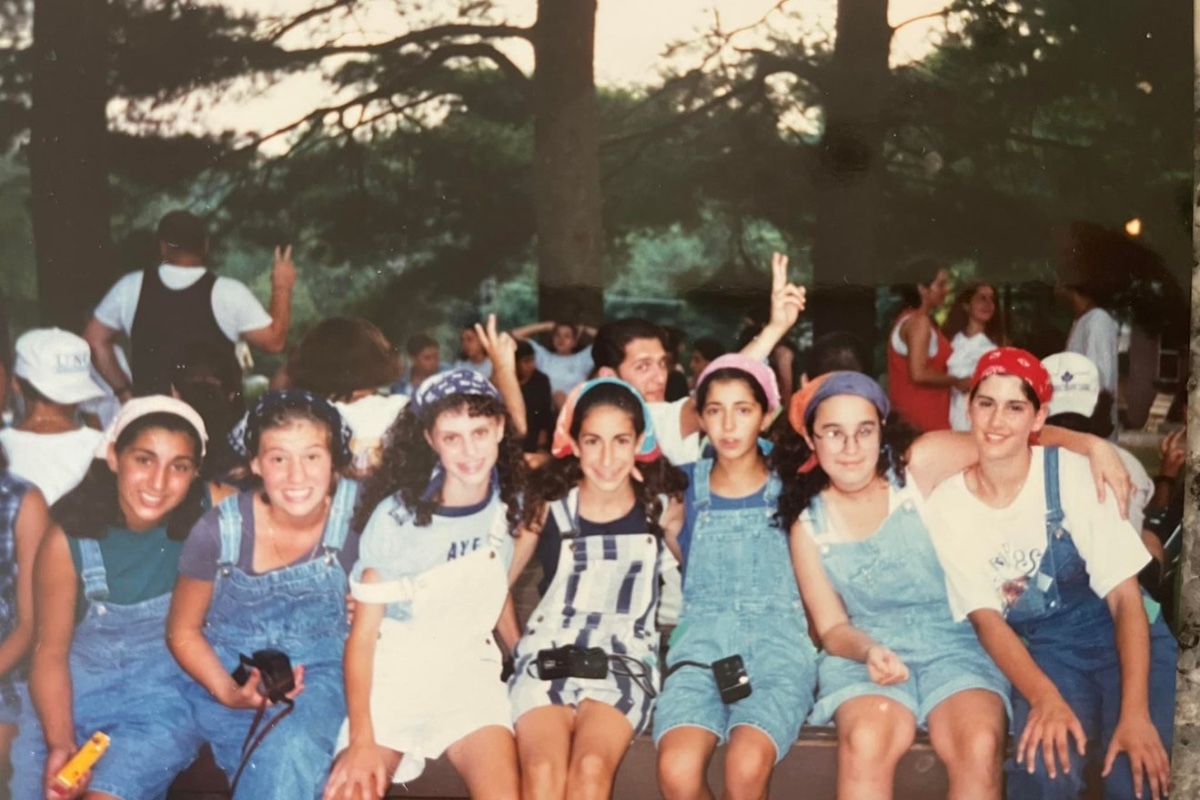
Camp in 1997, captured by Hye Photo.

If you miss me, I said, just remember that I’m there.

There are little specks of me all over that place.

I’m there in Cabin 14 with Simoné, trying to make it through my first homesick summer. I’m there on the swings with Diana, Ani A. and Nicole. I’m there in the kitchen with Anto and U. Tim. I’m there getting sunburned with Lauren on the dock. I’m under the trees asking a group of campers what makes an Armenian Armenian. I’m in the Mess Hall dancing with your Baba. I’m there with the people who would grow up to become my closest friends, my community and my family.

So if my boys miss me while they’re at Camp, they only have to look around.

In some small way, I’m right there beside them.

And for the record, I remembered to pack their sleeping bags.

I forgot the pillows.

Staff days Prepping for the camp dance’s ’60s night.

Maybe that’s Camp’s greatest gift: Somehow, one place can hold so many versions of us.

I arrived in Franklin in 1989 as a homesick 7-year-old who couldn’t understand why anyone had sent me there.

Thirty-seven years later, I understand.

I have been there as a camper. I have been there as a staff member. I am there now as a Camp parent.

And in all the ways that matter, I always will be.

Cheers to 75 years of Camp Haiastan.

Join AYF Camp Haiastan from Oct. 9-11, 2026, to celebrate 75 years of Armenian camping. Festivities include a Fun Run, Gala and more. Click here for tickets and more information: https://www.camphaiastan.org/75thanniversary/

Maybe that’s Camp’s greatest gift: Somehow, one place can hold so many versions of us.

Nora Keomrujian-Kzirian

Nora Kzirian is a communications professional with more than two decades of experience, including senior roles at Comcast and earlier work on Capitol Hill leading communications for U.S. Rep. Steve Rothman. A lifelong member of the Armenian American community, Kzirian grew up attending AYF Camp Haiastan and later returned as a staff member. She has held leadership roles in the Armenian Youth Federation, including chairing the AYF Central Junior Council and Junior Seminar Committee. Kzirian lives in the Philadelphia area with her husband and two sons, who are continuing their family’s Camp Haiastan tradition.

Leave a Reply

Your email address will not be published. Required fields are marked *


Back to top button