




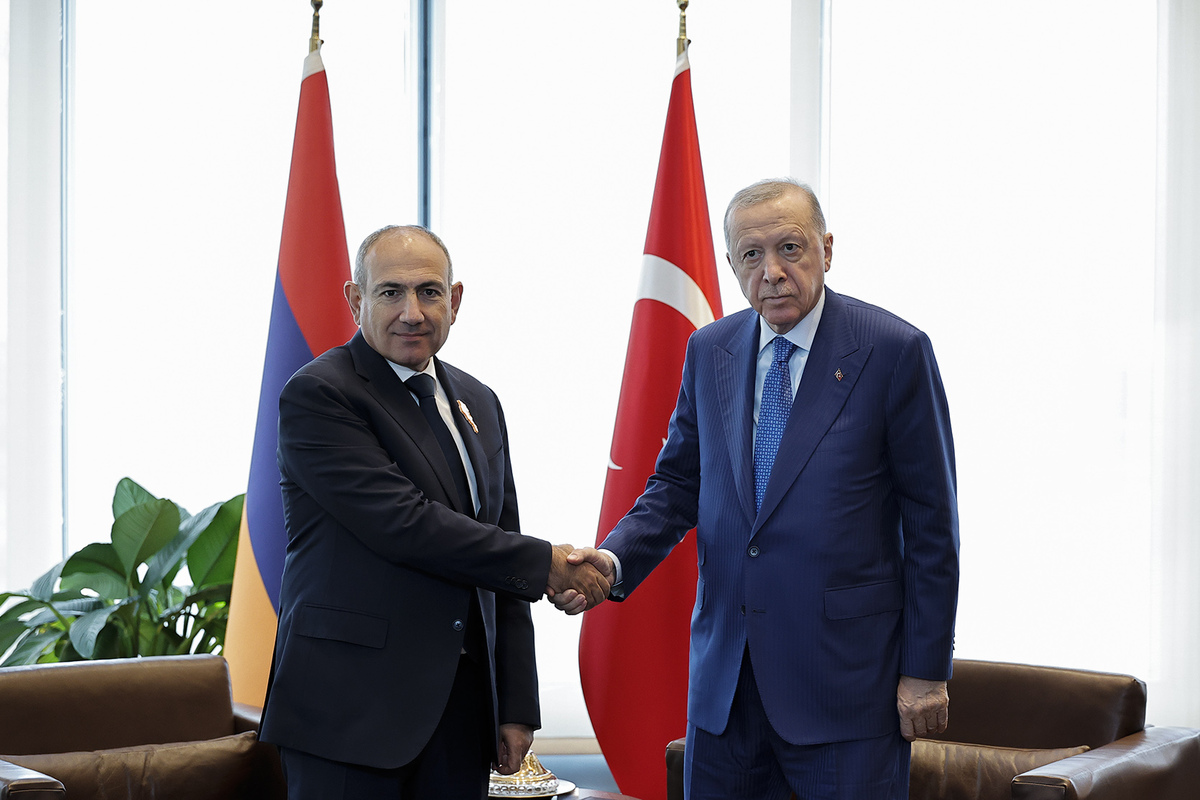
YEREVAN — The debate over the return of forcibly displaced Artsakh Armenians has intensified following remarks by Armenian Prime Minister Nikol Pashinyan, who suggested that advancing the return agenda could create tension and provide “nothing” for the refugees.
During a media briefing in Hamburg, Pashinyan addressed Azerbaijan’s recent statements regarding language in the Armenia–EU strategic agenda, specifically the reference to “Armenians of Nagorno-Karabakh who became refugees following Azerbaijan’s military operations.”
Pashinyan reiterated his longstanding warning that the topic of return is “extremely dangerous,” noting that he had raised the concern in an Aug. 18, 2025 message. He stressed that Azerbaijan, while promoting the concept of “Western Azerbaijan,” simultaneously acknowledges “Armenians of Karabakh,” creating what he described as a contradictory narrative.
Azerbaijani President Ilham Aliyev has repeatedly emphasized what he calls the “legitimate demand” of the Azerbaijani people for the restoration and protection of Azerbaijani cultural heritage in Armenia. Framing his remarks as part of a broader appeal for reconciliation and dialogue, Aliyev stated that such efforts are necessary “for respecting universal values, closing the chapter of hostility and promoting mutual understanding between peoples.”
Aliyev also reaffirmed the rights of the so-called “Western Azerbaijan” community — Azerbaijanis displaced from Soviet-era Armenia during interethnic tensions — and said that facilitating their return is a priority:

“Today, it is important to intensify efforts to secure the return of Azerbaijanis who were forcibly displaced from Armenia. Ultimately, the right of return is one of the fundamental principles of human rights. Ensuring this right means not only physical return to one’s homeland, but also the restoration of spiritual integrity, cultural heritage and the historical memory of society.”
Against this backdrop, Pashinyan proposed that Armenia and Azerbaijan adopt a joint roadmap to address both issues in parallel: “I want to make an open, public proposal to Azerbaijan. If they have concerns on these topics, so do we. I propose that we agree on a joint roadmap to close both issues simultaneously,” Pashinyan said.
He added that he had already informed the Armenians of Nagorno-Karabakh that their return is “not realistic” and argued that continuing to advance a return agenda would amount to reigniting the Karabakh movement — something he said “must not continue.” According to him, the movement has ended, and attempts to revive it are unproductive.
Referring to Azerbaijan’s frequent use of the term “Western Azerbaijan,” Pashinyan stated that the two sides must clarify “which issue is the cause and which is the effect.” He emphasized that Armenia has recognized Azerbaijan’s territorial integrity and expects full reciprocity: “I have said that there cannot be any ‘Western Azerbaijan’ in the Republic of Armenia. If we have recognized each other’s territorial integrity, then that recognition must be fully implemented.”
Pashinyan expressed hope that his proposal would be translated and officially conveyed to Baku, stating that removing these issues from the agenda would help prevent future conflict and promote long-term strategic stability.
Former Armenian Foreign Minister Vartan Oskanian sharply criticized the prime minister’s remarks, calling them “sensational” and potentially harmful to Armenia’s long-term national interests and security.
Oskanian said that the proposal could pave the way for future encroachments on Armenia’s sovereign territory, comparing it to Pashinyan’s 2019 statement, “Artsakh is Armenia, and that’s it,” which he argued contributed to the conditions leading to the 2020 war.
He condemned the proposal to Azerbaijan as fundamentally misguided: “It is simply unbelievable what Pashinyan is ‘offering’ Azerbaijanis. He asks them to renounce calling Armenia ‘Western Azerbaijan’ and abandon plans to resettle Azerbaijanis there, in exchange for Armenia dropping the issue of the return of Karabakh Armenians.”
Oskanian emphasized that the two issues cannot be equated under any diplomatic, legal or logical framework, citing international conventions and legal precedents affirming the right of peoples — especially those with autonomous status during Soviet times — to return to their homes after forced displacement, and potentially to negotiate autonomy or status arrangements.
He argued that by placing these concepts on the same level, Pashinyan has effectively opened the door for Azerbaijan to legitimize claims on Armenia: “By drawing a false equivalence between the two topics, Pashinyan has achieved only one thing today: he has paved the way for Azerbaijan to bring an internationally baseless territorial claim against Armenia into formal agenda.”
Oskanian concluded that the prime minister’s position represents a dangerous departure from established diplomatic principles and undermines Armenia’s ability to defend its rights under international law.
Former Artsakh State Minister and Ombudsman Artak Beglaryan also criticized Pashinyan, calling his approach a serious miscalculation regarding the rights of displaced Artsakh Armenians and the so-called “resettlement” of Azerbaijanis in Armenia.
In a public statement, Beglaryan argued that Pashinyan’s apparent attempt to equate the return of Artsakh Armenians with the relocation of Azerbaijanis within Armenian territory is fundamentally flawed.
“If Pashinyan truly believes that the return of the people of Artsakh and the resettlement of Azerbaijanis in Armenia are comparable in terms of status, justification, legal basis and other essential criteria, or that he can concede or ‘trade’ the inalienable right of Artsakh’s people to return, he is gravely mistaken,” Beglaryan wrote.
He further warned that placing Azerbaijan’s unfounded claims on equal footing with the undisputed right of Artsakh Armenians undermines the significance of that right and sends misleading signals to Azerbaijani President Ilham Aliyev. Beglaryan described such moves as attempts to legitimize past acts of aggression and reduce the likelihood of future Azerbaijani claims — a rationale he called dangerously incorrect.
The Artsakh Union also condemned Pashinyan’s remarks as “unacceptable and unjust” toward the people of Artsakh and the Armenian nation as a whole. In a statement, the union emphasized that the return of Artsakh’s displaced population is a fundamental right under international law, and any attempt to downplay it undermines democratic principles and violates the legal and natural rights of the affected population.
The Artsakh Union further highlighted that the right of return is reinforced by international law, including the International Court of Justice’s November 2023 ruling and a joint October 2023 statement by 40 UN Human Rights Council member states. Prior rulings, such as the 2015 European Court of Human Rights decision in Sargsyan v. Azerbaijan, also established a precedent for safe, voluntary and dignified return.
The statement underscored the historical context, noting that Artsakh Armenians were forcibly displaced under conditions of ethnic cleansing and crimes against humanity, whereas Azerbaijani departures from Armenia were largely voluntary and occurred under very different circumstances. The union stressed that the Republic of Armenia continues to bear legal, moral and international responsibility for protecting the rights and safety of Artsakh Armenians and ensuring the peaceful resolution of the conflict.
The statement concluded that Pashinyan’s remarks appear to abandon these responsibilities and risk legitimizing Azerbaijani actions, undermining prospects for a just and lasting peace. It emphasized that any durable solution to the conflict must prioritize the return of Artsakh Armenians while ensuring dignified living conditions within Armenia.



Pashinyan has gone down as the biggest traitor in Armenian history. That is an undeniable fact! What Vidkun Quisling is to Norway and Pierre Laval is to France, Nikol Pashinyan is to Armenia. If leaders in other countries did what Pashinyan did or even a fraction, there would have been an uprising, a revolution or a coup d’etat, and such a leader would have been deposed and either fled abroad to exile, imprisoned or executed. The greatest damage inflicted to the Armenian nation, after the Turks, Bolsheviks and Azeris, is Pashinyan. And since Pashinyan has usurped all powers, hijacked the democratic electoral process, has effectively become a dictator, and will continue his persecutions of Armenian patriots, his appeasement of Azerbaijan and Turkey, and with his treacherous sabotage mission of emasculating Armenia and turning it into a defenceless puppet state of theirs, he must be deposed ASAP, either through a revolution or a coup d’etat! Time is running out!
Ritengo molto saggio la risposta di Pashinyan che ha affrontato realisticamente il problema e dato una risposta non suggerita da emozioni ma da vero Politico con P maggiore. Lui non ha fatto alcuna equiparazione tra i due problemi ma ha chiarito che in futuro se di tale problema si vuole approfondire allora i due Stati si rivolgeranno ai Tribunali Internazionali esponendo ognuno in dettaglio le proprie richieste. Ed in questo caso sarà evidente che la Parte del giusto saranno gli Armeni.
Inoltre nel prossimo futuro quando l’Armenia che sarà finalmente uno Stato nel vero senso della parola,finalmente libera dallo statarello schiavo della Russia e Lui sarà ricordato come artefice e liberatore dell’Armenia Moderna.
Here is the English translation via Google Translate of Hrach’s comment about Pashinyan in Italian:
« I consider Pashinyan’s response to be very wise. He realistically addressed the issue and provided a response not prompted by emotion but by a true politician with a strong sense of humor. He made no comparison between the two issues, but made it clear that in the future, if this issue is to be explored further, the two states will turn to international courts, each setting out their requests in detail. And in this case, it will be clear that the righteous side will be the Armenians.
Furthermore, in the near future, when Armenia is finally a state in the true sense of the word, finally free from the slave state of Russia, he will be remembered as the architect and liberator of modern Armenia. »
That Pashinyan « will be remembered as the architect and liberator of modern Armenia » (« …sarà ricordato come artefice e liberatore dell’Armenia Moderna ») is held by a tiny fringe minority. He will be cursed by future generations of Armenians, and is already cursed by the large majority of Armenians, not only in the Diaspora, but crucially in Armenia.
He betrayed the people of Artsakh. Lets remember that most of the Armenian army was with held from the fighting leaving the Artsakh forces on their own, also even after the ceasefire this outmanned and outgunned force still held onto most of Artsakh proper. Pashoglu tben gave it away. Declared it part of Azerbaijan. Putin himself was shocked.
And lets not pretend that the turks would like to be friends and make up. They want Armenians and Armenia gone from that region. So they can fulfill their pan turkic dream. Hayastancis and Armenians in general who support pashoglu are so delusional its very sad.
Putin was shocked as he was confident that Armenia would still maintain claims, in part given it’s own irredentism in Ukraine mind you Russia has since the Soviet Union assigned the area to Azerbaijan always maintained that position. In maintaining claims the confrontation would definitely remain and Russia could claim to be helping to solve a problem which it has aggravated to make itself important, in the push and grab trick calling out “saved you”. Azerbaijan showed Russia up with the blockade and to deflect from their own failure to safeguard the area which Putin had sought as to make Russia important and control Armenia projected blame on Armenia for recognising Arktash as part of Azerbaijan which as stated always been the Russian position. It’s taken 100 years for Armenians to realise what Russia has been doing in manipulating and taking advantage of animosities to control Armenia. If Russia had been able to defeat the blockade like the Berlin airlift or Sarajevo siege relief then perhaps Armenia would have been right to maintain claims.
Charles, your mixing up Russia and the Soviet Union like all neocon warmongering anti Russians do. The Soviets/Bolsheviks assigned Artsakh to the Azeris, a newly formed country created by the bolsheviks in 1918 after the fall of the Russian Empire. It is well documented that the new Russia provided significant military support to the Armenians in the first Artsakh War. Helping them achieve victory. It was only after pashoglu, yes i call him by his turkish name, would create an anti Russian policy by banning Russian language and culture in schools, distancing and publicly criticizing the Russian leadership, that Russia withdrew active support. Which was predictable as loyalty and alliances work both ways. This was a signal to the Azeris to attack. Whos fault is that? Squarely it was Armenia’s. And it was by design by pashoglus western backers. And btw, your western backed second rate journalist leader from a poor family is worth billions now, after giving away Artsakh. Enjoy.