


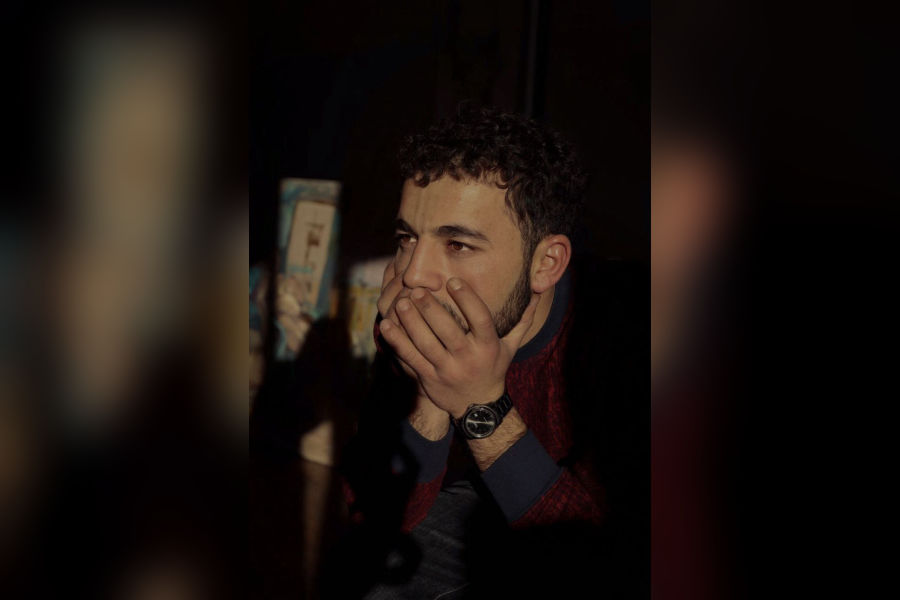
From October 22 through 30, the Pyunik Development Center displayed the first solo exhibition of painter Harutyun (Yengo) Yengoyan, symbolically titled “Freedom?” — giving shape to the complexities of “freedom” through expressive brush strokes and vivid colors.
The exhibition hall was softly lit, and the paintings — colorful landscapes, contemplative portraits, scenes of everyday life — hung on the walls seemed to breathe through their colors and silence. Among the visitors were young art enthusiasts, students, Yengo’s friends and fellow villagers from Dalarik. They wandered quietly through the halls, taking in the artist’s inner world through each work.
The artist and his roots
Though Yengoyan has lived and created in the village of Dalarik in the region of Armavir, his ancestral roots trace back to Moush. He graduated from Armavir State Art College and is currently studying painting at the State Academy of Fine Arts of Armenia.
“I’ve been painting since childhood,” Yengoyan told the Weekly. “Recently, I found some of my old drawings and realized that I can’t paint that honestly anymore. Back then, everything came straight from the soul,” he added with a smile.
As an artist, Yengoyan does not confine himself to a single genre. While exploring different themes, he particularly favors graphic forms, using pastel and sanguine techniques inherited from the Renaissance era that allow him to express delicate shadows and linear transitions.
Yengo’s appreciation for his homeland shines through his work. He assured that he would never forget the beauty of the land and people of his native village. His landscapes, painted in soft greens and grays, depict forests, valleys and the quiet of dawn. In these works, the artist seems to return to himself and to the simplicity of childhood through communion with the land.
People in a hurry
Yengoyan recalled that at different stages, he explored different subjects inspired by everyday life. “For a while, I was constantly riding the subway. I kept seeing people rushing to work, to class, home. I even asked a few of them where they were hurrying to. And I realized — they were driven not by desire, but by obligation,” he said.
In his subway-themed paintings, deep blues and metallic tones dominate. The figures appear frozen in motion, their gazes filled with emptiness and tension. Through these works, the viewer feels the unexpected pulse of city life, the dual rush and monotony of travel and work, the hustle of daily life.
“Freedom?” is a question, not a statement
Yengoyan paints and speaks of freedom, but refuses to define it clearly. “People are not free. When a person hurries to work, they belong to their boss. When you spend all day at your job, even your time no longer belongs to you,” he explained.
The exhibition’s title, “Freedom?”, invites viewers to think, posing the question: Are you free? Yengo leaves the audience without an answer, urging them to reflect on their own boundaries, their time and the burdens of their souls.
During the exhibition, Yengoyan personally asked each visitor what they saw in his paintings, wanting to understand whether he had conveyed his intention and reached the viewer’s heart. His genuine curiosity about each response made the dialogue between artist and audience all the more meaningful.
The story of books
Yengoyan pointed to a series of his paintings depicting books, created during his military service — a period when he began reading seriously. “There was a time I didn’t read and couldn’t understand people who did,” he relayed. “Then I started, and I realized how much I had missed.”
The color palette of these works is dominated by warm hues, browns and golds that symbolize wisdom and heritage. “My grandfather read a lot. When I read his books, I understood what a great legacy he left me,” he explained.
The world through a smartphone screen
In contrast to his works depicting stacks of books, one of his recent graphic works depicts two children staring into a smartphone screen. Rendered in blue and red tones, the piece feels like a warning. “Our future is at risk if children choose to live inside the screen instead of being educated,” he said.

Another painting portrays a woman sitting in her favorite pose, drinking coffee and smoking. The word “Money” is seen escaping from the plume of smoke. Below it, a line reads: “In our lives, things may happen that have never happened before.”
Here, the artist’s message transforms into social commentary: art is no longer just a space for beauty; it becomes a field of questions, uncertainty and unease.
The conversing canvas
Continuing the conversation between artist and viewer, Yengoyan displayed a white canvas in the final section of the exhibition, where visitors were encouraged to write in different handwritings what freedom meant to them. I, too, picked up a blue marker and wrote my own definition among colorful, criss-crossing words.
Yengo invited every visitor to write their personal understanding of freedom on this canvas. It becomes a polyphonic composition — a collective artwork created by both the artist and his audience.
Yengo’s exhibition and works suggest that freedom is not an achievement but a constant search. Even if we do not know where that search will lead, one thing is certain — it begins with sincerity.
You can follow Harutyun (Yengo) Yengoyan’s work through his Instagram.
All photos are courtesy of Harutyun Yengoyan unless otherwise noted.


Bonjour je viens de découvrir avec grand interêt ce jeune artiste peintre Yégo (Haroutioun (Arthur) Yengoyan ) qui a beaucoup de talent ! j’aime beaucoup ses peintures les thèmes qu’il aborde , le trait de crayon les tons choisis et surtout sa démarche artistique en quete de liberté ! BRAVO et Atchoroutioun a ce jeune talent qui a un avenir artistique assuré si il continue dans cette voie!