


ReflectionsThe Homeland

Portals of Armenia
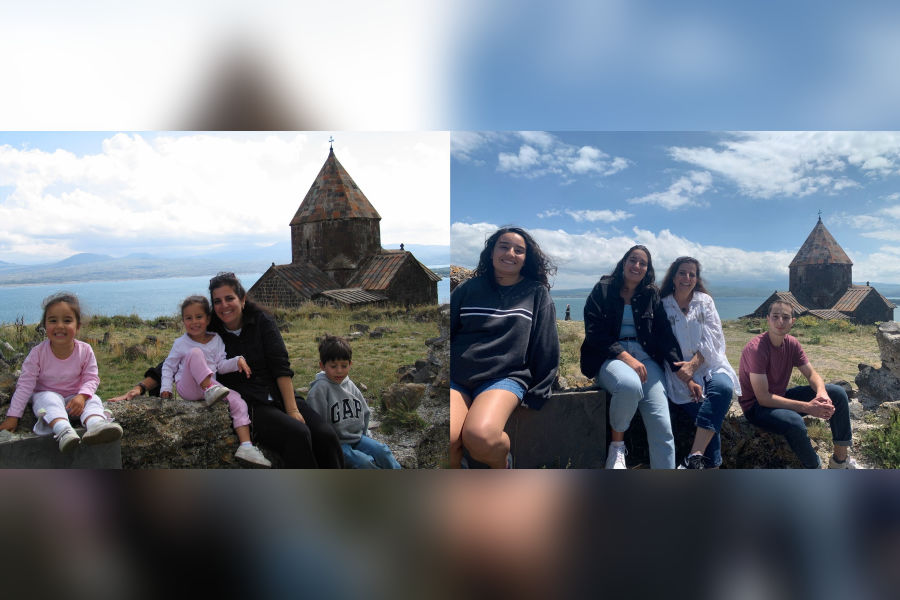
I have been coming to Armenia for 25 years now (I turn 25 today). I’ve witnessed many significant changes in the country with my own eyes, within my own lifetime. We’ve gotten to the point where, each time I visit, I’ll see something new and proclaim to friends, “Well, this didn’t exist back in my day.” Though much has changed (socially, politically, economically, etc.), there is just as much that has stayed exactly the same. 

Every year that I come to Armenia—whether through a research opportunity or to see friends and family—I spend time visiting and revisiting some of my favorite sites. Looking through my camera roll, it is clear that while I have had the privilege of seeing Armenia grow as a young nation-state, Armenia has witnessed me grow, too.

As I celebrate the end of the first quarter of my life, I’d like to offer some reflections and perhaps share a new lens with which to view our beautiful homeland.

I first became fascinated with the concept of portals in Armenia when I took this picture at the Akhtala monastery in Lori.

Akhtala Monastery Fortress, Lori

I was immediately fascinated with the framing—a doorway which appears to lead you far, far away, to some ancient paradise. It’s as though just one step forward would change your life completely.

Advertisement

Perhaps, on the other side of this portal, there is another Armenia. Perhaps, in this new (old) Armenia, there is no war. Perhaps the people there still dance in the mountains of Western Armenia, of Nakhichevan, of Javakhk, of Artsakh and call these lands by one name: Armenia. Perhaps, in this new (old) world, people tell tales of a love story between a shepherd boy and a village maiden, and neither gets killed at the end. Perhaps they’ve never needed to come up with songs like “Kini Lits” or “Axpers u Es,” and are puzzled to learn why we cry when we sing them.

Looking through these portals of Armenia, you become enraptured with the possibilities of what could have been, and what still might be.


Every picture tells a story, and your choices as a photographer—angle, lighting, framing—can change that story. 

In other words, your own perspective (or lens) is reflected in the photos that you take. Over the past 25 years, my lens has changed dramatically. I can see the same mountains, with the same millennia-old sacred sites and feel something new. Feel something…magical. 

Nothing has changed, but somehow, everything has changed in Armenia.

It is no coincidence that my obsession with capturing portals began after over 100,000 people were forced to flee Artsakh in September 2023. At that time, I was living in Yerevan and volunteering where I could. On a systems-level, we were not prepared. NGOs and government-run humanitarian initiatives alike were caught off guard during the crisis. At one point, boxes of prenatal vitamins, donated by a non-profit organization abroad, filled the living room of my apartment.

Portals exist in Artsakh, too. If only the Artsakhtsi people could have been teleported to this make-believe land of magic, unity and happiness, instead of being forced away from home, only to return in their dreams. 

Bardzrakash Monastery, Lori (left); Sranots Bridge, Tavush (right)

My fantasies of the land and people beyond the portals motivate me to do my part in shaping the Armenia that we do have. So, I return—again and again—with new projects, new ideas, new sources of outside funding. I take more portal pictures, and I reflect on the ways I have changed in my time away from the homeland.

So, what exactly is a portal picture? Well, you can decide for yourself. What started as a simple idea—to capture Armenia’s beauty within a four-walled frame—has evolved significantly. The pictures you take are a reflection of yourself and how you view Armenia.

I have been coming to Armenia for 25 years, and here is my message to you.

Come to Armenia and experience this magic for yourself. But, crucially, come to Armenia again, and again and again. See what changes here. See what changes in you.

Ani Arzoumanian

Ani Arzoumanian is a medical student at UMass Chan Medical School. She received her B.A. in neuroscience from Colgate University in 2022, with minors in creative writing and anthropology. At Colgate, Ani volunteered as a firefighter/EMT with the local fire department, and she also served as a reporter, editor and copy editor for her college weekly, The Colgate Maroon-News. After graduating, she lived in Armenia for a year and led a research study investigating the utilization of state ambulance services and assessing the quality of electronic health records. Ani is the founder of ASA United, the largest network of Armenian Student Associations (ASAs) in the world, and was on the executive board for two years. She is the founder of the ASA Compass, a bilingual online magazine which publishes undergraduate student writing and artwork, and was the co-editor-in-chief and design editor of its first publication in 2023. Ani is a member of the AYF, and has been a Weekly contributor since 2016.

Leave a Reply

Your email address will not be published. Required fields are marked *


Back to top button