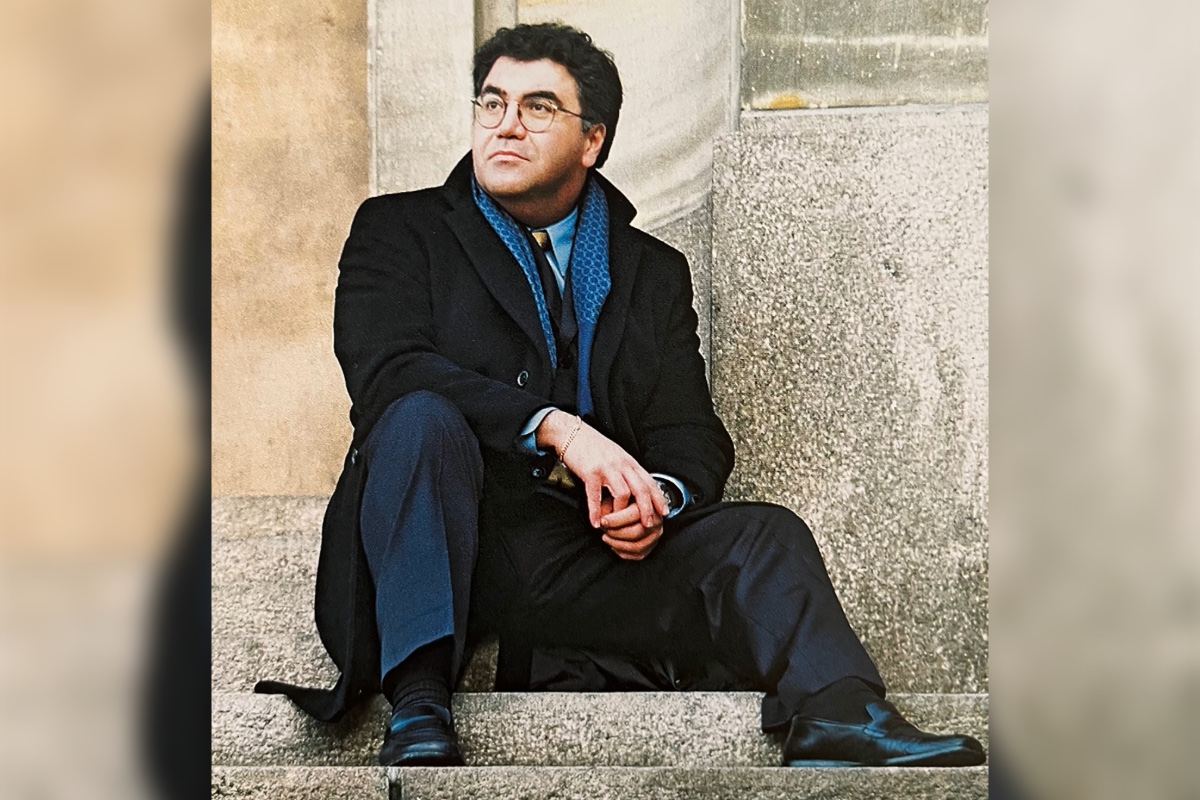



The sound that remains: Remembering Hachig Kazarian

As a dance would start, I would hear the wailing sound of the solo clarinet, unmistakably signifying the beginning of a Haleh (a traditional Western Armenian circle folk dance) and that we should gather with our friends to begin the dance.
The tempo of the song would begin slowly, arms would clench — the bonding of only close brothers and friends. A circle of men would build and embrace the dance floor — a wall of dancers — as you could see the feet slowly shuffle. As the music progressed, his clarinet playing grew more intense.
This was the sound of Hachig Kazarian.
On Sept. 26, 2026, his clarinet went silent as we lost a true legend within the Armenian music world. He was 85 years old.
Hachig was an icon, a titan and an innovator. His sound influenced generations of Armenian clarinetists, many of whom tried to imitate or emulate what he did. But the unmistakable tone, phrasing and style of Hachig’s playing belonged to him. It was his voice.

His playing influenced my desire to play music. Watching him on stage, taking command and leadership while performing, captivated my attention each and every time. Those of us who might have been called “band groupies” always stood near the stage in order to watch his magic unfold for the evening.
That stage presence was a result of a lifetime devoted to music.
Born and raised in Detroit, Hachig began playing clarinet as a boy and was introduced to Armenian music at a young age by Haig “Zurnaji Haig” Krikorian, an old-country Armenian musician and family friend who taught him to play village songs and dances by ear.
Hachig went on to study at the Juilliard School in New York from 1960 to 1966, earning bachelor’s and master’s degrees in clarinet performance. While in New York, he became immersed in a remarkable period of Armenian American and Middle Eastern music, performing alongside musicians such as John Berberian, Charles “Chick” Ganimian and other artists that would become some of the most important names of that generation.
Over the decades, Hachig performed and recorded extensively, including as a member of the legendary Kef Time ensemble alongside one of his best friends and musical colleague, oudist Richard Hagopian. His professional life also included another important role: educator. He spent decades teaching instrumental music in the public school system while continuing to perform, record and preserve Armenian music.
In 2015, I produced a documentary (“Guardians of Armenian Music”) paying tribute to the Armenian musicians in Detroit who helped preserve traditional music and bring it to our community. Hachig was an integral part of that documentary. In many ways, his experiences, knowledge and perspective helped shape the tone and structure for the entire documentary.
As a young man who traveled for kef (party), I attended and participated in many events where he played. Almost every time I audio recorded those live appearances. I did not simply run to the stage, put down a cassette recorder and walk away. I always asked him for permission because I felt he deserved that type of respect. And if he had said no, I would have honored it.
Not only did he influence my love of music, he taught me to tune my very first kanun over 35 years ago.
But what I learned from Hachig went well beyond the instrument and songs.
Before I became a musician, I had the opportunity several times to work with him in an event-organizing capacity. Usually this meant hiring Hachig for an Armenian Youth Federation dance and letting him choose the other artists with whom he wanted to perform. I learned from him the importance of creating ensembles that would sound musically pleasing.
Directly and indirectly, I also learned from him the business of being a musician — how to create a contract, how to book a performance, how to present myself on stage and so much more.
What was different about Hachig was that he was not just a musical titan to us musicians. He was also a father and uncle figure to a bunch of us boys who grew up with his children.
That made the relationship different. There was the musician we admired from the dance floor and watched from in front of the stage, but there was also the man we knew away from the stage.
As I got older, that relationship evolved. The admiration I had for his musicianship never went away, but our conversations increasingly went beyond music — to family, life, being a good husband and being a good father.
And yet, music was never very far away.
In recent years, Hachig slowed down his public performances, but he never stopped performing or practicing music. Some of my greatest recent memories were playing music with him at family parties, graduations and other special gatherings.
Through it all, he never stopped teaching, either.
In fact, he offered to show me alternative approaches to learning and memorizing the makams (a system of modal scales). In 2024, he asked me to perform with him in a small ensemble so that we could play Armenian village dances from his ancestral homeland of Van. We performed the songs for the Houshamadyan organization for the purpose of archiving these Armenian dances.
Not only was it an honor to be asked to play with him, but we performed those songs on the very same stage where Hachig had performed as a boy, at one of the original Armenian community centers in the City of Detroit.
There was something particularly meaningful about that experience because decades later, Hachig was still doing what he had done throughout his life — passing the music from one generation to another.
But for Hachig, passing along the music was about more than teaching someone how to play it. It was about making sure it would never be forgotten. Preserving this music was incredibly important to him.
His catalog of Armenian village dances was part of that work. He understood that this music was more than entertainment. It carried history. It carried culture. It carried the memory of people and places that were no longer here.
In 2024, he published his book “Western Armenian Music: From Asia Minor to the United States,” which became the capstone of his career. While his book took several years to envision and write, it has now become an essential document and teaching resource for anyone interested in understanding Western Armenian music and what it took to preserve it in the United States.
Hachig was a Juilliard graduate, an extraordinary accomplishment and one that certainly added to his musical credentials. Yet when it came to Armenian music, he would often tell you that you did not need to be a Juilliard graduate to play it.
The music needed to be in your heart and soul.
But if you were going to play it, you needed to play it well.
Playing the music well went beyond simply playing notes. It meant understanding the lyrical origins of each song. One of my own regrets as a musician is that I don’t speak the Armenian language. Hachig felt (and rightly so) that was truly unfortunate for anyone playing our music, since much of it is connected to lyrics. He would ask: How could you really feel the song if you don’t know what the song is about?
That was Hachig. There was always something deeper behind the music.
His generation had the opportunity to experience many of the musicians we now consider masters of Armenian, Greek and Middle Eastern music. I always marveled at the stories he would tell about musicians he had seen perform and those he had the opportunity to perform alongside such as oudists Hrant Kenkulian and Agapios Tomboulis.
Through those stories, he gave us a glimpse into a generation of music that, as he would often remind us, “we missed out on seeing.”
He was right.
We did miss out on that generation.
But what Hachig may not have said was that our generation had its masters, too.
He was one of them.
Over the past few weeks, many people have approached me personally to offer their condolences on Hachig’s passing. At first, I found it a little strange. Why were people offering me condolences?
Then someone said something that put it all into perspective: “You’re all part of a musical brotherhood.”
And I realized they were right. Somehow, that understanding made the loss feel even heavier.
For so many of us, Hachig wasn’t simply a musician we admired. He was our mentor and our inspiration. He helped shape how we understood this music and, for many of us, how we became musicians ourselves.
So his loss feels personal to all of us.
I have many memories of Hachig and feel fortunate to have known him — not simply as the musician I watched from the side of the stage when I was young, but eventually as someone I could perform alongside, learn from, laugh with and call Baron (a term of respect).
My generation and the generations that follow now have a monumental task. We have an obligation not to allow this music to disappear. To do so would mean losing a piece of Armenian culture and history.
Hachig spent much of his life making sure that wouldn’t happen.
And perhaps that is the greatest tribute we can give him: to keep playing it, teaching it, documenting it and passing it along.
The clarinet may have gone silent.
But the sound of Hachig Kazarian has not.
Selected Discography of Hachig Kazarian
- “Harem Dance / Pretty Girl” — Armenian Jazz Sextet (Kapp Records, 45 rpm; uncredited performance), 1957
- “Armenian Echoes” — Hye Tones, c. 1960
- “Passport East” — Hye Tones, 1962
- “Armenia, Armenia: Armenian Songs and Dances” — Hachig Kazarian and His Ensemble (originally released as “The Exciting Sounds of Hachig Kazarian”; Monitor Records/Smithsonian Folkways), 1964-65
- “Music of the Middle East” — John Berberian (Roulette Records), 1966
- “Impressions of the Middle East” — Herbie Mann (Atlantic Records), 1967
- “The Wailing Dervishes” — Herbie Mann (Atlantic Records), 1967-68
- “Kef Time Las Vegas” (Saha Records), 1968
- “Kef Time Fresno” (Saha Records), 1969
- “Kef Time Detroit” (Saha Records), 1971
- “Kef Time Hartford” (Saha Records), 1975
- “Tom Bozigian Presents Songs and Dances of the Armenian People,” 1979
- “Harry Minassian” (CK125), c. 1980
- “Changing Directions: Music for Intermediate Folk Dance” (Vols.1-5), 1985 (High/Scope Press)
- “More Exciting Sounds of Hachig Kazarian” (Kross), 1993
- “Mediterranean Montage” — The Levendes (American Recording Productions), 1997
Author’s note: The discography is not exhaustive. Throughout his career, Hachig Kazarian contributed his talents to numerous recordings as a guest artist, sometimes appearing on only one or two tracks. Additional recordings and collaborations may not be represented in this list.