


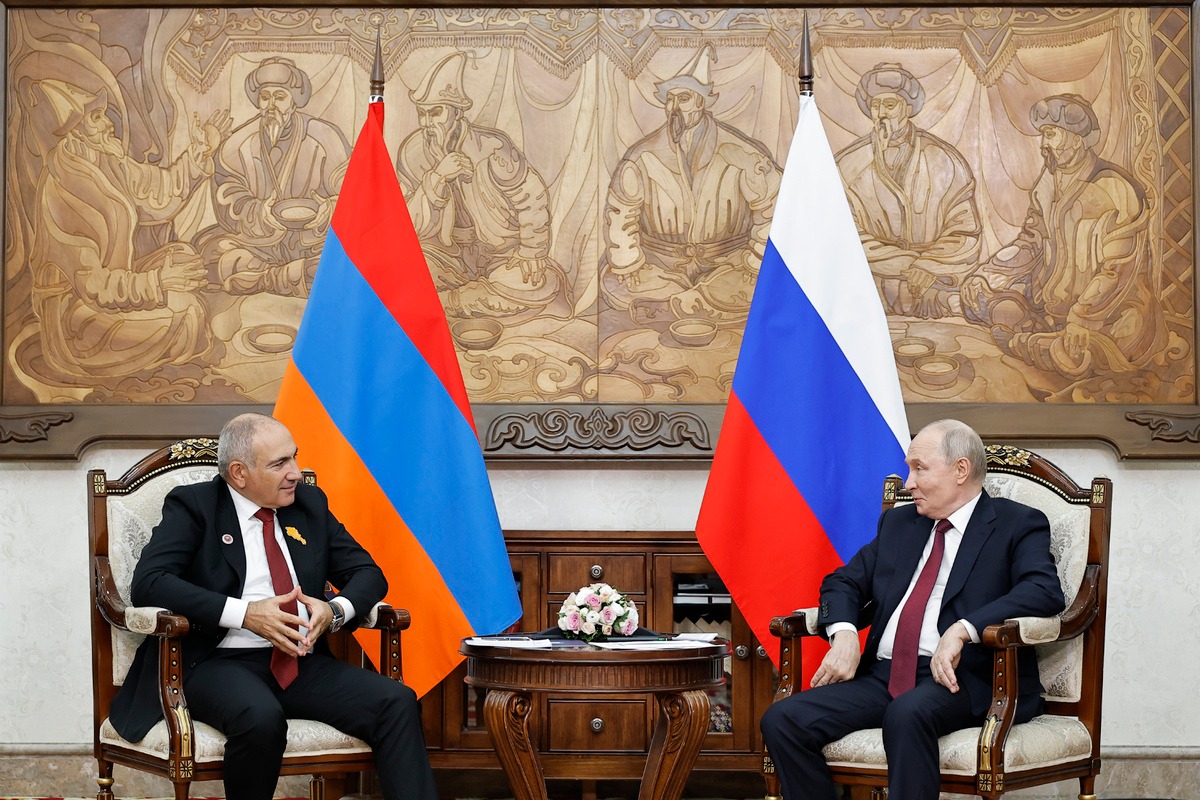
YEREVAN — The cordiality captured in the photographs from Bishkek could not conceal the widening strategic divide between Armenia and Russia.
When Prime Minister Nikol Pashinyan sat across from Russian President Vladimir Putin on the sidelines of the Shanghai Cooperation Organization summit, the two leaders spoke the familiar diplomatic language of partnership, economic cooperation and historical ties. Yet nearly every major issue hanging over the meeting pointed to a relationship undergoing a fundamental transformation.
Putin arrived with numbers, warnings and what at moments sounded almost like a challenge. Russia, he noted, remains Armenia’s largest economic partner, accounting for roughly 30% of its foreign trade. Bilateral trade turnover reached about $2.5 billion in the first six months of 2026, while Russian companies continue to hold substantial positions across Armenia’s energy, transport, mining and nuclear sectors. The economic relationship, whatever the political rhetoric in Yerevan, remains extraordinarily difficult to replace.
Then came the harder message.
Armenia may seek membership in the European Union if that is ultimately what Armenians choose, Putin said. But Moscow does not believe Armenia can indefinitely remain inside the Russian-led Eurasian Economic Union while also integrating into the EU’s regulatory and customs system.

Technical standards, customs rules, phytosanitary requirements and competing economic regimes would eventually force Armenia to decide which system it intends to join.
Pashinyan told Putin that Armenia understood a moment would eventually arrive when it would have to make a definitive choice. He argued, however, that the moment had not yet come because Armenia currently has no economic alternative capable of replacing the benefits it receives from the Eurasian Economic Union.
For years, Pashinyan has presented diversification as a way to increase Armenian sovereignty: reducing reliance on Russia while building stronger relationships with Europe, the United States, India and other international partners. But Bishkek exposed the limits of that approach.
The question, therefore, is not whether Armenia should cultivate relationships beyond Moscow. The more difficult question is whether Pashinyan is dismantling existing leverage before new guarantees have proved capable of carrying the weight.
Putin puts Gyumri on the table
Nothing illustrated that uncertainty more than Putin’s remarks about Russia’s 102nd Military Base in Gyumri.
“If Armenia believes that the Russian military base is not needed,” Putin said after the talks, Russia could leave “even tomorrow.” Moscow, he added, would not impose its military presence on Armenia. The statement did not mean that a Russian withdrawal has been agreed to.
Armenian officials have repeatedly said removing the Gyumri base is not currently government policy, while Moscow has previously said it has received no request from Yerevan to revise the agreement governing the Russian military presence. The base is now expected to remain under interstate agreements through 2044. Yet presidential statements matter precisely because they change what is politically imaginable. For decades, the Russian base in Gyumri was treated as one of the fixed pillars of Armenia’s security architecture. Putin has now publicly said it does not have to be. That creates an unavoidable question for Yerevan: If Russia leaves Gyumri, what exactly replaces it?
Armenian journalist and media expert Nairi Hokhikyan warns that the removal of Russian forces from Armenia would not simply mark the end of a military presence. It could fundamentally alter the balance of power in Turkey’s favor.
He points to the massacres in Shirak in 1920, including the killing of thousands of Armenians in what became known as Jardidzor, as a reminder of what can happen when Armenia is left without an effective deterrent against a stronger neighboring power.
In his view, removing Russia without first establishing a serious alternative would not strengthen Armenian sovereignty — it could leave the country dangerously exposed to Turkish pressure and ambitions.
A war of words beneath the diplomacy
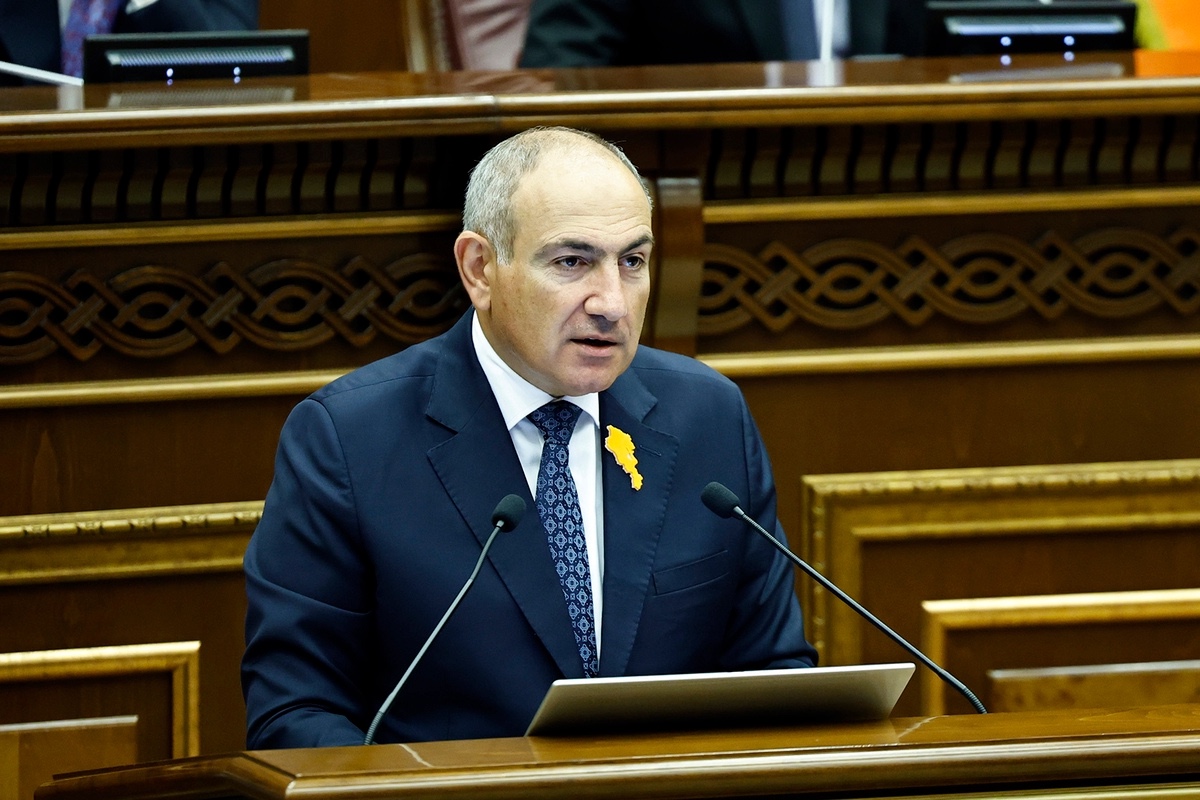
The Putin-Pashinyan meeting followed one of the sharpest periods of public disagreement between Armenian and Russian officials in years. When Pashinyan presented his government’s new program, Russia was conspicuously no longer described as Armenia’s “strategic partner.”
Pashinyan defended that change by returning to one of his central accusations against Moscow: that Russia and the Collective Security Treaty Organization failed Armenia during Azerbaijani attacks on Armenian territory in 2022.
The Kremlin responded sharply. Presidential spokesman Dmitry Peskov said Moscow continued to view its partnership with Armenia as beneficial to both countries and disagreed with Pashinyan’s characterization of the relationship. Peskov has said that if Armenia no longer considers membership in the CSTO useful, it is free to formally withdraw.
Russian Foreign Ministry spokeswoman Maria Zakharova accused Armenian officials of deliberately worsening relations with Moscow and attempting to demonstrate political loyalty to Western governments.
Foreign Minister Ararat Mirzoyan responded saying he no longer wished to be questioned about the statements of “that woman” and had stopped following Zakharova’s remarks. Yet in the same interview, Mirzoyan acknowledged the fundamental contradiction at the center of Armenia’s current foreign policy.
Yerevan appears to want to downgrade the political meaning of the Russian alliance while retaining many of its economic advantages. Moscow is signaling that Armenia may not be able to do so indefinitely.
The economic front is already opening
Restrictions imposed by Russia on some Armenian exports have disrupted trade and transit, creating new pressure on sectors of the Armenian economy that have long depended heavily on access to the Russian market.
Whatever Moscow’s motivation, Pashinyan has responded by insisting that Armenia will continue diversifying its export markets even if access to Russia eventually improves. Europe, meanwhile, is attempting to provide an alternative.
The European Union has moved toward temporary trade measures intended to support Armenian exporters affected by the Russian restrictions, including substantial tariff liberalization covering large portions of Armenia’s agricultural and beverage exports.
For Pashinyan’s government, this is precisely what diversification is supposed to look like.
Replacing an ecosystem supported by decades of business networks, migration patterns, transportation links, language familiarity, labor mobility and deeply integrated commercial ties is not the same thing as signing a new trade agreement.
Attempts to rapidly redirect Armenian commerce inevitably raise a larger strategic question: How much economic pain is Armenia prepared to absorb as the price of geopolitical reorientation?
Putin has invited Pashinyan for follow-up talks expected to focus on practical issues, including trade, infrastructure, railways and Armenia’s role in the Eurasian Economic Union. Pashinyan described the Bishkek meeting as “very good” and said the dialogue would continue in Moscow, presenting it as part of an effort to redefine, rather than rupture, relations with Russia.
The visit will show whether Yerevan and Moscow can still produce concrete agreements despite the steady erosion of political trust.
Artsakh returns to the center of the argument
The dispute over Armenia’s relationship with Russia ultimately leads back to the issue that continues to divide its political class most sharply: Artsakh.
In Bishkek, Putin again challenged Pashinyan’s account of how the conflict ended, arguing that a decisive turning point came when Armenia’s leadership recognized Azerbaijan’s territorial integrity at the 2022 Prague meeting — a position Moscow says included Nagorno-Karabakh.
Putin’s argument is that once Yerevan itself accepted Azerbaijani sovereignty over the territory, Russia’s ability to treat Artsakh as a separate security question was fundamentally altered. Pashinyan has rejected that version of events, maintaining that Russian officials had themselves previously recognized Nagorno-Karabakh as part of Azerbaijan.
The argument has taken on particular significance this week.
Sept. 2 marks the 35th anniversary of the declaration of the Republic of Artsakh. Opposition figures gathered at Yerevan’s Yerablur Military Pantheon to commemorate the anniversary and used the occasion to sharply condemn Pashinyan’s handling of both Artsakh and Armenia’s current foreign policy.
Garnik Danielyan, a former lawmaker and member of the Armenian Revolutionary Federation Armenia Supreme Body, said the opposition arrived at Yerablur with a sense of shame because, in his words, they still had no good news to bring to those who died fighting for Artsakh.
“Neither Nikol Pashinyan nor any other government can close the page of Artsakh,” Danielyan said, arguing that as long as Armenians continue to regard Artsakh as part of their national cause, the issue will remain politically alive.
He also rejected the government-aligned argument that continued discussion of the right of Artsakh Armenians to return risks creating the conditions for another war. Danielyan said the authorities were using fear of renewed conflict to justify concessions while, in his view, gradually weakening Armenia’s territorial and security position.
That criticism was echoed by opposition lawmaker and ARF Bureau member Lilit Galstyan, who described the anniversary as one of the most important dates in modern Armenian history but said it had been overshadowed by the government’s “unbalanced” domestic and foreign policies. Galstyan argued that the Artsakh issue cannot be erased by political decree and said Armenians should continue advocating for the rights of the displaced population, including the question of return.
ARF Armenia Supreme Body chairman and opposition lawmaker Ishkhan Saghatelyan, accused the Armenian government of actively undermining efforts to keep the issue on the international agenda. According to Saghatelyan, Armenian organizations continue to raise the rights of Artsakh Armenians in the European Parliament and other international forums, but those efforts are considerably more difficult without the backing of the Armenian state.
“The problem is not only that there is no state standing behind this agenda,” Saghatelyan said. “The state is working against it.”
Saghatelyan argued that international recognition of the displaced population’s right of return still exists, but that Yerevan’s refusal to champion the issue has made it substantially more difficult to prevent the matter from being politically closed.
He also accused Pashinyan’s government of failing to use major diplomatic moments — including the COP29 summit in Baku and subsequent negotiations involving Washington — to press more forcefully for the release of Armenian detainees held in Azerbaijan. For Saghatelyan, the issue of Artsakh is inseparable from Pashinyan’s broader geopolitical strategy.
Reacting to the Pashinyan-Putin meeting in Bishkek, he accused the prime minister of leading Armenia into new trials that could carry serious consequences for both the state and its population.
For Pashinyan, the loss of Artsakh has become part of the justification for abandoning a security model he says failed Armenia and replacing it with recognized borders, regional normalization and a more diversified foreign policy. For the opposition, Artsakh represents precisely the opposite lesson. They argue that successive concessions reduced Armenian leverage without producing enforceable guarantees.
Thirty-five years after Artsakh declared independence, more than 100,000 of its Armenian residents are displaced, its institutions no longer function on the territory, and its future has largely disappeared from the Armenian government’s diplomatic agenda.
Yet politically, the issue is far from gone.