Yeghia Tashjian

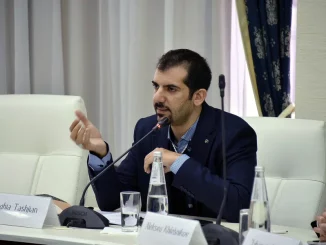
Yeghia Tashjian is the Issam Fares Institute Public Policy and International Affairs-American University of Beirut’s Regional and International Affairs Cluster Coordinator. He holds a master’s degree in Public Policy and International Affairs from the American University of Beirut and completed the "Strategic Leadership in Global Societal Security Program" at the Swedish Defense University in 2022. He earned his bachelor’s degree in political science from Haigazian University in 2013 and has worked in the university's Armenian Diaspora Research Center between 2016-2017. Yeghia's master’s thesis focused on China's geopolitical and energy security interests in Iran and the Persian Gulf. Currently, Tashjian is engaged in research on the phenomenon of Turkish-Russian 'co-opetition' in the MENA+ Caucasus region and Russia's involvement in the International North-South Transport Corridor. He contributes to various local and regional newspapers, has presented various topics from minority rights to regional security issues, and is a part-time instructor in the Department of Political Studies and Public Administration at the American University of Beirut.
Columns

Armenia must not ignore developments in the Middle East

From February 13-14, 2024, I was invited to Moscow to attend the 13th Middle East Conference of the Valdai Discussion…

Read More »
Columns

Is Aliyev sincere in his “peace” plans?

Aliyev’s recent remarks on Armenia On January 10, 2024, Azerbaijan’s President Ilham Aliyev gave a 2.5-hour interview with local TV…

Read More »
Columns

A reflection on the “Modern China and Eurasia” conference held in Yerevan

From December 8-9, 2023, the Yerevan-based “China-Eurasian Council for Political and Strategic Research” (CECPSR) foundation headed by Dr. Mher Sahakyan…

Read More »
Columns

Does the EU have any strategy in the South Caucasus?

From November 27-29, 2023, a delegation of the European External Action Service (EEAS) and the European Commission visited Yerevan. The…

Read More »
Columns

How are external factors complicating the political landscape in the South Caucasus?

After Armenia’s defeat in the 2020 Artsakh/Nagorno-Karabakh war and the shift of the geopolitical balance of power in the South…

Read More »
Tashjian's Take

Instead of dissolving, Artsakh should have a government in exile

On September 28, 2023, Artsakh President Samvel Shahramanyan issued a decree announcing that, in the wake of Azerbaijan’s assault on…

Read More »
Columns

How the military escalation in Gaza could impact the South Caucasus

On October 7, 2023, Palestinian Islamist militant group Hamas launched operation “Al-Aqsa Flood,” aiming to destroy the Israeli army positions…

Read More »
Columns

The Geopolitical Background of the Moscow-Yerevan Rift and Russia’s Future in the Region

Recent geopolitical developments in the South Caucasus have once again appeared in the headlines of media and analytical centers. Experts…

Read More »
Columns

What does the expansion of BRICS mean for the South Caucasus?

The BRICS summit, hosted by South Africa from Aug. 22-24, 2023, came amid a tumultuous, almost entropic period in global…

Read More »
Columns

What does ISIS’s revival mean for the South Caucasus?

The socio-economic crisis was one of the causes of the disintegration of centralized governments in Syria and Iraq in 2011…

Read More »
Back to top button