



Warlords in the White House
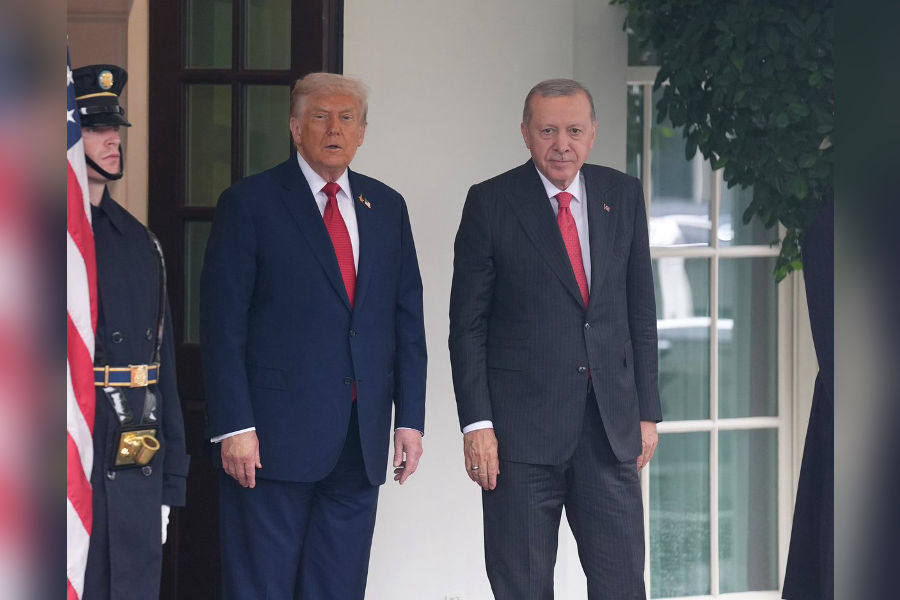
Turkish President Recep Tayyip Erdogan recently visited the United States to meet with President Donald Trump. The White House video of Erdogan’s visit shows the friendly atmosphere between the two heads of state. However, there are parts of this meeting that require deeper analysis in order to help the public fully understand the context.
The video starts with Trump’s display of “friendship”: “It’s a pleasure to be with President Erdogan of Turkey, and we’ve been friends for a long time actually. Even for four years when I was in exile unfairly as it turns out.”
Erdogan and Trump’s friendship during their terms in office is well known. But here we learn that Erdogan kept in contact with Trump even during the four years when he was out of power. Although this suggests the possibility of lobbying by Turkey on Trump’s behalf, such speculation cannot be confirmed at this point.
Trump then continued: “Rigged election, you know. He knows about rigged elections better than anybody.” Erdogan has ruled Turkey since 2002 — 23 years in power. He is notorious for election fraud.
In the 2014 presidential election, insider testimony revealed that Erdogan’s party allegedly followed a consistent five-part strategy in every vote, as reported by Cumhuriyet:

- Disseminating fabricated public opinion surveys to shape voter perception.
- Deliberately manipulating vote counts, with falsified tallies submitted to the election board.
- Coercing or bribing election officials to prevent them from reporting tampering.
- Prematurely broadcasting exaggerated AKP leads on election night to demoralize opposition observers and drive them from polling stations.
- Registering non-existent voters using fake addresses, or even names of deceased individuals, to inflate turnout figures.
The 2015 general election was also plagued with irregularities: ballot overprinting, misuse of state funds by Erdogan, censorship of the media, suspicious electricity cuts during ballot counts and much more.
After the so-called coup attempt in 2016, Turkey effectively shifted into one-man rule under Erdogan. State organs completely fell under his direct control.
During the 2017 constitutional referendum, reports claimed that Erdogan colluded with the Supreme Election Board to distribute pre-prepared ballots in his favor, with voters allegedly rewarded financially for casting them. Additionally, in the middle of the ballot count, non-stamped envelopes suddenly appeared. The Supreme Election Board controversially decided to count them as valid — even though they were not official envelopes of the Election Board.
In 2019, Erdogan lost many major cities in local elections. In Istanbul, he went so far as to annul the results and force a re-run, only to lose again.
It turns out that Trump’s words were not far from the truth: Erdogan really does “know about rigged elections better than anybody.” But this statement also functioned as Trump showing off the card he held in his pocket before the meeting began.
Trump continued with more praise: “He has built a tremendous military, powerful military. Uses a lot of our equipment…And we have had tremendous relationship both having to do with war and having to deal with trade…We do a lot of business with Turkey. They build great products. They built beautiful, great products. Really, fantastic manufacturers and we buy a lot from them and they buy a lot from us.”
Are these statements merely compliments — or admissions?
Turkey has long acted as a rogue state in the region. Its illegal occupation of Cyprus in 1974 was only the beginning. In 2020, Ankara announced its intention to expand its maritime boundaries at the expense of Greece and Cyprus. Turkey has also cooperated with jihadist groups, providing them with weapons and medical aid. Today, Turkey still occupies an estimated 12,000 square kilometers of northern Syria and about 4,000 square kilometers of Iraq, all under the guise of counterterrorism. Since 2020, Turkey has intervened militarily in Libya, siding with radical Islamists.
One neighbor, however, remains Turkey’s close ally: Azerbaijan.
During the 2020 Artsakh (Nagorno-Karabakh) war, Turkey recruited approximately 4,000 Syrian mercenaries for Azerbaijan, according to Armenia’s ambassador to Moscow. Each recruit was paid 10,000 Turkish liras for three months of service, with 1,500 liras as an advance payment before travel. Families of the dead were compensated with 25,000 liras.
Turkey and Azerbaijan also held large-scale military exercises in Nakhichevan with 5,000 personnel and heavy equipment. Afterward, around 600 Turkish servicemen remained, including a 200-strong battalion tactical group, 50 instructors in Nakhichevan, 90 military advisers in Baku, 120 flight personnel at Gabala Airfield, 20 drone operators at Dollyar Air Base and others stationed in Yevlakh, the 4th Army Corps and Baku’s naval base.
Economic ties reflected this military alliance. The Turkish Exporters’ Assembly reported that Azerbaijan purchased $123 million in defense and aviation equipment from Turkey in the first nine months of 2020. Deliveries included armored patrol vehicles, rocket artillery, missiles and armed UAVs. Among them were Bayraktar TB2 drones, armed with MAM-L guided bombs, which played a decisive role in the war. Turkish-supplied TRG-300 rocket launchers were also used in key Azerbaijani offensives.
Crucially, research by the Armenian National Committee of America (ANCA) revealed that Bayraktar drones contain parts and technology from U.S. firms and NATO-based affiliates. This means that the U.S. government indirectly enabled the ethnic cleansing of Armenians in Artsakh.
Human rights reports confirm the scale of the atrocities — there was a full-scale human rights crisis for Armenians. Weapons with wide-area effects, including cluster munitions, were used in or near civilian areas. Strikes deliberately targeted homes, schools, businesses and hospitals, causing widespread destruction and damage to water, electricity and telecommunications infrastructure. Hospitals and clinics were damaged, ambulances were attacked and health-care provision was severely impeded. Some of these attacks appear to have been intentional or were carried out using weapons that could not distinguish between civilian and military targets.
The Armenian civilian population was driven from their homes, with older people often left behind in desperate conditions. Those who fled faced pressure or outright coercion not to return, resulting in cultural erasure and the seizure or destruction of property. Reports documented torture and ill-treatment of captured Armenians, extrajudicial executions and summary killings. In some cases, prisoners of war were decapitated and corpses were desecrated.
The humanitarian crisis was further compounded by the blockade of the Lachin Corridor, which cut off access to food, medicine, fuel and other essential goods. This blockade left thousands of civilians, including children and the elderly, in life-threatening conditions without adequate power, heating, or health services.
Trump’s praise for Erdogan’s military achievements thus amounts to an implicit acknowledgment of U.S. complicity in these crimes.
The interview continued with Erdogan’s response: “As you’ve said, we have an opportunity here today to be able to discuss some of the issues regarding the F-35 the F-16, and also the Halkbank case…And based on what you have mentioned regarding the Heybeliada (Halki) school, we are ready to do whatever we can that falls on our part …when I get back [I will] try to discuss this issue with the esteemed Mr. Bartholomew to discuss how we can move forward on that.”
Here, Erdogan revealed his cards. He openly used the fundamental rights of a vulnerable minority — the Greek Orthodox community in Turkey — as a bargaining chip in negotiations over fighter jets and banking disputes.
Erdogan spoke with Trump about the F-35 and other disputes between Turkey and the U.S., mentioning the Theological School of Halki (Heybeliada) in the same breath. We should read this together with Greek Patriarch Bartholomew’s U.S. visit last week, during which he discussed the seminary with Trump.
Erdogan meant, in other words, “I will let Christians in Turkey have a school if you give me F-35s and only if we resolve the other disputes between us.”
This is nothing new for Turkey. In the Ottoman Empire, Christians could not freely build schools or churches without obtaining permits. They could not even repair them without the Sultan’s permission.
The same pattern appears here.
It also reminds me of Archbishop Mkrtich Khrimian, who carried the Armenian issue to the Berlin Congress in 1878, because the Sultan refused to solve it. I truly hope this will not follow the same pattern in its outcome, because we know what happened after that: the genocide of the Armenians.




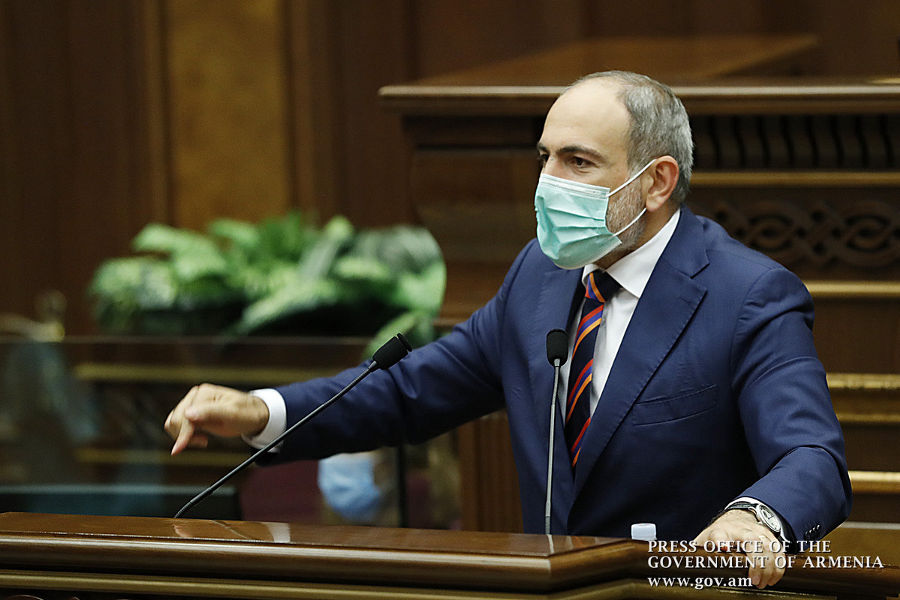
Those who still entertain the idea (such as ANCA) that Trump, who envies dictators with their unlimited powers, who wants such powers for himself, and who appeases dictators like Erdogan and Aliyev, among others, will somehow punish them, need to return to reality. As long as Trump remains president, and relations between the United States and Turkey and Azerbaijan don’t deteriorate to hostility, this chuminess will unfortunately continue. There were no repercussions for the gross human rights abuses by Erdogan and Aliyev from the Democrat presidents Obama and Biden either, despite their hypocritical parroting of “human rights” and “democracy”.
What an insightful article!
There’s no doubt that Trump loves dictators. He knows Aliyev’s name but calls Pashinyan “the other guy.” That said, the complicity of the Democrats in the ethnic cleansing of Artsakh is equally obvious. France’s attempts to bring up the issue of the blockade of Artsakh at the Security Council were vetoed several times by Blinken and the Biden administration.